To resolve an impossible crime, one has to think like a criminal. This is FBI agent Will Graham’s blessing and curse, which leads him to territories sinister and “perverted” as Loundes would have called it on the National Rattler. If you have recently watched Michael Mann’s 1986 classic “Manhunter”, the first film in the Hannibal Lecter universe, you already know that Will wanted to work by Hannibal’s side.
While Will tries to understand the “Tooth Fairy” by stepping into his mind, Hannibal approaches vengeance with a subtle, almost artistic precision. Based on the novel “Red Dragon”, “Manhunter” takes us on a delirious journey of cryptic bloodbaths and spirals of unusual psychology as Will Graham is back at the FBI bureau with a new case.
Manhunter (1986) Plot Summary & Movie Synopsis:
Who is the Tooth Fairy?
The film opens with Agent Crawford coming all the way down to Will’s island paradise in Florida to break the little reverie that he was living with his wife and child ever since the arrest of Hannibal. Will’s crisis was that while resolving the Hannibal case, he got knee deep into its psychological abyss, eventually ending up thinking like a killer. Following the crisis, he removed himself from the agent life and has been hatching turtles on an island in peace. Crawford, on the other hand, believes he has a case in hand which only Will can resolve. As Will considers whether the cost would be too high for him, he ultimately cannot ignore the calling of his previous life.
Crawford fills Will in on the case: so far, two murders have taken place where entire families were killed with almost a ritualistic precision, with their bodies staged, and bite marks on the bodies. Will visits the Leeds household crime scene, comes across blood splattered on the wall, and tries to piece the scene together. He has one other guiding material: some home videos of both families, by which he may be able to make sense of their life before this brutal bloodbath.
He has roughly three weeks in hand before the next full moon to resolve this case. Will gets Price, his old forensic buddy, flown in, and discovers a set of print marks on Mrs. Leeds’ body just when he starts thinking like the killer, that he must have touched her with an ungloved hand due to her beauty. Due to the bite marks on both the Leeds and Jacobi families, the FBI informally starts calling the killer “tooth fairy”.
How Does Dr. Lecktor Send a Message to the Killer?
Now Will is convinced that being perverse is the only way to get around a perverted mind and goes straight to visit Hannibal (Dr. Lecktor here) in his cell. It goes without saying that Hannibal is cunning, and he plays a clever hand by asking for as much information about the case as possible, getting hold of the case file from Will. Dr. Lecktor is allowed a phone in his cell to consult with his lawyer.
Using this opportunity, he calls up Sidney Bloom’s office, manipulates an employee, and extracts Will’s home address. Why is Lecktor doing this? Well, by the time he starts pulling his strings, Will is at Birmingham, dealing with his old frenemy Loundes. Loundes is the editor of National Rattles who’s been out to get to Will by menacing coverage. While personal beef is getting slightly on Will’s nerves, Mr. Chilton, Lecktor’s warden, drops a bomb on Will and Crawford, saying that the tooth fairy has written to Lecktor on a scrap of toilet paper signed as “avid fan”. At the FBI Academy, Quantico, Will, Crawford, and the team look at the letter where the tooth fairy expresses his awe of Lecktor, and says that he, too, is in the middle of a “becoming.”
Philosophies aside, there must be a way that Lecktor is also communicating with this fan of his, and it does not take much time for Will to figure out a torn-out section of the letter, scanning which he realises that Lecktor is using the personal ads section of the Rattles to convey his message to the tooth fairy. While the FBI puts its heads together to decode Lecktor’s cryptic message, Will takes Loundes on his side, hatching up a plan to lure the killer, with himself as the bait!
Who is the Red Dragon?
If Will considers using himself as bait, Hannibal has already been there—and unlike Will, he truly wants the Tooth Fairy to take it. As Will stages an interview with Loundes to provoke the killer by writing an insulting headline about him, and also revealing his location in a photo (so that the killer comes and gets him), the FBI has decoded that Lecktor has revealed Will’s home address in that message to the killer. The tooth fairy knows his people, too. Instead of attacking Will, he abducts Loundes from a parking lot.
This is when we first see him, a lanky, pale man with a cleft lip who keeps Loundes tied down to a chair and explains his philosophy. He calls himself the “Red Dragon”, inspired by William Blake’s “The Great Red Dragon Paintings”, and his killing work is to imitate the paintings as he rises like a red dragon over them. He surely has a vision, since after this correspondence, he briefly kisses Loundes and then returns Loundes to the parking lot tied to the chair, burning in flames.
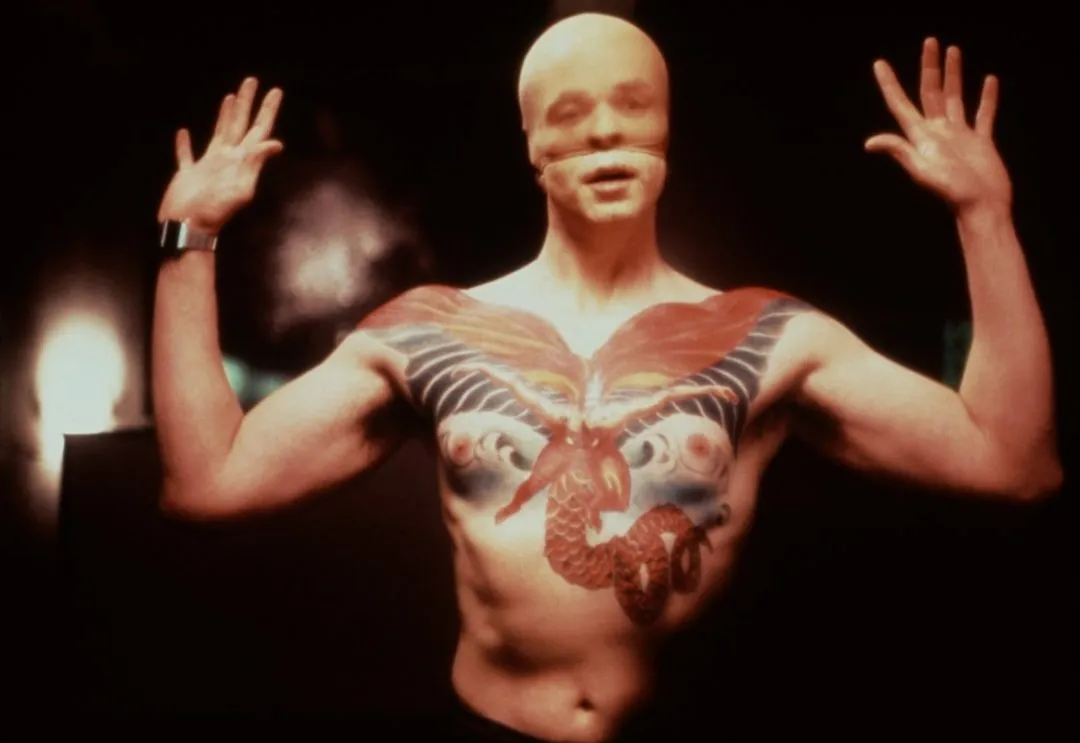
Before killing Loundes, the killer makes him record an apology for the news he ran, and also shows him the video of his next victim. While the victims on the video were not Will’s family, Will is now scared for his wife and child and flies them into a safe house, thinking that the Red Dragon, or tooth fairy, can strike at any time. Well, we can never be too sure if the tooth fairy would stick to his plans, and he clearly does not.
Manhunter (1986) Movie Ending Explained
Did Will Kill the Tooth Fairy?
While we were seeing this killer under various aliases, including the tooth fairy, red dragon, and avid fan, in the final segment of the film, we meet the real-life persona of the tooth fairy. Much to my surprise, he is just an ordinary employee called Francis Dollarhyde who works in a film developing studio called St. Louis. Dollarhyde befriends visually challenged Reba McClane and offers her a ride home from work.
On the way home, he pulls a grand gesture of taking Reba to touch a tiger at the vet’s, and clearly, she is impressed by this man’s sensitivity. After a few rounds of gin and tonic at Dollarhyde’s place, Reba and him makes love. Dollarhyde looks for affection and approval. He is validated by desire, so when Reba starts giving him all those, he starts feeling special, until there is a rupture.
Soon enough, on the next full-moon night, Dollarhyde stalks Reba and finds her at the door with another coworker, exchanging words and laughing. This triggers his jealousy, and he kills the man, abducting Reba. While he felt irreplaceable in Reba’s eyes before, it is no longer the case, and he wants to punish her for it. On the other hand, Will has figured out the tooth fairy’s need for approval by decoding how he stages the corpses towards the mirror, and his general obsession with stalking and reflections.
Will also starts rewatching the home videos and realises that Dollarhyde knows certain details about the families that can only be learned by peeking into their houses. Crawford makes a few phone calls and confirms that it is true that all the films came from a lab in St. Louis, and while on a plane, they vet the employees to finally locate the tooth fairy and his address.
The end of the film, of course, showcases the FBI’s bravado. Despite having SWAT teams active, Will becomes the hero of the night as the tooth fairy is about to kill Reba. He heroically breaks through a glass window, shattering it, and shoots the tooth fairy. Reba is saved, and the tooth fairy finally stops being a threat to Will and his family. The film ends with Will’s quiet reconciliation with his family in their island paradise as they count baby turtles that were about to hatch at the beginning of the film. Life feels like a full circle for Will again.
Manhunter (1986) Movie Themes Analysed:
Desire and Playing God
In the twenty-first century, there’s been a growing fascination with the mind of the serial killer. In shows like “Mindhunter,” audiences are both repelled and drawn in by the precision—the obsessive attention to detail, the patterns, the repetition—that governs it. While it has become the unwinding tactic for some of us, the seeds were planted back in the previous millennium.
“Manhunter” deals with three very complex mindsets: Will’s mind, which suffers from PTSD, Dr. Lecktor’s “psychopathic” brain, for lack of a better term, and the tooth fairy’s mind that wants to be seen, desired, and play god. At one point, Dr. Lecktor explains that once you try playing god enough times, you slowly become it by claiming such power. For the tooth fairy, the rationale works in terms of desire. He killed all of his victims, molested them, and in the end, propped open their eyes for them to see him in his full glory. He thought that being seen by them was equivalent to being desired by them.
The tooth fairy also hides behind different aliases in the film, but the one that he has claimed for himself is the “red dragon.” To deal with the reality of his actions, he philosophises the bloodbath and deems it necessary to his “becoming.” Psychoanalyst Jacques Lacan has called this kind of story weaving, or myth-making, the neurotic’s individual myth, where a neurotic person builds their own narrative to make sense of their life. While his mode of murder and fetish has been mirrors, in the last sequence, Will breaks through a large glass pane, symbolically shattering his sense of self. Once his ego is shattered, nothing is left of this man, and therefore, he dies at the hands of the hero.
In the end, “Manhunter” is about human vulnerabilities, even with all its gore and blood. Will Graham’s victory feels triumphant, but the tooth fairy, like Dr. Lecktor, will leave his impression on his mind long after the moment of killing. While serial killers live, kill, and die, the pathological mindset that drives a human to kill returns. And as Will admits, more often than not, the seeds of it lie dormant in childhood trauma, abuse, shame, and the malaise caused by it.