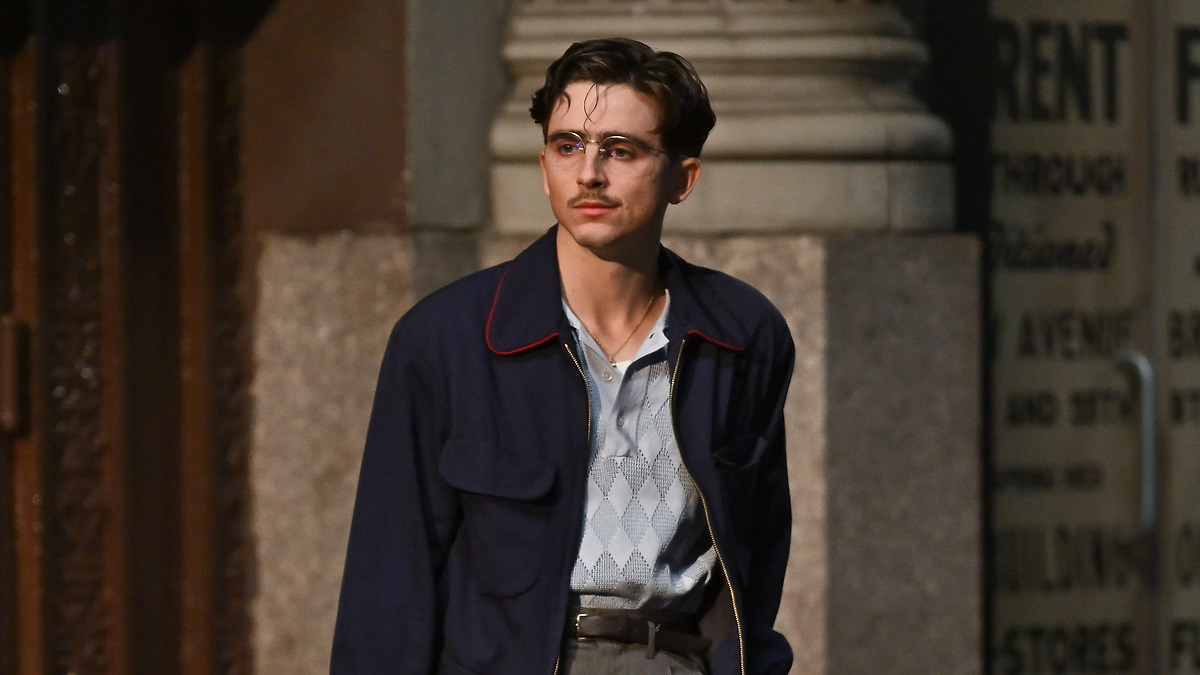
Marty Supreme” (2025) is the rare film that could be described as both an epic and a shot of adrenaline, as Josh Safdie’s semi-biographical sports thriller is both grandiose in scope and visceral in its intimacy. Although there’s not an instance in which the film grinds to a halt to imply development that it cannot depict, it encapsulates a significant, unforgettable period within the life of a truly singular anti-hero.
Safdie has shown interest in petulant, aggressively temperamental protagonists within the films he made alongside his brother, but Timothee Chalamet’s Marty Mauser is a character like no other. The degree to which the film empathizes with Marty’s obsessive, unquenchable desire to win may be up for debate, but there’s not a moment in which his sporadic journey isn’t completely riveting.
Although it’s loosely inspired by the true story of the table tennis player Marty Reisman, “Marty Supreme” feels like the unification of classic sports cinema archetypes and the stylized, anti-establishment movement of the “New Hollywood” era. Marty is introduced and defined by his compulsive, dedicated commitment to table tennis, a sport that has grown increasingly popular in a globalized post-war generation.
After a narrow loss at the world championship, Marty initiates a one-sided rivalry as he stakes his reputation and self-being on the prospect of a comeback victory. Marty’s skills are impressive, but he’s so single-minded in his goals that he’s managed to aggravate and offend nearly everyone in his path. As ambition gets the better of him, Marty faces seemingly insurmountable odds as he seeks a means to return to Japan to contend for the global title.
“Marty Supreme” doesn’t seek to explain Marty’s connection to table tennis as much as it showcases it. From the moment his journey begins, Marty’s immersion within the nuances of an emerging activity is evident from the haunted, frighteningly voracious performance by Chalamet. Although the athletic scenes themselves are focused on being as kinetic as possible, “Marty Supreme” questions what the route to success is as America begins a new era as a global superpower.
The consequences of World War II are felt throughout the film as Marty finds himself ill-suited for the role of a citizen, partner, and son as he disregards all familial and civic responsibilities for the sake of victory. Without ever confirming the film’s sentiments through banal dialogue, Safdie leaves it open to interpretation on whether Marty’s arc is purely selfish narcissism or a means of defying the social and financial parameters of a modernist American dream.

Also Read: The 10 Most Iconic American Movies of all Time
“Marty Supreme” flows too naturally between its set pieces and fiery exchanges to ever feel like a series of vignettes, but there’s a surprising degree to which the goalposts change as Marty is faced with continuous setbacks. While the acidic pain of his embarrassing loss fuels his most toxic traits, Marty himself becomes lost within some of his macro-adventures, which open the film up to the potential of its supporting cast.
As with the films that Safdie and his brother made, “Marty Supreme” is filled with unconventional casting choices, including everyone from Tyler, the Creator and Penn Jillette to Abel Ferrara and David Mamet. The varying degrees of experience result in a truly fluid ensemble that succeeds in gathering characters who feel as if they’ve escaped from different walks of life. It’s not only an effective means of worldbuilding, but the perfect approach for a film like “Marty Supreme” that so fluidly bends genres.
The most emotionally resonant of the supporting cast is Odessa A’zion as Rachel, a love interest to Marty who becomes roped into his adventures. The tension within their relationship isn’t based on a lack of affection, but the degree to which Marty’s lifestyle would ever accommodate someone else. What could’ve easily been a thankless romantic foil role is made relevant because Rachel is perhaps the only character whom Marty seems to genuinely respect without any asterisks, even if she’s often caught within the crossfire of his dismissive haughtiness.
Some may find a female character defined only by her relationship with the male protagonist to be an exhausting trope, but every single member of the “Marty Supreme” ensemble is defined by the transactional relationship they have with Marty. A’zion is able to voice the same repulsion and infatuation with Marty as a viewer might, and also manages to bring a softer side out of Chalamet.
Check Out: 20 Great Films from the Golden Age of Hollywood
Although Marty’s rags-to-riches-to-rags-again story often puts him in a position to run schemes and parade around as a showman, the film finds an interesting means of satire within his flirtations with “how the other half live.” The unusual, uncomfortable relationship Marty forms with the faded movie star Kay Stone (Gwyneth Paltrow) serves as a challenge to his notions of self-worth.
Compared to a former icon who has settled for being an artistically compromised commodity, Marty finds pride in the fact that he won’t settle for second-best. The degree to which Paltrow is aware of the subtextual intentionality of her casting isn’t clear, but the awkward friction she has with Chalamet exemplifies the dubious, irreverent humor that Safdie excels at.
By far the most surprising player in “Marty Supreme” is the businessman and radio personality Kevin O’Leary, who took on the first “real” acting gig of his life (outside of an infamous stint as a “Shark Tank” host) as Stone’s husband, Milton Rockwell, a tycoon who was coaxed by Marty into a sponsorship. Perhaps O’Leary didn’t have to give much of a performance to become a skeevy, shamelessly compassionless capitalist, but the presence of a truly nasty character who will not bend to the logic of empathy heightens the stakes of the film.
O’Leary’s dismissive, casually cruel characterization is the perfect counterbalance to Chalamet’s sincerity, as even someone as narcissistic as Rockwell seems to recognize the use that Marty may have. While his involvement in the film may be underplayed for the sake of not sending the wrong message, O’Leary wouldn’t be undeserving of any Best Supporting Actor nominations that come his way during award season.
“Marty Supreme” is kicked into another gear thanks to the exhilarating score from Oneohtrix Point Never, whose synth-heavy compositions contribute to the uneasy blend of terror, exhaustion, and existentialism that the film often evokes. The modernized score strikes the perfect blend with the impressive degree to which Paris, Tokyo, and New York of the 1950s are recreated, as Safdie creates a period piece that never feels antiquated or nostalgic.
There are certainly more nuanced takeaways to find within Safdie’s complex depiction of futility and fulfillment, but at its core, “Marty Supreme” is a work of finely crafted entertainment. Whether it’s sneering or celebrating its titular character, “Marty Supreme” is a ride worth taking.



![Ten Months [2021]: ‘NYAFF’ Review – The swirling chaos of unplanned pregnancy](https://www.highonfilms.com/wp-content/uploads/2021/08/Ten-Months-2-highonfilms-768x432.jpg)