
A supremely talented sportsman trying to make it big while surviving the hardships of life. Then, suddenly, someone spots him and helps him break through and achieve his potential. Life is going well; he is doing everything right, winning trophy after trophy, and out of the blue, his life takes a one-hundred-and-eighty-degree phase shift. With everything torn apart, his relationship with his mentor is also ruined. He comes to a place where there is no turning back. However, we, as an audience, have woven our hands together in a knot of faith, and he rises from the ashes and wins again.
How many times have we seen this storyline in sports drama films? The protagonist follows all the aforementioned situations, and the film ends on a good, positive note. The bulk of mainstream cinema follows this templated screenplay structure. In this format, it is easier for the director to stage the climax and make the audience feel for the protagonist. That is why we cheered for Kabir Khan when Vidya saved the penalty. It is the reason we feel so heartbroken when Iqbal accepts Kamal’s offer. This screenplay structure became popular after the immense success of “Rocky” (1976).
“Moneyball” rejects this sports drama template and chooses a completely different path. It defies the idea of hero worship and is focused on exploring the complexity of human behavior. Bennett Miller took the docufiction approach to shoot the film. Instead of high-octane drama and adrenaline rushes, Miller opted for nuanced and subtle emotions. “Moneyball” doesn’t show a single clip of baseball until the third act of the film.
The protagonist, Billy Beane, attempts to create a winning team with half (or even a third) the money of his rivals. Miller focuses on Beane’s unconventional scouting philosophy and how he uses data analytics with the help of Peter Brand, a Yale economics graduate, to achieve his goal. In between, we can see flashbacks of Beane’s arduous career as a baseball player.
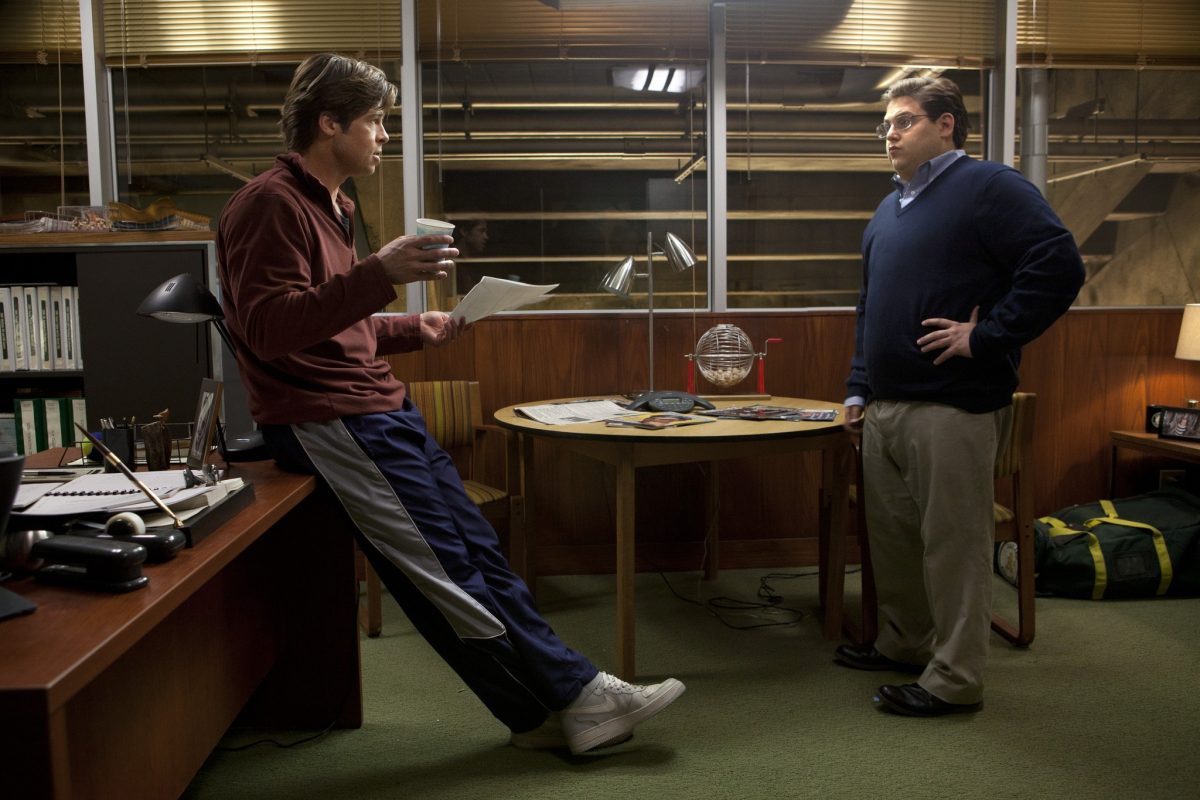
Beane is skeptical about traditional baseball scouting methods after the New York Mets scouts declared him a child prodigy, prompting him to decline a Stanford scholarship, which turned out to be an extremely regrettable choice. However, Miller does not want us to feel sorry for him. He treats grief as a daily, prosaic emotion rather than something heart-wrenching. That is where “Moneyball” makes its stance clear. It reminds us that instead of glorifying our struggle and victimhood, we should focus on how to move forward.
The players Billy and Peter choose for their team are almost all of whom are suffering from some kind of grief and trauma. However, Miller never attempts to evoke sympathy for these characters. He graces them with dignity and crafts their personal battles realistically. Walter Pfister’s immaculate cinematography takes care of the rest. His desaturated, gritty, and naturalistic colour grade with soft contrast forged a profound look. The Oakland Athletics’ clubhouse becomes the heart of the chaotic mise-en-scène between the players, and Pfister’s camera makes it look majestic.
The scenes are long, and the editing is slow and deliberate. Miller takes enough time to establish every conflict that Billy is going through. Close-ups of Brad Pitt’s face and his staring eyes with a blank expression in moments of uncertainty induce an extremely powerful feeling of devastation. Billy is divorced and usually meets his daughter at his ex-wife’s house. Whenever Billy is in the car, thinking about his current situation, Miller uses extreme close-up shots to show the claustrophobia of his mind and inner turmoil.
Also Read: The Top 25 Best Sports Movies of All-Time
Pitt delivered a brilliant performance. Instead of prompting us to empathize with Billy, he creates distance and renders Billy’s grief with delicacy and authenticity. He chooses silence over dialogue. He transforms the ordinary into something astonishingly beautiful and poetic. Pitt’s scenes with Philip Seymour Hoffman are a complete delight. They both just stare at each other with complete numbness, and everything is being communicated.
The background score often plays a huge role in elevating emotional scenes, but here, Miller takes a different approach. His minimal use of music and strategic silence expose the hollowness of Billy’s life more provocatively, turning his never-ending agony into a living, breathing entity. Miller wants us to understand the duality of life, and through this journey, he stirs a passion for baseball inside us.

The Oakland Athletics can not win the championship despite Billy’s unwavering dedication and relentless grind. Instead of a winning hero, we get a man who was misjudged as a child prodigy in his teens and, after giving his heart and soul to a project, remains still a ‘loser’ in his adulthood. However, the film does not end there. Then we see, in their office, Brand shows Beane a video of batter Jeremy Brown, who hits a home run but does not realize it.
That is how life is. Sometimes, we do not even realize how far we have come and how many lives we have touched until we stop thinking about failures, take a pause, and look back with an open heart. Only then will we understand that sometimes acceptance of failure and the courage to own it define the true essence of success.
But Miller does not end it here, either. After the office scene, Billy goes to the field. We also see a distorted image of him lying alone on the field in Brand’s office camera. Miller purposefully uses a top shot at the beginning of the sequence to portray Beane’s journey from internal loneliness to eternal salvation.
However, his distorted image while lying down tells us that there is still something inside him that needs to be resolved. Miller then cuts to the car, where Billy is driving towards an unknown destination. By then, he had already rejected the 12.5 million offer by the Red Sox, which could have made him the highest-paid general manager ever. However, he was still confused. The ultimate purpose is still missing from his life. After all this hard work and loyalty, what is next? Where will life go from here?
At this moment, Billy takes out the audio CD of his daughter’s song and starts listening to it. Miller uses a mid-shot at first, then the camera goes to Beane’s eyes. His eyes become teary, and his soul starts smiling. The last ounce of grief that he had kept inside his heart is now released. Before the screen turns black, we hear his daughter singing, I can’t figure it out, it’s bringing me down, I know, I’ve got to let it go and just enjoy the show.