“Revenge is a dish best served cold.” “Murderer Report” (Original title: Sal-in-ja Ri-po-teu, 2025) is a film that binds vigilante justice, social commentary, and interrogative thriller to create a film that is eerie and engaging in equal measures, even if it isn’t always convincing and logical. In most of these movies, the social thread is often superficially used as a justification for the onslaught of violence. In this film, thankfully, the violence depicted is just a reference point and executed methodically and never made for claptrap.
The use of didactics sometimes does become a tad overwhelming and lethargic, but largely the film remains an engaging if not an enthralling and fulfilling watch. On paper, the story gives out a sense of Deja vu, an investigative journalist desperate to land an interview she is ambivalent about- on one hand, a major breakthrough for her dwindling journalistic career, and on the other hand, a potentially dangerous encounter with a man who claimed to have committed 11 murders.
Such encounters can go any way, and the films based on such concept-heavy themes can also go any way. It is difficult to engage the interest of the viewer when the key elements of a thriller are missing: one, it is not a whodunit, because the story establishes the killer at the very outset, the question is why and how? Moreover, the screenplay entirely relies on the eerie atmosphere, dialogues and the performances of the actors as there is not much action happening on the screen.
At a runtime of 1 hour and 47 minutes, the film limits most of its action in a single room, and so, the filmmaker can be lauded for his engaging screenplay and absorbing direction, even though none of the themes presented in the story are by any means novel or unique.
Yes, the story does try to bring a fresh perspective from the vantage point of the psychiatrist, but after a point, you start anticipating the narrative, and hence the climax doesn’t offer the shock value it should ideally have. Also, the film doesn’t ponder upon the ethical implications of the killings sufficiently and justifies it on the lines of the same rhetoric propounded endlessly in umpteen movies on vigilante justice.
Cho Young-jun’s South Korean thriller “Murderer Report” revolves around Baek Seon-ju, a veteran reporter who is currently going through rough weather both personally and professionally, and her life undergoes a massive change after she receives an unusual call for an interview by a serial killer. Lee Yeong-hoon is a psychiatrist who claims to be a serial killer. Kim Tae-han plays the partner of the journalist, and there’s a detective, who turns out to be the real antagonist of the film by the end of the film.
Murderer Report (2025) Plot Summary & Movie Synopsis:
The Premise: When an Investigative Scoop Turns Into a Psychological Snare
Murderer Story starts off in a noir fashion with the blank screen brought to life with a telephonic conversation. We are informed about a journalist looking for a scoop to save her dwindling career, which is at stake due to a major fiasco in her last assignment. She receives a call where a man introduces himself as a serial killer who has murdered 11 people and is on his way to commit the 12th one the same evening. He asks the journalist to interview him.
The journalist is reticent, and so is her partner (a detective), who reluctantly agrees to become her aid in this interview after she informs him that the interviewee has warned her that if the interview is not taken, he will commit another murder. For her, the interview has a two-fold purpose—saving her dwindling career and saving the life of the person the interviewee is willing to kill next.
Here, we also get to know about the daughter of the journalist, who is suffering from severe trauma and is exhibiting suicidal tendencies. The journalist blames her divorce for it and believes that her daughter doesn’t like her and wants to go to her father. All these snippets of information are essential as the story progresses to its climax.
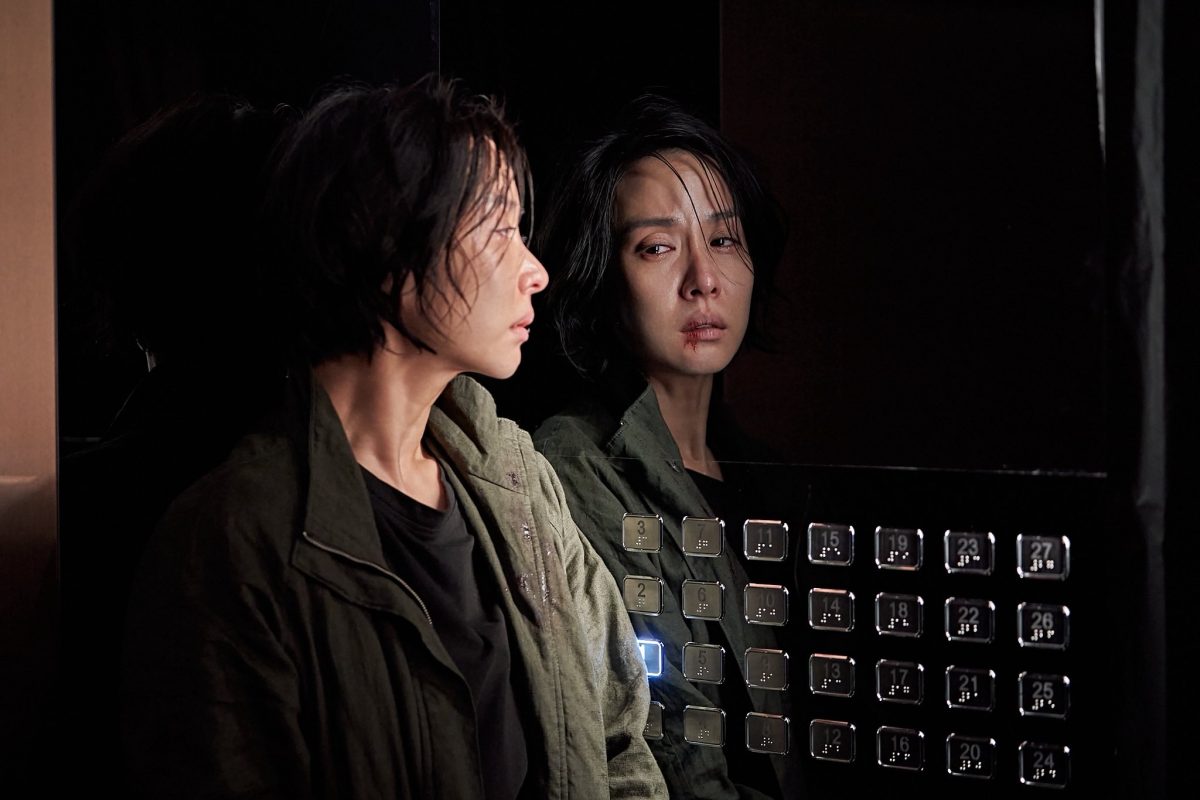
Meanwhile, the journalist checks into the hotel where the CCTV is under maintenance. She smells something fishy, but has no other choice. She enters the room and sets up the surveillance devices, which are accessed by her partner from the adjacent room, so that he can track the activities of the room and come to her aid. But the interviewee has other plans, and the journalist soon realises that it is she who is being trapped rather than her setting the trap.
Can Trauma Ever Justify Violence?
The interviewee arrives, showing sharp acumen and awareness of his surroundings. The interview starts with basic questions, but as it progresses, it turns darker when the journalist realises that the interviewee is not merely saying those things for effect—he actually means them. He gives a glimpse of his murderous intent when he brutally hits and sedates a waiter, claiming that he is responsible for the sexual assault of a hotel staff member, who is one of the patients of the interviewee, a psychiatrist by profession. Unlike a typical criminal, he is suave, well articulated, and has a moral high ground to justify his actions.
His story starts with a personal anecdote describing the tragedy of his wife and newborn due to the trauma of being sexually assaulted. Unresolved trauma, for him, is the anchor for suicides and mental issues, leading to criminal instincts and anger that doesn’t get closure. The psychiatrist makes it his mission to help in the prognosis of his patients by eliminating the roots of their trauma.
Check Out: The 10 Best Korean Movies on Prime Video
This not only helps in the healing process of his patients but also provides a coping mechanism for the psychiatrist to overcome the grief of his personal loss. So, like the journalist who is motivated by both personal conviction and professional commitment, the psychiatrist is also carried forward by his personal anger and his duty as a psychiatrist.
Murderer Report (2025) Movie Ending Explained:
How the Interview Unmasks the Detective and Breaks the Case Open
Things take a personal turn when the psychiatrist introduces a case that is eerily similar to that of the journalist’s daughter. The mask of her impassiveness or indifference comes off as she becomes outright desperate and even violent towards him to extract information out of concern for her daughter’s safety. He uses hypnotism to extract from her the innermost feelings of the journalist towards her daughter, where she feels disenchanted and even angry with the growing distance between them.
Here, the second act of the story unfolds as it is revealed that the two events mentioned at the beginning of the story—the involvement of the journalist in an industrial case reporting fiasco and her daughter’s trauma—are interlinked. The perpetrator of both cases is the same person: her partner, the detective who, until now, acts as a trustworthy ally and saviour.
As layers of discovery start unfolding, the partner becomes violent and aggressive, and the journalist is shell-shocked to know that he steals her data, which unearths a major scam by an industrial plant with hazardous consequences, and sells it to the company. Not only that, he tries to silence the only eyewitness to his crime—the daughter of the journalist—whom he brutally rapes, leading to her traumatic and near-suicidal state.
The psychiatrist, in this case, justifies his method of therapy by making her realise that when emotional stakes are high, intervention becomes necessary. The journalist confronts her partner, who reacts violently and tries to harm her, only to be sedated by her. The detective gets the same treatment as the eleven others, proving the claim on the phone where the psychiatrist tells the journalist that he will commit another murder.
Even though the journalist is able to screen the edited footage and reconcile with her daughter, she is not at all satisfied with the methods of the psychiatrist and rebukes him for using violence to justify his ends. This leads to a moment of introspection and doubt in the mind of the psychiatrist as he ponders the ethics of his actions. But as he is ready to accept his mental defeat, he is informed by his assistant that a victim is waiting for counselling, and this alters his state of being. The film ends on this open note, signifying perhaps that the psychiatrist will go back to his ways again in pursuit of eliminating criminals as a form of therapy.
Murderer Report (2025) Movie Themes Analyzed:
Ethics, Authority, and the Illusion of Moral Certainty
The first voice we hear as the credits start rolling on the blank screen is of the psychiatrist asking for an interview. The journalist doesn’t show any interest before the man mentions the 11 murders, calling himself a serial killer. The dialogue is intercut with visuals of forensic analysis, with disturbing visuals of X-rays, mutilated bodies, and evidence of crimes.
Her partner constantly warns her not to indulge in this interview, which he considers the wisecracks of an unstable individual, but then she reveals another twist to the tale: he is on another murder trail,l and only her interview with him could stall the possible crime. So she points out that she is trying to save another life. But here is the dilemma: she is also trying to save her skin and salvage her reputation from an earlier misfire in her last assignment.
So the line between the ethical commitment and the hunger for a scoop exists simultaneously through her character. The scenarios make sure that you can easily look through their motivations and don’t sympathise with any of the characters, a trope that helps at a later stage when the film goes all over questioning the system that produces criminals and silently condones the crime.
Using its cinematography and sound design, the film tries to build tension before the actual interview- we see frequent slo-mo shots of people walking, the clock ticking, the lift going up and down, and unnecessary suspense about the identity of the people emerging in the scene, even though the viewer can clearly visualise who is coming.
The serial killer is portrayed as a man of meticulous knowledge, which he conveniently attributes to his patients—his supposed sources of information—though at times this explanation feels a little too neat. He dispenses information and moral sermons with equal confidence and flair. Instead of following a straightforward narrative path, the film adopts a dialogic structure, allowing information to emerge in fragments. These exchanges often drift into detours and digressions, mirroring the uneasy, circular nature of the interview itself.
The nature of the dialogue evokes the Bhagavad Gita, one of the most significant philosophical discourses in Indian thought. The resemblance lies not in equal profundity—it clearly does not—but in the way dialogue is deployed. The questioner begins with confidence and moral certainty, yet as the exchange unfolds, the questions gradually diminish beside the weight and assurance of the answers offered.
By the end, the act of questioning itself collapses into a form of surrender, producing a profound transformation in the questioner’s life. The crucial difference here is that the one dispensing answers is also the agent of action, not merely a guide or facilitator. Moreover, the interviewer eventually turns inward, interrogating the moral consequences of the killer’s actions, only to find himself caught in an ethical dilemma of his own.
Objectivity and Bias: The Facade of Neutrality

Also Read: 15 Best Korean Movies on Netflix
Another important dimension that the film explores is the neutrality of the people involved in an interview. In an interview, the interviewer is supposed to be a distant observer, who is not expected to make judgments on the veracity or suitability of the statements made by the interviewee until and unless the interview is interrogative in nature.
Here, the setting of the story lends itself to an investigative scoop, yet even within this framework, the interviewer is never fully in command of the exchange. The binary between interviewer and interviewee is repeatedly destabilised by the psychiatrist, who more than once turns the ethical lens back on her, questioning the very foundations of journalism. At one point, he goes further, hypnotising her into revealing her innermost feelings about her personal life.
In this sense, the power relation between the two individuals is frequently challenged because even though the interviewer has the medium (the recording device and the medium to carry out the message), it is the interviewee who is the one incharge of everything else, ranging from the settings (hotel room) to the nature of interaction to the final outcome.
Both individuals, along with the journalist’s partner—a detective who is ultimately revealed as the film’s antagonist—begin as observers but gradually become participant-observers, and eventually active participants, in the unfolding process. One question that lingered with me throughout the film was whether such an elaborate setup was truly necessary when the same outcome could seemingly have been achieved without it. Does the construction serve any purpose beyond functioning as a dramatic device?
The film takes a longer route to provide a questionable conclusion and doesn’t provide a conclusive end that could finally settle the issue once and for all. It may be the intention of the maker to show that there are always those waiting for a helping hand, and the predators can be found anywhere and everywhere, often from places least expected. The result is the unending cycle of trauma. That’s why the psychologist doesn’t claim to have healed his patients, but it starts a prognosis.
Also, it means that vigilante justice doesn’t solve the problem; it creates a void that is then filled with guilt. While the psychiatrist in this case is able to take the agency from his patients and free them from the consequences of their action but, this leads him to his own sense of guilt. In the beginning, he denies the guilt by justifying his actions, but by the end of it helps agrees with the assessment that he cannot escape the blood in his hands.
Intent, Agency, and the Collapse of the Saviour Complex
Another related question raised through the film is the question of intent and agency. The question of intent is raised constantly throughout the film, both for the interviewer and the interviewee. When the journalist decides to take the interview of a self-declared serial killer, her partner asks him her intent. He assumes she is doing it out of her need for an exclusive story, but she points out that she is doing it to save a life. When the psychiatrist asks the same question to her, she repeats the same thing, but the psychiatrist analyzes her pulse and face and concludes that she is lying.
“Murderer Report” talks about how the personal and political spaces can merge together in an uneasy combination that it often difficult to segregate one intent from the other. Even for the psychiatrist, his sense of justice emerges from his own personal tragedy where his destructive emotions didn’t get a foreclosure, and he could empathize with his patients going through the same catharsis.
Similarly, the interviewer is swept through a surge of emotions and impulsive reactions when she realizes that her daughter is among the psychiatrist’s patients, seeking his help. Her composure collapses into unrestrained rage once she uncovers the identity of the person responsible for the devastation in their lives.
The facade of the interview fell long ago; it now states its actual objective: to seek foreclosure. For the journalist, the final consequence of this event was to re-establish her professional career and to rekindle her relationship with her daughter. So there is a marked shift in the goalposts from the start of the interview to the end of it.
In the beginning, all the principal characters come with a sense of saviour complex: the journalist for trying to save the life of the next victim of the psychiatrist, for the psychiatrist to help them come out of trauma and cycle of oppression, and for the detective friend to come to the aid of the journalist and nab the criminal.
But by the end of the narrative, the detective saviour comes out as an oppressor to the journalist as well as to the society, the journalist finds herself broken emotionally because of the treachery of her partner and trauma of her daughter, and the uber-confident psychiatrist also ends up with an iota of doubt over his iron-clad conviction regarding his methods.
In conclusion, “Murderer Story” is not entirely convincing in its narrative and never quite arrives at a definitive answer. Yet it offers ample food for thought, raising uneasy questions about ethics, societal oppression, and the unbroken chain of trauma such forces generate. In both story and treatment, the film recalls works such as “A Wednesday” (2008) and “Table No. 21” (2013), which adopt a similar approach—taking a long, winding route to address a relatively simple question.
This method allows multiple interconnected threads to coexist within the narrative, creating a discourse that feels deeply personal while retaining a broader, universal resonance. The performances are consistently strong; despite the limited number of characters, each is used with purpose and justified within the film’s structure.
The film leans heavily on performances to sustain its momentum, and thankfully, the actors never strike a false note. Would I recommend it? Yes—though without unbridled enthusiasm. It offers nothing particularly new or distinctive, but it is competent and assured enough to earn a place on your watchlist without any sense of embarrassment.





![Game Over Netflix [2019] Review: Taapsee Shines in The Oddly Fascinating Thriller](https://www.highonfilms.com/wp-content/uploads/2019/06/795665-794517-taapseegameover-768x432.jpg)