
Joseph Gatti’s documentary film, “Phenomena,” tries to distill the mysteries of the universe within its 90-minute duration. Gatti begins it with a note clarifying that every image we see in that time is real, meaning it’s not computer-generated. The reason becomes clear within a few beats when we see a string of visuals that are bound to be compared in a way that almost every image gets questioned and analyzed these days.
They look vivid, colourful, and awe-inspiring, as if it’s a meticulously designed abstract work painted with something as malleable as watercolor. We see similar patterns emerge naturally across a surface, almost like how different tones and shades of colors would respond to a sheet of handmade paper.
There’s no easy or definitive way to describe the sheer beauty of those patterns, and nearly every adjective you can come up with to explore its marvel may seem valid. Gatti’s eye for visuals and a skill to hold our attention through them become evident as he takes us through a consistently immersive string of moving images, while backing it with a kinetic electronic score from Rival Consoles and a thumping and meditative score from Nils Frahm.
Their distinctive but complementary styles converge in a journey that satisfies the filmmaker’s curiosity about the universe. He divides the film into ten chapters to analyze how life takes shape on Earth, while comparing the smallest elements with the largest in the universe through practical experiments.
As a cinematographer, his interest seems rooted in understanding how the light works. That’s why he seeks help from his father with a tool that can visualize a sound through tones and patterns. He shows microscopic views of everything from a small particle found in nature to the image of something as expansive as the Hubble Ultra-Deep field, while analyzing them through scientific concepts. Most patterns he shows are shot in a makeshift lab, presumably in his own home. That’s why it’s fascinating to see these droplets and atoms forming and reforming shapes, while simultaneously visualizing how they appear on a grander scale in nature.
Some of his experiments create constantly shifting visuals that look eerily similar to sand formations in a desert, while others yield results similar to crystalline patterns in snowscapes. At other times, when he analyzes gravitational pull, the spiral patterns look nearly identical to planets revolving around a star, even if the shape of elements in his experiment might be closer to marble. He follows up almost every experiment with a description of these parallels through his voice-over, but that doesn’t feel necessary when his visuals are enough to do the work themselves.
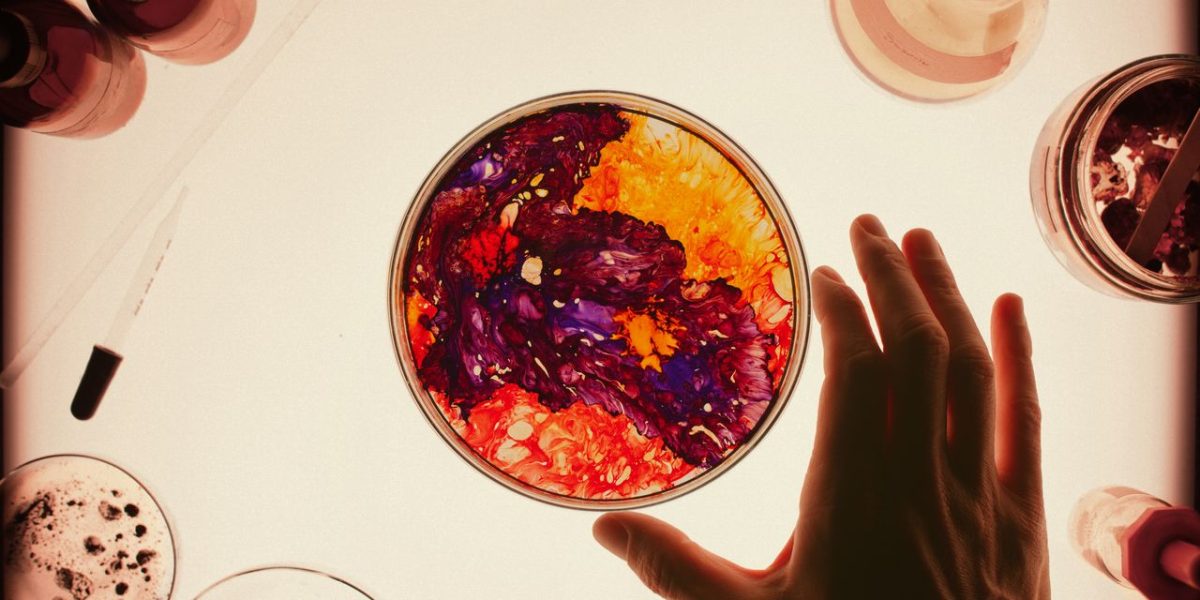
Some of the most stunning results he manages to capture are when he works with a dark, liquid mixture of a magnetoid to study primary aspects of electromagnetism through their gradual push and pull. Patterns also emerge when he interacts with music, including an audio sample from the star child scene from “2001,” to understand the effects of resonance.
While audio-visually immersive, it isn’t the most insightful look into the mysteries of the universe. Most of his observations can satisfy the curiosity of someone who’s barely aware of its scientific concepts, but anyone well-versed in this domain may not find it inherently amusing. It may have to do with the film’s limited duration as opposed to an episodic series.
Gatti has previously worked on an eponymous television project that similarly explores the relationship between science and art through music and geographic patterns. It may have lent him a canvas to analyze everything from a wider perspective. Still, even if the film isn’t an in-depth breakdown of ideas like matter, gravity, and nuclear physics, it benefits from the sense of wonder in his voiceover narration, which reveals his deep investment in his research and a desire to communicate it in an accessible manner.
Gatti, who wrote the script with Joseph Nizeti, ensures he holds a wider audience’s attention by often explaining everything in layman’s terms, without diluting its essence. At one point, he follows his observation about energy and the correlation between different structures in the known realm by saying, “I know that might sound like I’m tripping, but it’s true.”
The best part of documentation might be the seamless transition between all its visual elements and factual observations, which are backed by a coherent chain of thought. Although not directly related to his themes, it’s worth noting that the experience is clearly enhanced by the sonic landscape of Frahm and Consoles, which plays a major part in connecting all the ruminations ‘feel,’ as expansive as they are in theory.






![Ten Months [2021]: ‘NYAFF’ Review – The swirling chaos of unplanned pregnancy](https://www.highonfilms.com/wp-content/uploads/2021/08/Ten-Months-2-highonfilms-768x432.jpg)