
We all have our irrational fears, and if chimpanzees don’t land somewhere on your list, then that’s likely because they’re actually a fairly rational fear to have. Our closest living relative in the animal kingdom, chimps are incredibly smart, deceptively strong, and viciously territorial, frequently cited for the tribal, oftentimes cannibalistic wars they wage among themselves in the increasingly diminishing boreal lands they call home. So naturally, we humans, in our infinite wisdom, have decided that a creature of such infinite dangers would make for a pretty sweet pet.
Now the list of chimpanzee pet owners is probably rather short—particularly in this, the modern age of animal activism—but even shorter is the list of films that have exploited this unsuspecting danger for means of visceral horror. Save for the existential terrors of the “Planet of the Apes” series and that one pivotal scene in Jordan Peele’s “Nope,” it would be difficult to scrounge up even one notable film that sees horror staring back at us with a heaving pant-hoot and an aggressive chest-pound. And so, like our own simian ancestors discovering the potential for weaponry in a dry animal bone, “Primate” emerges as the discovery of such obvious destructive potential.
As with most horrors of human hubris, “Primate” sets for its colosseum the ridiculously extravagant mountainside home of Lucy (Johnny Sequoyah) and her family in Hawaii. Returning from a long absence—presumably to study, but fractured family dynamics hint at a prolonged retreat intended more for personal distance—Lucy, accompanied by her best friend Kate (Victoria Wyant) and her own obnoxious friend Hannah (Jessica Alexander) lands to spend the summer with her younger sister Erin (Gia Hunter) and estranged father (Troy Kotsur, bringing welcome dignity to any deaf actor’s role even in a film this frivolous). Alongside one more family member, of course…
Ben (Miguel Torres Umba, clearly a person in a monkey suit but seamless in his primal mannerisms) is the family’s adopted chimp from their deceased matriarch’s time as a linguistics professor, and his status as a staple of the family has been marked by a persistent gentility around those he knows. All this changes, though, when the shackles of bourgeois excess finally take their toll on the downtrodden ape, and his disgust towards the exorbitant wealth and hedonism of his human overlords finally snaps him into his original animalistic state.
…That, or a bite from a rabid mongoose sends him on a bloody rampage through the isolated property.
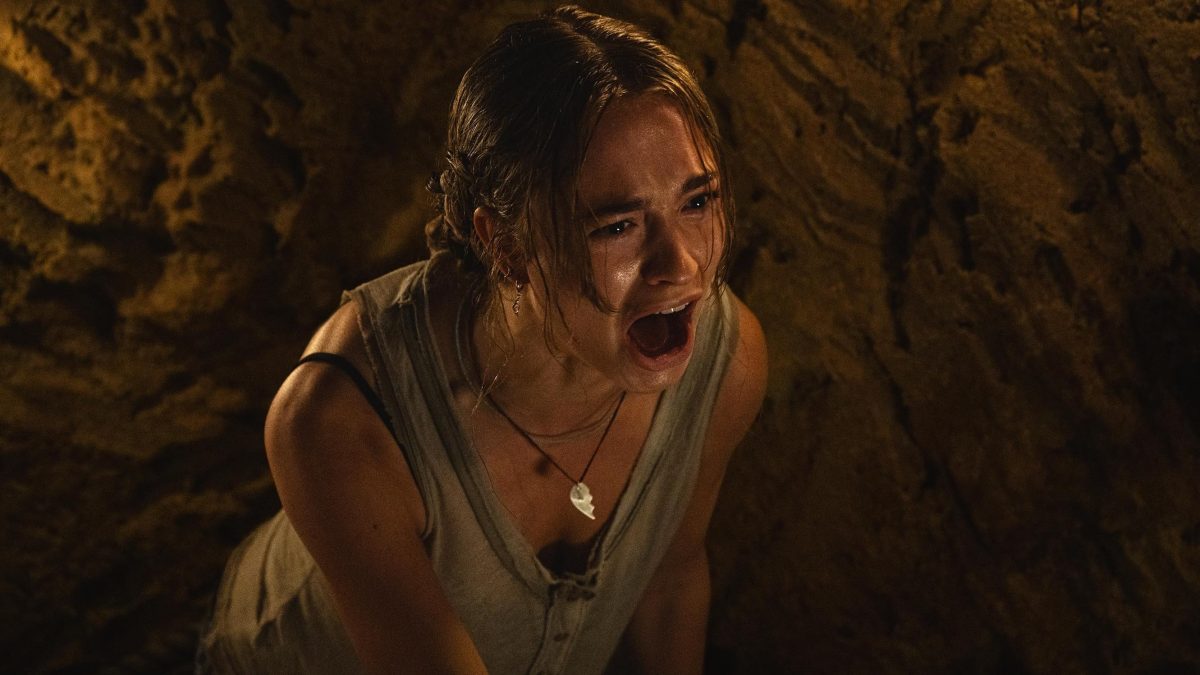
In truth, director Johannes Roberts and co-writer Ernest Riera aren’t aiming for that level of class-bound nuance in the symbolism of their titular figure (which “Primate” is the *real* monster, etc. etc.); it only takes about 30 seconds of the most “Yes, we’re in January”-level expositional dialogue you’ll hear all year to parse out that this script isn’t aiming for anything more sophisticated than “Ape scary.”
But aside from us already getting roughly six decades’ worth of more considered (relatively speaking, anyway) chimp commentary in the form of those aforementioned “Planet of the Apes” films, sometimes, going primal is enough, especially when you know exactly what animal you’re studying, and how to go about observing its more feral behaviour.
Not to suggest, either, that “Primate” is going completely apeshit (sorry, we had to sneak at least one in there) with an instinctive energy towards its craft—in truth, the rabid carnage could probably have been taken further—but Roberts is more than happy to unleash as much tenderized gore as the murky nighttime lighting of a gaudy, cliffside infinity pool will allow. The film never forgets what it is, and no amount of wooden dialogue can distract from Roberts’s pivotal understanding that the only subject of any real importance here is the one who never talks at all.
Ben, for his part, is never anything less than completely real in front of the camera, as Umba’s thorough chimpanzee posturing is matched by a convincing enough costume that humanizes the facial features only enough to let the light reflect off the deadened eyes of a killing machine, reminding us why Jane Goodall had the good grace to study these animals from a distance in their natural habitat, rather than shipping one out to her home for a cup of tea.
That “Primate” resorts neither to motion-capture technology clearly outside its budget nor a real-life chimpanzee tortured to engage in propaganda against his own species, ultimately, makes for the best optics for the film. Beyond practical reasoning, though, this is simply an effectively tactile means of unleashing what is essentially a home invader in the form of our most primordial relative.
If Roberts is subsequently doing nothing to reinvent the formula, this is mostly the result of a clear understanding that “Primate” only has one hairy, occasionally bipedal element that makes it stand out—and the further understanding that, with such commitment to the gnarly field study, nothing else was truly needed.





![Before We Vanish [2018]: An Alien Invasion Film Exploring the Reason for Human Existence](https://www.highonfilms.com/wp-content/uploads/2018/01/Before_We_Vanish_HOF-768x432.jpeg)