From 1618 to 1648, the appropriately named Thirty Years’ War engulfed Central Europe into absolute calamity. A disastrous conflict that turned ever-present religious friction into a multi-national conflagration hitherto unseen across the wider continent, the overall death toll of the seemingly endless bloodbath is estimated to have reached as high as 8 million, incurred from causes as explosive as direct military action and as secondarily devastating as the spread of the bubonic plague. By virtue of national alliances, unsuspecting soldiers from all across the European lands would go off into one of the deadliest discords of a century rife with warfare, and as is the case with any war, those few who managed to return, bloodied and beaten, were never the same.
Markus Schleinzer’s “Rose” contextualizes this ultimate futility and pervasive decay precisely by leaving it to simmer in the background, as the spectre of the Thirty Years’ War remains firmly lodged as a trail not far behind one of those soldiers who made it out, quite literally, by the skin of their teeth. Further encapsulating that futility, though, is the fact that the film, at its core, chooses not one of those young boys forced into the pit of near-certain death, but rather one of their peers who made the plunge of their own accord, and for reasons that elude even themselves.
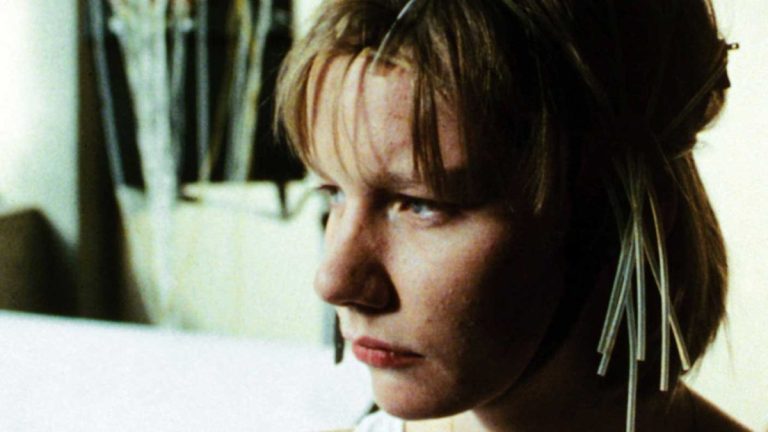
If Rose’s (Sandra Hüller) reasons for posing as a man and enlisting to fight in one of Europe’s most disastrous religious clashes are left unarticulated by the time her story begins just as that war has come to an end, Schleinzer revels in obscuring, to an even greater extent, the subsequent motivations for how she will come to spend her days in the aftermath of the devastation. Making her way to a distant Protestant village, Rose’s masculine ruse persists as she lays claim to a piece of farmland for which she mysteriously holds the necessary paperwork. The land is rough and has gone untended, but Rose is determined to stake this claim and embrace the fertility of this endeavour.
That strive for fertility can’t quite be replicated when Rose’s ingratiation into this village life requires her—her unnamed male persona, as it were—to take a wife and start a family of her own in order to cement her position as a landowner in good standing. How far she is willing to go to entertain this deception, then, leads to the question of how much of this is a deception at all.
Also Read: The 5 Best Sandra Hüller Movie Performances
Enigmatic as “Rose”—the film and the character alike—becomes with regards to this motive to play the long game, this cryptic characterization is precisely what makes Schleinzer’s work so mesmerizing when it refuses to lay down a simple answer. Even as Marisa Growaldt’s narration contextualizes the extent of Rose’s commitment—and attempts to frame it, at least in part, within the inherent drive for power and capital that corrupts all mankind—there comes a point at which the yield of the harvest can’t possibly be worth the back-breaking effort required to nurture it.
Critical to this driven ambiguity is Hüller’s performance (already an award-winner at this year’s Berlinale), whose rigid illegibility becomes absolutely instrumental to Schleinzer’s desired sense of period-ready detachment. “Rose” never leaves space for its titular soldier-turned-farmer to let her hair down and shed the facade even in the comfort of her own solitude; her decision to sleep in a cupboard tied shut from the inside gives a stark enough indication of the extent of her desired isolation even from the viewer’s gaze.
All we have, then, is the facade itself, which gives enough hints of its own volatility in every one of Hüller’s stiff marches across the field or her assured but spongy vocal deliveries. How much of this physical presence is the act of a woman imitating traditional masculinity and how much of it is whatever physical comfort Rose finds in her own corpus (be it in a more abstract reading of possible transness, or a literal view of a body crippled by war) is left mostly to the imagination, and Schleinzer’s strange tonal grasp—somewhere between the historically based pastoral dispassion of “The White Ribbon” and the austere farce of a Hlynur Pálmason film—encourages this characteristic opacity to a deliciously discordant degree.
Even when the film slows to a close, and Schleinzer and Alexander Brom’s ruminative script necessitates something in the way of a straight answer to its subject’s patriarchal subversions, “Rose” maintains the timbre of a broken, barely intelligible echo from a time when round bullets flew like sparrows, and the only control that can be found is in keeping the one that nearly tore your face off trapped between those very same lips. Open those lips to let out an explanation, and that last tangible grasp of dominion will slip out along with it.



![Oslo August 31st [2011] MUBI Review – A sympathetic tale of a drug-addict coming to terms with his life](https://www.highonfilms.com/wp-content/uploads/2017/04/review-oslo-august-31st-joachim-trier-768x415.jpg)