
I still remember the seven-year-old me struggling to believe that “Ishaan’s” (Darsheel Safary from Aamir Khan’s “Taare Zameen Par”) mother, “Maya” (Tisca Chopra), is just a figment of the creator’s imagination and doesn’t exist in the real world at all.
Maybe the struggle was genuine and justified for a seven-year-old child who didn’t want to be part of what people call reality at the cost of renouncing the world where magic was so organically a part of his imaginary dwelling, just like Ishaan’s daydreams, that one doesn’t need to buy tickets to witness it. However, times have changed, I have grown, and Maya has become Tisca Chopra – a filmmaker with a sharp tone who made a promising debut with a piquant short “Chutney” in 2016.
It took almost a decade for Chopra to come up with another film (this time a full-length feature). Her directorial debut feature, co-written by Sanjay Chopra (Tisca Chopra’s husband), “Saali Mohabbat,” dropped on Zee5 on December 12th. The film, another addition to the domestic noir (very popular these days), is a whodunnit that features double murder, women’s deprivation, lust, blackmail, and every other substance that you need to cook a delectable chutney. But the question is whether the chutney was cooked well or not. Nah is the answer. It tastes flat this time!
A great many actors (whom we have seen delivering subtle performances in the past) – Radhika Apte, Divyenndu Sharma, Anshuman Pushkar, Sharat Saxena, Sauraseni Maitra, and of course Anurag Kashyap – were involved in the film, but what, apart from alluring the audience (momentarily shifting the critical focus from the film), can even the greatest actor do if he is marooned on a set with an average script in hand consisting only of flat dialogues?
Radhika Apte is, as usual, a standout. She plays [apparently what seems to be] a double role (Kavita and Smita), but whether the two mentioned women were different beings or the same is a mystery (one too easy to solve) that Chopra has left for us to decipher.
Anshuman Pushkar delivers yet another good performance after “Maalik” and makes us foresee the good actor he is yet to become. On the other hand, Sharat Saxena has an okay-okay character to play, while Kashyap’s occasional appearance as a strongman (delivering dialogues and a demeanor so unchanged from his real-life interviews that it becomes a challenge to believe he is playing a character at all) doesn’t add any spice to the recipe.
Divyenndu, who plays a corrupt, typical desi police officer, sometimes indeed retains the spark that we have seen in him during “Mirzapur,” but at times he fumbles and struggles with his character, especially in the end, with a Hector-Salamanca-like guise.
“Saali Mohabbat” begins with a typical upper-class house party, where guests cannot be imagined without a disciplined formal smile and a drink in their hands (establishing the fact that no teetotallers are allowed inside such a party), where Kavita (Radhika Apte) finds her husband with another woman and decides to tell a chronicle (or a story-like presentation of a conundrum) of revenge. The film then shifts from the posh guest room to a quiet town named Fursatganj.
In Fursatganj, we find “Smita” – a simple housewife – whose relation with her husband (Anshuman Pushkar) is in tension. She is deprived of love and every nominal need that a wife deserves (a character that is hard to imagine without Radhika Apte, because it seems she has a special talent to embody deprived and psychologically complex women). The narrative casts a swing towards the audience when Smita’s sister Shalini (Sauraseni Maitra) comes to their house. Smita’s husband – who is neck-deep in debt – overcomes his age-old annoyance at the first sight of Shalini.
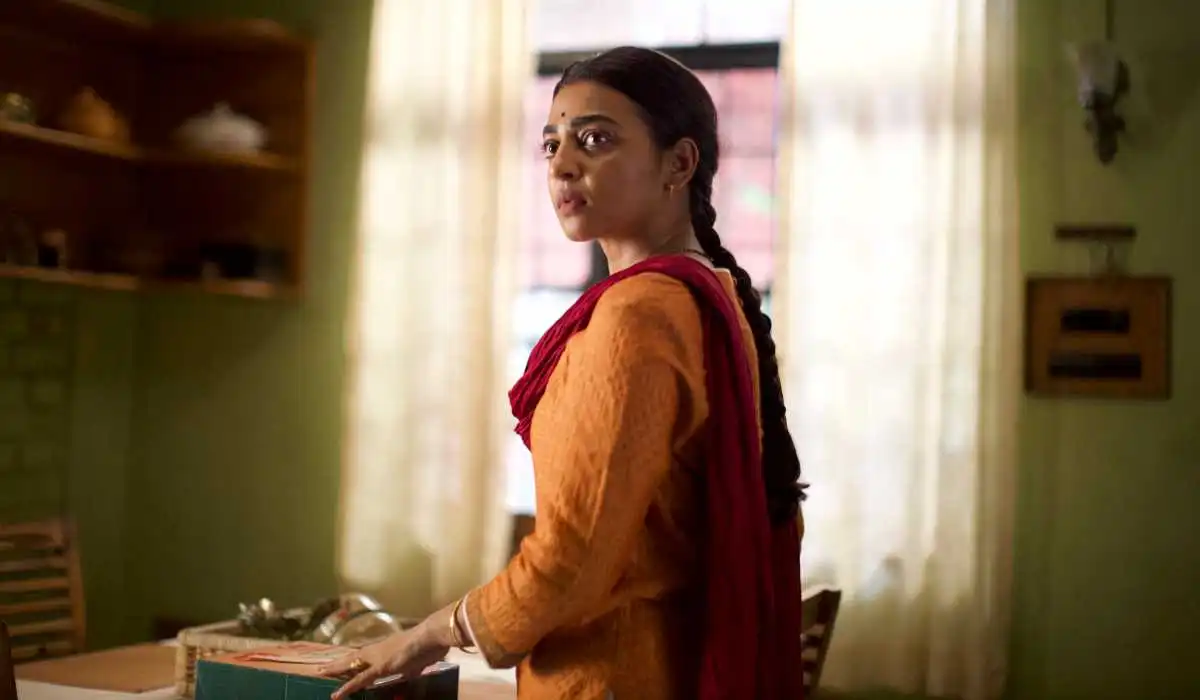
Shalini brings an air of sensation with her in Fursatganj, where nothing interesting really happens too often. Smita’s husband and a policeman (Divyenndu Sharma) easily find themselves captivated by Shalini’s beauty and die to spend a moment or two with her (deep down, the audience knows it’s nothing but lust). Though the policeman doesn’t get much of an opportunity, Shalini’s brother-in-law ends up in a wild streak of sex with her that Smita accidentally discovers.
Here, Tisca Chopra made a brilliant effort to save the film from sinking. A double murder – of her husband and sister – that Smita commits (that’s what the policeman suspects as he collects substantial evidence to blackmail Smita) is the only act you wouldn’t have expected at the outset from that character. Developing a character arc like Smita’s is a tiring task for a writer and a much more difficult one for a director to make us believe. However, Radhika’s efforts should also be acknowledged as she carefully channels the character from an innocent homemaker to a cold-blooded killer.
The problem with “Saali Mohabbat” is that a film intending to unfold a whodunnit rarely depends on a single character. The entire structure of the film is not built with the expert skill that one needs to operate in such genres. Thus, it crumbles down easily, as none of the trickery is set in particular places to portend the killer work.
The film could have been saved, as it also incorporates a philosophical POV with the crime, but a philosophy that tries overtly to justify a crime doesn’t simply work because it needs many more layers to make us believe in its aphorisms. Yet, let alone the aphorism, the dialogues of Sharat Saxena are so bland and conventional that they are not convincing either.
In a nutshell, “Saali Mohabbat” is disappointing as it not only offers nothing new but also fails to give a tight structure to the film. However, Chopra can be given another chance for an expected sequel, as she leaves spaces for a part 2 in the film, but rarely in history have we seen a sequel making up for a bad prequel.





![Shubh Mangal Zyada Saavdhaan [2020] Review: A Loud & Headache Inducing Piece That Must Be Cautioned Against](https://www.highonfilms.com/wp-content/uploads/2020/02/Shubh-Mangal-Zyaada-Saavdhan1-768x319.jpg)

![Gabbeh [1996] Analysis: Glimpses into a lyrical divinity](https://www.highonfilms.com/wp-content/uploads/2022/08/Gabbeh-1996-768x509.jpg)