
Though Argentine cinema has largely built its international reputation through considered dramatic reckonings with the sociopolitical tumult of the 20th century—driven in no small part by the lasting political divide represented by the years and aftermath of the Perón administration(s)—“Strangers in the Park” (Original title: Parque Lezama, 2026) begins with a simple assertion that attributes an implied timelessness to what we’re about to see: “The following conversation could take place in 2030 or 1980; in the year 500 or two days ago. Or even… right now!”
That quote is largely paraphrased because, like the film that follows it, this opening text simply has no idea when enough cutesy vacuity is enough, as Juan José Campanella’s adaptation of his own play of the same name—itself an adaptation of Herb Gardner’s American play “I’m Not Rappaport”—roots itself in the droning discourse between two octogenarians, one seemingly intent on talking the other to death.
This in itself isn’t necessarily a deal-breaker of a premise—it might actually make for a stimulating or, at the very least, amusing affair—if not for the fact that Campanella’s staid production finds nothing in their idling rapport worth exploring with such timidness. If the greatest villain, as one disingenuous character here states, is time, then “Strangers in the Park” exemplifies that truth by making every minute spent with these elders feel like an entire day of our own lives has come and gone, lost to the eternal aether of life’s regrets.
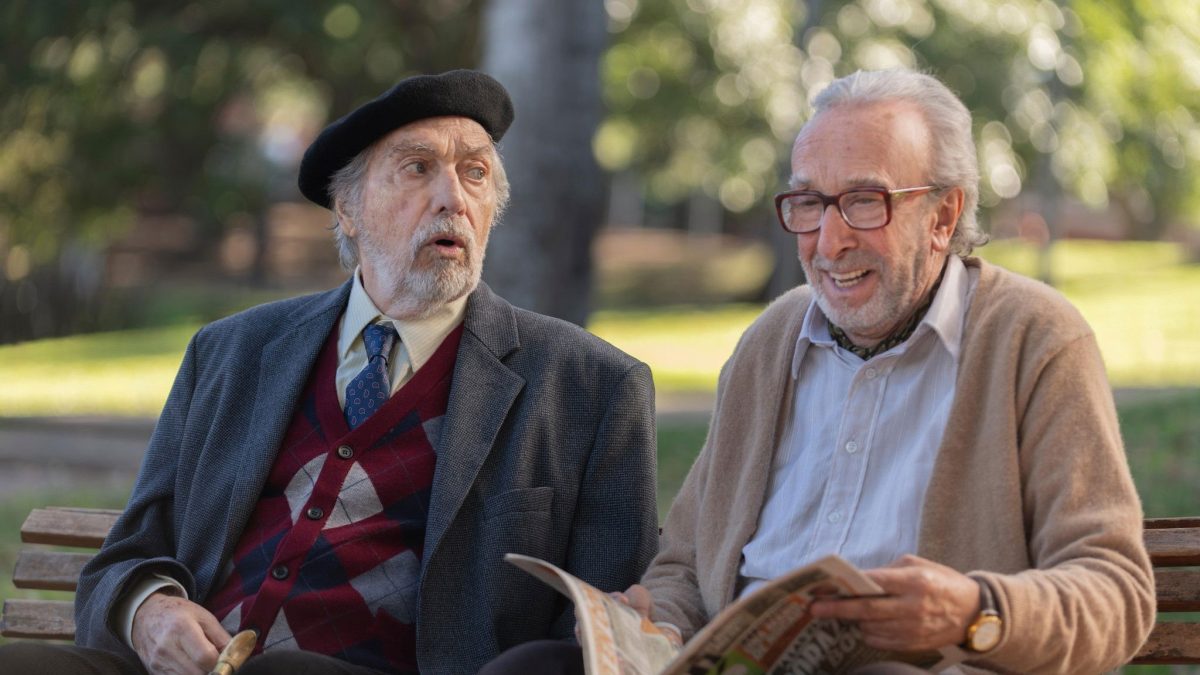
Antonio (Eduardo Blanco) certainly feels the life draining from his pores as he sits quietly in a serene park in Buenos Aires. All the man wants to do is spend his day sitting on his favourite bench and reading his newspaper, when a mysterious blabbermouth (Luis Brandoni), who’d rather embellish the details of his life than stick to whatever boring truth he refuses to reveal amid his endless diatribes, appears and refuses to leave Antonio’s in peace. Perfectly embodying the ethos of the film he’s in, this man talks endlessly and says virtually nothing, leaving poor Antonio’s desire for mere quiet as just another opportunity lost in the wind throughout an underwhelming life.
Now, according to the film’s official synopsis, “Strangers in the Park” thrives on the political jabbing between a passionate communist and a more passive “live and let live” type, but Campanella hardly mines the dynamic between Blanco and Brandoni for anything in the way of fiery or thought-provoking interpersonal debate. Rather, the film relegates itself to a series of nonstop lectures from Brandoni’s nameless (or many-named) communist who espouses vague slogans about sticking to one’s principles while Antonio cowers at the prospect of doing anything more than telling this man how annoying he is.
Also Check: 10 Essential Argentinian Films of the decade (2010s)
Admirable as these moral convictions from the man temporarily known as “Hoarse Throat” may be, “Strangers in the Park” never gives any real detail to those convictions that may contextualize them within Argentina’s greater political context, or any tangible political context at all. The film doesn’t even find any real conviction in exploring his knee-jerk tendency to use his political expression as a shield to unforgivably lie to his own daughter about some rather major family lore.
All we get is more limp scolding from his cohort. This makes the opening text about this union’s timelessness read more like a slimy evasion of real grit that might shift Campanella’s efforts into more than inconsequential, sugary fluff, as these characters’ political leanings appear to be little more than half-hearted tools for underbaked conflicts.
In this respect, it bears mentioning that Gardner’s source play (and the following film adaptation that, in a reflection of Campanella’s later efforts, the playwright himself would direct) finds in its simplified premise the space to at least explore the dynamic of racial divides. Not the most novel exploration of social tensions, to be sure, but at least it’s something. Comparatively, Campanella finds absolutely nothing—no bite, no wit, no whimsy—in the interplay between his two leads, compounded further by the fact that they aren’t even really peers.
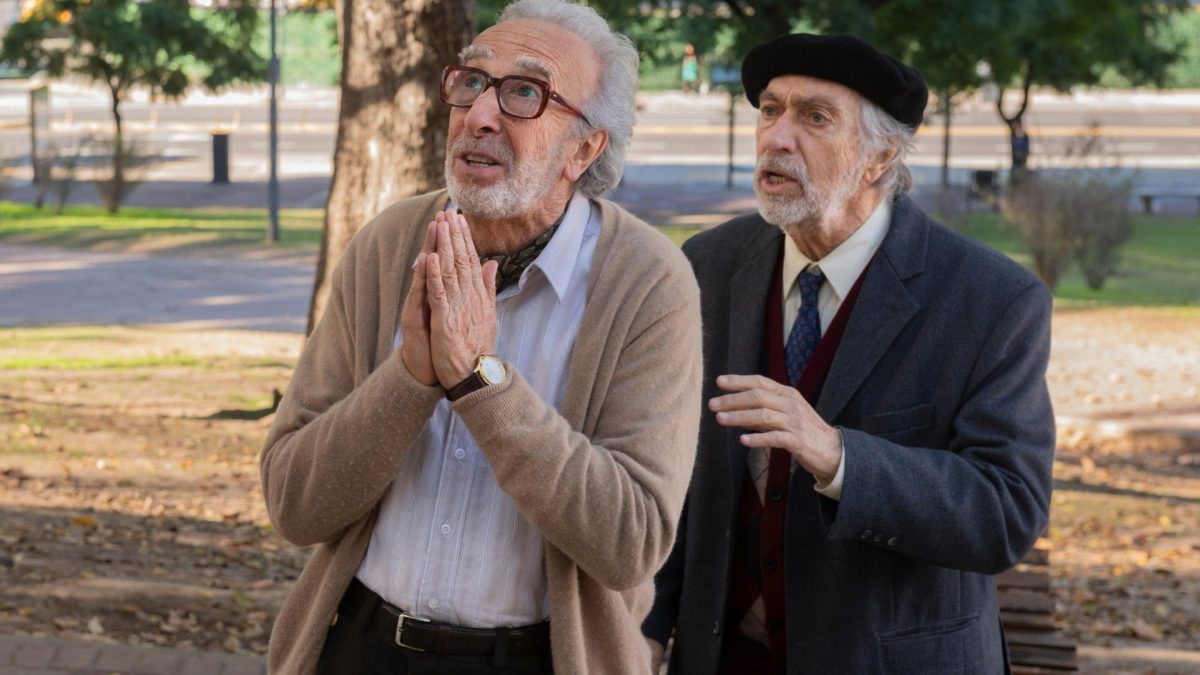
Blanco, who in real life hasn’t even hit 70, dons some marginally impressive aging makeup whose latex contours become more apparent the longer you look at them, bringing him up an extra 15 or so years to match the real-life 85-year-old Brandoni. This pointless decision becomes more distracting the longer Blanco spends onscreen, as his exaggerated tremoring, excessively hoarse vocals, and relentless stammering feel more like cosplay than integrated performing, especially next to a more spirited costar who channels his real-life political background into something at least attempting to resemble a flesh-and-blood character.
True to its roots, “Strangers in the Park” never lets you forget the fact that it’s based on a stage play, as Campanella offers no cinematic means of adaptation that might warrant a retelling supplemented by considered choices in editing or shot composition. The best we get, naturally, is a schmaltzy piano score intended to beat our emotions into submission, but the film, on its own terms, offers nothing to warrant that kind of affective attachment.
The most Campanella is able to communicate from his two wayward souls is Antonio’s sense of exhaustion and downright anxiety that we’ll be at the mercy of one more of his screen partner’s empty verbal crusades. By the time Antonio finally begins to sit in giddy anticipation of another wholesale lie, we’re just about ready to do what he never could and run for the hills, ready and willing to leave that cursed park bench as nothing more than a distant relic of a moment already forgotten by the time that lonely patch of grass and pavement has exited our line of sight.




![All That Breathes [2022]: ‘Sundance’ Review – Mapping Delhi’s streets & skies into a Stirring, Stunning Miniature](https://www.highonfilms.com/wp-content/uploads/2022/01/All-That-Breathes-Sundance-2022-768x431.png)