
In 1996, in West of Oron, an old woman lies dying on her bed, watching the fire of war flicker outside her house like a grieving mother witnessing her son’s suffering for decades before the end of her own impoverished life. This image opens “The Arab,” followed by a long shot that plunges us into the chaos of the Algerian civil war, along with a Muslin’s wail accusing the continuous riots committed against the nation.
Loosely inspired by Algerian writer Kamel Daoud’s 2013 novel “The Meursault Investigation,” documentary filmmaker Malek Bensmaïl premiered his debut fiction feature “The Arab” in the Big Screen Competition at the International Film Festival Rotterdam 2026. The film revisits the defining moment in Albert Camus’s canon, “The Stranger,” in which the existential anti-hero Meursault kills an unnamed Arab man on a beach, engendering a gratuitous murder stripped of context, background, or identity, even during the subsequent trial.
In Camus’s novel, the slain Arab remains nameless and devoid of personal detail, a narrative omission that has provoked certain accusations of colonial blindness and deliberate erasure. This problematic legacy has increasingly come under scrutiny, notably in François Ozon’s adaptation of “The Stranger.” Ozon attempts a partial redress by granting the Arab a named grave and gestures of reconciliation through dialogue. Yet such acknowledgement remains insufficient. Where Ozon raises awareness, Bensmaïl goes further: he radically reconfigures the narrative structure itself, reclaiming historical visibility and discourse power for the Arab subject.
As its title suggests, “The Arab” centres Arab identity as both subject and perspective. The film begins with a young journalist, Kamel (Nabil Asli), who produces on-the-scene reports on the escalating civil war. Courageous yet indecisive, he documents events with factual restraint. His editor, however, is less concerned with truth than with the number of deaths, urging him to adjust the focus of his coverage.
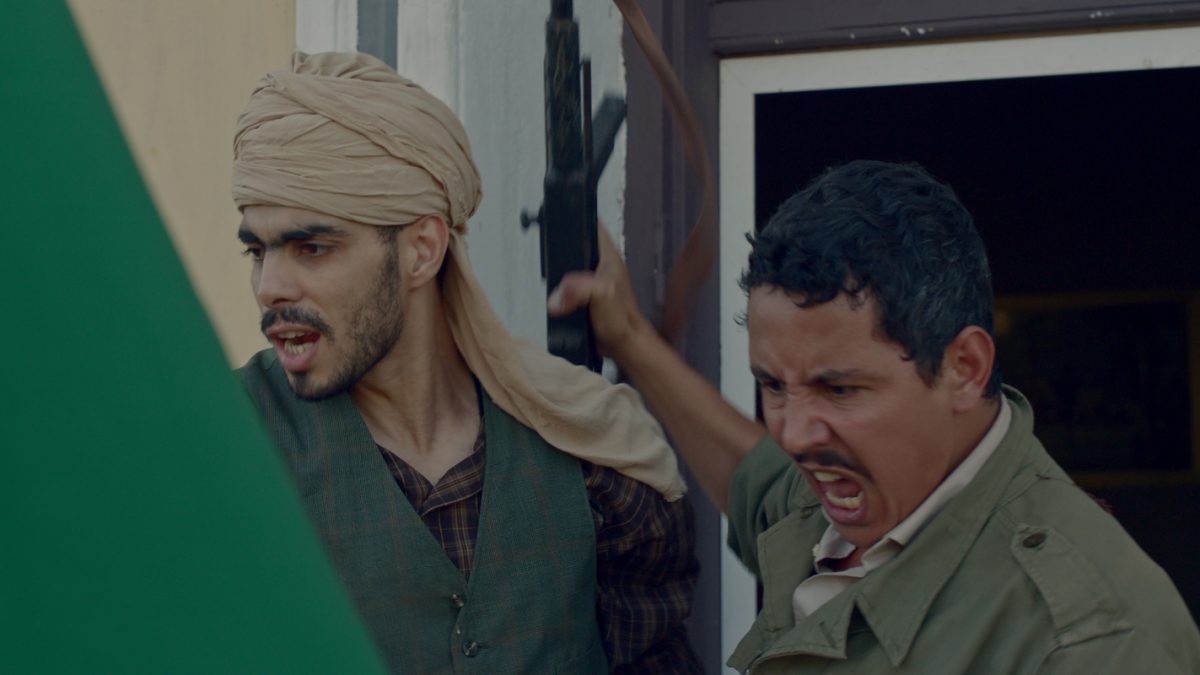
One night, in a lively local bar, Kamel meets Haroun (Ahmed Benaïssa), a brooding, enigmatic old man burdened by an unspoken family history. Learning of Kamel’s profession, Haroun gifts him several books, among them Camus’s “The Stranger,” and asks him to reread it carefully. As their relationship deepens, Haroun reveals that the unnamed Arab killed in the novel was in fact his elder brother, Moussa (Brahim Derris).
Contrary to the literature’s oversight, the Arab has a name, a job, a lover, and a family that is no different from any other in his life. This revelation astounds Kamel (and perhaps, by extension, us readers long shaped by the text). Through a series of flashbacks, Haroun recounts his family’s story to incredulous Kamel. It is the 1940s in the Casbah, during French colonial rule, cynically celebrated in newspapers as part of a “united France.”
Young Haroun (Dali Benssalah) supports his family as a part-time shoe cleaner amid impecuniousness and the absence of their father (who is notably missing throughout the film). Not long after the life portrait of Moussa is unfolded, the family is devastated to learn that Moussa has been killed by a Frenchman, which throws them into a stifling state of loss.
Bensmaïl resists dwelling on legal justification or moral explanation of the tragic incident, focusing instead on how the family continues to live under the shadow of bereavement. Haroun’s mother continues working as a maid on the colonial estate of Laquais, gaining access to the property after it is abandoned when the French army retreats. At this point, the film’s visual framework shifts. The image expands from a 4:3 ratio associated with colonial memory to a widescreen format, signalling the transition into the contemporary era of narration.
Haroun grows into adulthood, but remains psychologically bound to his traumatised, controlling mother. It plants the seeds of a dramatic twist when Haroun allows a repatriating Frenchman to stay overnight in the vacant house before leaving for Algiers. However, his mother, played by Hiam Abbass, bereft of reason, forces Haroun to shoot the man, convinced he is responsible for Moussa’s death. Another innocent life is taken. Through this bitter irony, the film exposes how individuals continue to suffer across historical transitions, and how violence reproduces itself while an original injustice remains unresolved.
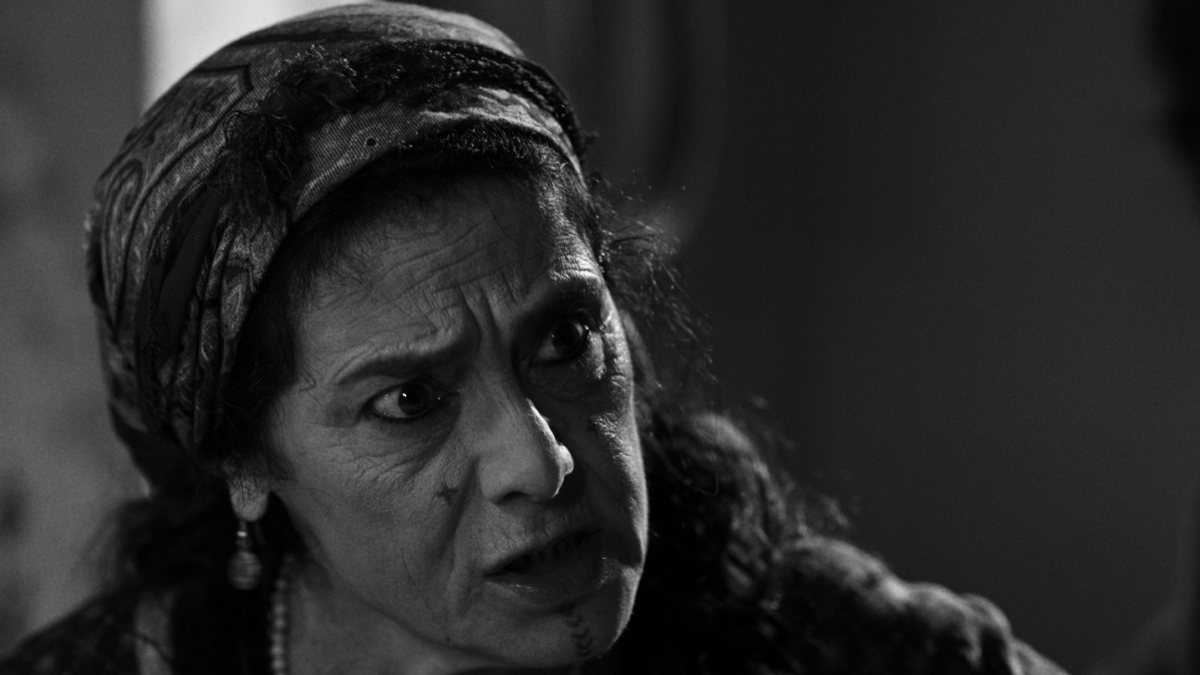
By reconstructing the life of the erased Arab, Bensmaïl restores Moussa’s individuality through a narrative spanning from the 1940s to the late 1990s, paralleling Algeria’s turbulent national history. This approach resonates with what Saidiya Hartman terms “critical fabulation”, a method that uses fictional reconstruction to interrogate and expose colonial archives. “The Arab” operates precisely in this context.
Through a counter-novelistic strategy, Moussa’s identity is reiterated not through literature, but through journalism, a medium that privileges lived reality over fictional abstraction. In doing so, the film intervenes in fiction with the real, using fabricated elements to produce a powerful encounter with historical truth.
Cinematographers Lionel Jan Kerguistel and Gilles Porte intensify this effect by rendering Moussa’s lived past in stark black-and-white imagery, while the interplay between past and present, edited by Matthieu Bretaud and Julia Grégory, deepens the film’s emotional and political resonance. In the end, “The Arab” acts as not merely a meditation on memory or colonial mourning; it is a confrontation with the present and the future of the state‘s trajectory. When Kamel asks Haroun, “What do you want me to write?”, the question provokes a deeper interrogation of the socio-political responsibility fallen upon a writer who should be considered upright.
In this case, a stand for neutrality alone does not suffice to express one’s situation when discourse itself is shaped by power. What matters really is not what is written, but how it is written, from which angle, to what extent, and for whom. This may help explain why Haroun condemns Camus’s novel as Meursault’s story precisely, because it renders the victim cold, abstract, and marginalised without further annotation.
Obviously, with resolution, “The Arab” chooses to speak from the Arab perspective, for the Arab, and as the Arab. It reclaims discursive authority and reverses the source material’s viewpoint, transforming the same event into a profoundly different story told from the subaltern voice that was once silenced.




![There Are No Saints [2022] Review: A bleak but traditional Revenge drama](https://www.highonfilms.com/wp-content/uploads/2022/04/There-Are-No-Saints-2022-768x432.jpeg)
