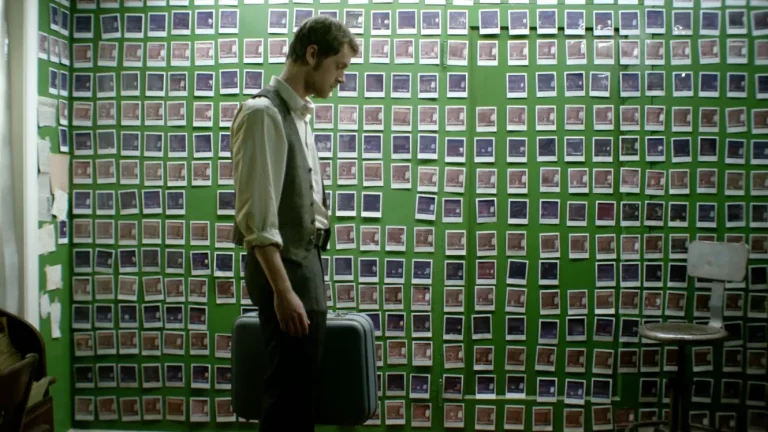
Andre Gaines’s psychological thriller, “The Dutchman,” uses the genre traits to distill the experience of black humanhood in America. He does that through the lens of a young African American man during a peculiarly terrifying night in New York. Gaines also co-wrote the film’s screenplay with Qasim Basir, based on Amiri Baraka’s 1964 play, “Dutchman,” which is an intertextual plot device in the film as well. The film expands on themes introduced in Baraka’s play, reshaping a few plot points, potentially to offer a contemporary interpretation of his prescient allegories.
Speaking about the film’s structure, those who aren’t familiar with the play before watching the film may find the eventual moment of revelation predictable and thus be dissatisfied with it as a genre piece. Apart from that, Zazie Beets’ character as the protagonist’s wife seems underwritten, especially considering how crucial her role is within the overarching narrative. Nonetheless, Gaines manages to capture the paranoia surrounding the protagonist’s life, either overcorrecting or overcompensating for what others deem he lacks.
Spoilers Ahead
The Dutchman (2025) Plot Summary & Movie Synopsis:
What happens in The Dutchman?
The film begins with a Carl Jung quote, which reads, Who looks outside, dreams. Who looks inside, awakens. Thereafter, it follows Clay (André Holland), a New York City dweller suffering from identity struggles. He briefly mentions his ‘double consciousness’ as an American, black man, referring to identities based on how others perceive him as opposed to who he is. His therapist, Dr. Amiri (Stephen McKinley Henderson), mentions those worries of public perception as the root of his anxieties, slowly eating him up. His wife, Kaya (Zazie Beetz), says he should have spoken to her about his feelings, and that way, they might have avoided being in therapy altogether.
A brief history: in the past, Kaya had been unfaithful, but returned to him instead of being with the other man. It, however, didn’t make Clay feel better. That’s why, after she leaves the therapy session, Dr. Amiri gives him a print copy of Baraka’s play, hoping he would refer to it to deal with his identity struggles.
Clay walks out, talking with his friend, Warren (Aldis Hodge), on the phone, who says that ‘Turnabout is a fair play,’ referring to his marital issues with Kaya. He is supposed to be at Warren’s apartment soon for a party, but instead of those thoughts, he gets caught up thinking about the plot of Dutchman. Since then, he finds himself in situations with a near-identical scenario to the protagonist of that play.
How does Lula enter Clay’s life?
Clay goes to a subway station and behaves as he ought to, but the security officers stop him anyway. There, he notices a black boy with his mother scrolling through her phone to find their pass. They are the only others stopped there, implying racial profiling by the officer. A few minutes later, he steps into his subway to see a young white redhead (Kate Mara) staring at him from outside the window. As the train leaves the station, she steps in and walks over to sit right next to him. He stands up, uncomfortable by her presence, staring out the window where he earlier noticed her. She says there’s only a dark wall outside and accuses him of staring at her before.
The woman, Lula, starts half-flirting, half-teasing him based on her ill-defined notions and stereotypes of black men to trigger a response from him. She also mocks his speech, which he plans to read at Warren’s, claiming it sounds like him. Throughout this interaction, she keeps eating an apple and eventually hands it over to him — a biblical reference that adds another reference with her representing Eve.
Anyhow, she follows him out of the subway, saying she is ‘Lena the Hyena,’ calling him ‘Morris the Hyena.’ That’s when he sees a black woman nearby and walks over to help her get her belongings back in her bag. The woman looks at him with concern and, realizing his internal duel to attain salvation, tells him that his fate will be different. After that, Lula follows him, inviting herself to the party even though he didn’t tell her he was going to one.
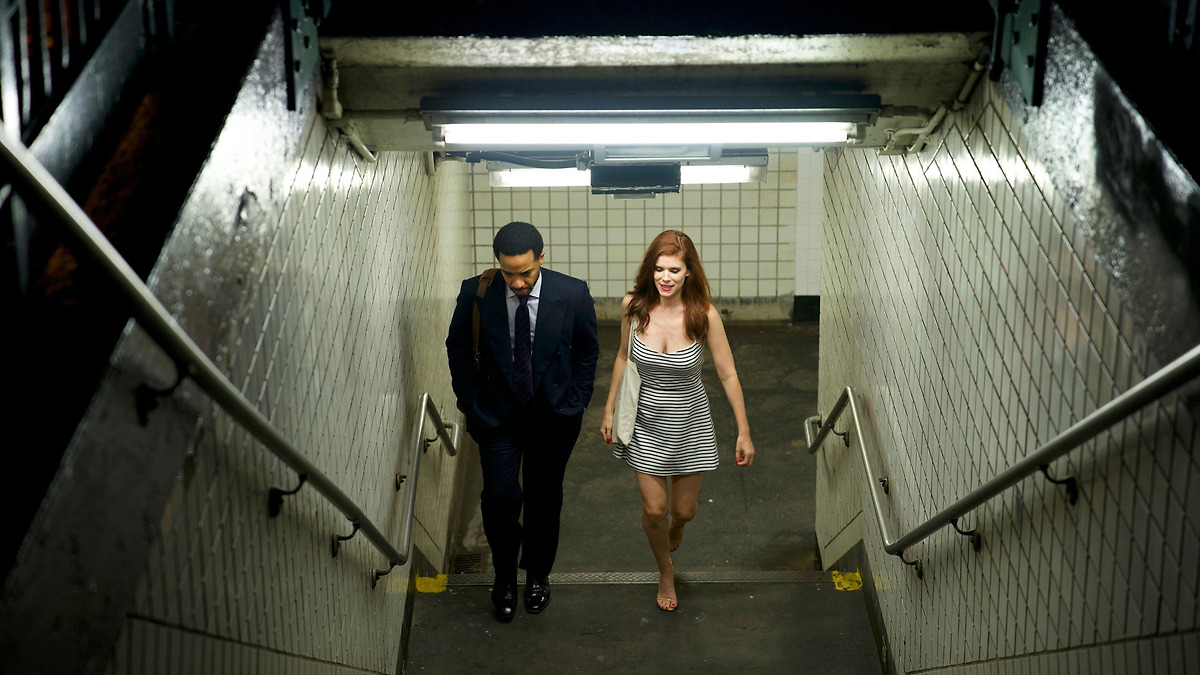
Does Lula join Clay at the party?
Despite Clay’s initial hesitation, he eventually acquiesces, agreeing to take Lula to the party after getting into bed with her at her apartment. They have sex, where he fleetingly thinks of the time Kaya slept with another man. Once they are done, she goes to another room, while he looks at a miniature version of a theater with only a single, tiny, male mannequin-esque figure.
She steps back, wearing a different dress. For a brief moment, she looks unlike herself, old and wrinkled, despite being out of focus. That isn’t the case when he looks at her. Suddenly, he decides to walk out without her, but she starts screaming. So, he gives in to her manipulation and takes her with him.
She continues teasing him about trying to act differently from his honest self, implying he is trying to be more like his white peers, while claiming her own wish to be black, without caring how ignorant and insensitive that sounds. He confronts her and the world at large for enjoying or benefiting from black culture without letting those benefits reach the very people it originated from.
For a brief moment, before getting in a taxi with her, he sees an enactment of a scene with a black man and a white woman in a subway car, possibly an enactment of the aforementioned play. Then, while in the cab, she teases him about his concerns about his future, prompting him to leave in the middle of the road. She follows and manipulates him again into letting him take her to the party.
How does Clay end up in jail?
Warren looks at Clay, shocked that he came there with someone like Lula. She walks in, unperturbed, disturbing two black people talking about a painting, sharing her unsolicited opinions. Kaya steps in and takes Lula away, but Lula also makes Kaya question her own sanity. As it happens, Clay talks to Warren about his emotional burden, while people like Lula will benefit from the work they do.
Eventually, after introducing Warren on the stage, Clay takes Lula’s purse and walks out, hoping to take charge of the proof of their sexual intercourse, which she had been using against him. Right on the corner, the cops notice him, followed by Lula, a white person, who calls him a thief, prompting them to arrest him.
While in jail, a man who looks like Dr. Amiri says that Clay has a few hours to reverse his curse and rewrite his fate. Soon, Kaya gets him out of jail and questions him about almost rushing out of the party, thus embarrassing her. However, they can’t reconcile at the moment, leaving them to part ways. After that, he finds his way to a theater, a bigger version of the one in Lula’s house.
The Dutchman (2025) Movie Ending Explained:
After parting ways with Kaya, Clay walks into a theater with a set that resembles the room Dr. Amiri works from. He looks for a copy of the play to help him find a way out of his mess, as suggested by Dr. Amiri before. As he starts reading, he realizes that it depicts the scenes he experienced with Lula.
Soon, Dr. Amiri arrives there, warning him to change the fate from that of the play’s protagonist. In the play, the black protagonist dies in the end, killed by Lula, who symbolizes white America. Instead of letting her (or what she represents) create division among black men, to then benefit from that very division.
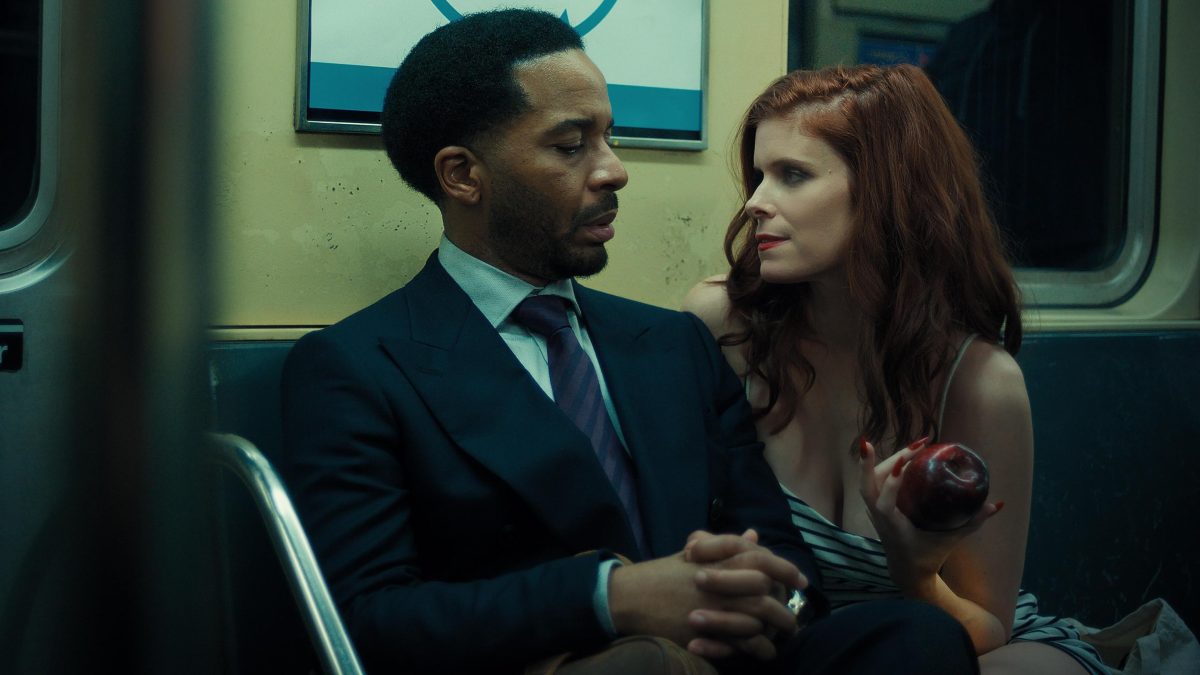
He returns to a subway station, but unlike before, he jumps over the turnstile, and the cops don’t even notice that. This moment likely represents a shift in his mental state, benefiting him, and the lack of concern about perception liberating his mind. In the train, he sits down and falls asleep next to a traincard saying ‘Break the cycle.’ Somehow, he loses track of time and suddenly finds Lula’s fingers wrapped in his. She tries to manipulate him, claiming he behaves like a sophisticated white man, then reminding him of his own cultural roots, making him want to return to those, again, to profit off of it.
What do Clay’s final words represent?
Instead of giving in, Clay steps up and confronts Lula for trying to put black men like him in a box. Unlike before, he gets furious, confronting her about her prejudices, eventually stabbing her with a weapon she earlier used to stab him while he was trying to get off the train. Once the cops arrive, they judge by appearances and arrest him. But the woman he met earlier, who prompted him to think about his fate, steps in to save him with video footage, showing that he acted to defend himself. Lula is revealed to be the old woman that we briefly see in an out-of-focus moment at her house.
At the crack of dawn, Clay walks back home, noticing how there’s no sign of injuries on his body. It seems like he has decided to reconcile with Kaya. Before going in, he opens the print of that play, noticing every page to be blank. In the final moment, Dr. Amiri tells Clay, “The past is a prologue,” to which Clay responds, saying, “But it doesn’t have to be.” There’s a difference in their tone. Dr. Amiri seems more assured in his views, whereas Clay’s reaction suggests it’s something that he has only then learnt. His final words probably imply his newfound understanding of the potential of reversibility of things that compelled Mr. Baraka to write his play.
Hence, instead of thinking it’s only a prologue, he might have considered it as a possibility in his present, something he must look out for. It also marks a shift from the play’s ending, where Lula kills Clay with the help of bystanders, as he takes charge of the situation and does not let white America control his views about himself. Nonetheless, this is only one interpretation of this scene, and someone with a lived experience of these traumas may have a more nuanced understanding of it all, unlike any outsider, including me.
The Dutchman (2025) Movie Themes Analyzed:
Identity Struggles, Assimilation, and Race-Dynamics
The film, although thematically incoherent at times, captures details that others seem almost afraid to acknowledge. Through Clay’s identity struggles, the film explores the country’s delicate race dynamics, with Lula representing white America. During a scene, Dr. Amiri points out Clay’s potential struggles between conformity and acceptance, identity and assimilation, anger or restraint, and vulnerability or violence. It becomes the core of this provocative film that tries to offer a visceral, full-bodied experience of the life of a black man living in America. Lula seemingly represents the darkness in Clay’s life, where her chatter may be the inner voice constantly making him second-guess himself.
Through Lula’s character, the film also addresses a near-fetishization of black culture, which not only deprives black people of the fruits of their creative and intellectual labor but also leads to harmful tropes with fetishized notions, which is something that the writing for Perfidia’s character in “One Battle After Another” was also criticized for by some.



![The Killing of Kenneth Chamberlain [2021] Review : A harrowing true story brought to life by an incredible Frankie Faison](https://www.highonfilms.com/wp-content/uploads/2021/12/The-Killing-Of-Kenneth-Chamberlain-1-768x432.jpg)