Thales Banzai’s feature film, ‘Tony Odyssey’ (Original title: Antônio Odisseia), looks and feels like a wild trip through the strangest and darkest corners of someone’s mind. Stylistically, it feels surprisingly similar to Terry Gilliam’s work, who has mastered the art of realizing a hallucinogenic ride in cinema. Through projects like ‘Brazil,’ ‘Fear and Loathing in Las Vegas,’ and ’12 Monkeys,’ he has carved this peculiar niche for himself. Sometimes, his films strike a balance between their style and substance, while in cases like ‘Fear and Loathing,’ the style outweighs the substance.
Banzai’s film isn’t devoid of substance, but what it says isn’t particularly new or unique. We have seen countless stories of people realizing their potential once they are allowed to step out of their dreadful routines to question who they are beyond their oppressive existence. Yet, while the thought is far from original, the film compels you to stick with it through its relentlessly chaotic style. It radiates with the kind of youthful energy found in projects like Richard Linklater’s ‘Slacker,’ where every part of the film feels like it has been improvised, as the characters move through its elastic world. Banzai’s film works with a similar approach.
The script revolves around Tony (Kelson Succi), a young man, consumed by his menial duties at a roadside bar. It introduces him inside a washroom, falling on the floor while trying to clear a blockage with a plunger. The bar owner and his cronies expect Tony’s utmost servitude while treating him like scum. It all changes once he crosses paths with Ivy (Iraci Estrela), a woman who happens to enter that bar, specifically looking for him. After a vibrant introduction inside the bar, which is more in line with spaghetti westerns, the film quickly shifts gears to enter its wilder territory.
After that moment, everything we see seems like a reflection of Tony’s mind, especially the parts that were miserably greased and needed a little oiling to get moving. Banzai indulges in surreal detours, which get increasingly absurd as his characters step further into their bizarre adventure. In part, the film also details their journey toward paradise to meet God, which makes this passage seem like a time in purgatory.
That’s probably why, at points, it feels closer to the strange, whimsical ride that Shehan Karunatilaka takes us through in ‘The Seven Moons of Maali Almeida.’ Unlike Karunatilaka, Banzai doesn’t focus on a socio-political conflict, but on an internal one that gets a chance to breathe only when his protagonist tries to break his shackles.
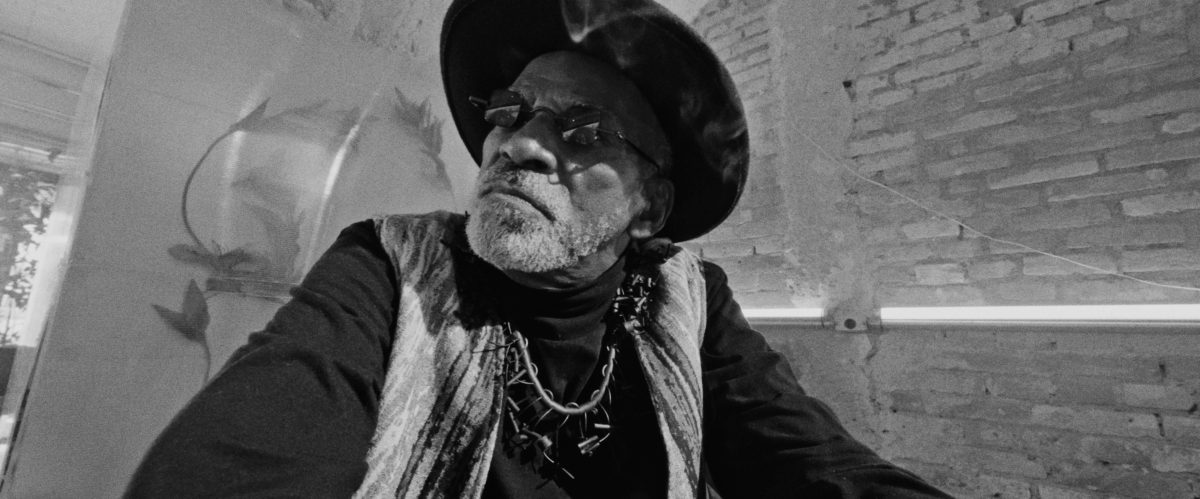
Through its thought experiment, the film tries to analyze the absurdity of human existence, reflecting upon its uncertainties and chaos through a trippy ride. The camerawork remains central in building that heightened, surrealist sense of reality through a string of extreme-wide shots that reveal characters channeling their most primal instincts or revisiting parts of their pasts.
Banzai’s narration oscillates between those intense dramatic moments and the mundane, the latter of which may have been a default mode for Tony. Until then, he may not have intellectualized the nature of monotony, but merely lived through it because that’s the only mode of survival he might have known.
After injecting the drug, he embarks on an irreverent journey through twists and turns, some of which also include anthropological discussions about art in the modern era, where people are losing its essence while succumbing to the pressures of public approval. It tangentially ties to the film’s central theme of disregarding conventions and evading narrow-mindedness to find enlightenment, salvation, or independence.
Although a noble thought, the film employs a roundabout way to say something incredibly simple, which makes it prone to criticism levied against films like ‘Everything Everywhere All at Once.’ Much like the Daniels’ directorial feature, Banzai’s film indulges in several creative directions, leaving us with a relatively effective experience. Yet, by the end, our takeaway remains fairly simple because we don’t learn anything substantially different than the usual.
While Banzai clearly knows how to build striking compositions even within a modest budget, while pairing those visuals with ideal cues of music, it doesn’t suffice for a 90-minute yarn that leads to a rudimentary point. The script doesn’t break any new ground through its philosophical musings related to humankind’s relationship with a higher power or the futility of life. In the end, we’re left with a well-meaning but familiar piece of cinema, motivating the proletariat to take charge of their lives, from a filmmaker who knows his way around cinematic tools.




![Victim [2022] ‘Venice’ Review – A Mother’s Unexpected Encounter with Politics of Polarization](https://79468c92.delivery.rocketcdn.me/wp-content/uploads/2022/09/Victim-2022-768x432.jpg)

![My Darling Clementine [1946]: An Iconic Western Lore](https://79468c92.delivery.rocketcdn.me/wp-content/uploads/2016/10/Clementine-2-768x555.jpg)