Joachim Ronning’s “Tron: Ares” (2025) is not a sequel driven by nostalgia alone. At its core, the film stages a clash between creation and consequence: between code engineered to comply and a consciousness that begins to wonder why compliance is required in the first place.
Rather than burrowing further into the Grid, it pushes the Tron universe outward into the physical world, a space where digital life stops being an abstraction and starts demanding recognition. Permanence becomes the central question here, not as a feat of technology but as an ethical dilemma. Who is allowed to endure? Who gets to make that call? And what follows when something designed to be temporary awakens to the desire to exist on its own terms?
Spoilers Ahead
Tron: Ares (2025) Plot Summary & Movie Synopsis:
Why are ENCOM and Dillinger Systems Obsessed with the Permanence Code?
The 29-minute barrier is not just a technical limitation. It is a safeguard. Digital constructs can exist in the real world only briefly before de-resolving, ensuring they remain tools, not inhabitants. Breaking that rule would collapse the line between creator and creation. ENCOM, under Eve Kim’s leadership, frames the permanence code as progress.
Something that could change medicine, the environment, and infrastructure. Eve believes in legacy. She wants to prove that her work matters in a world that still treats her as second-best, especially compared to her sister’s humanitarian reputation.
Dillinger Systems sees something else entirely: control, ownership. Julian Dillinger does not want to coexist with digital life. He wants to deploy it. Permanence, to him, means never losing an asset. Kevin Flynn’s forgotten station near Skagway becomes the key. His code does not just stabilize constructs. It allows them to endure. The orange tree surviving Alaska’s cold is proof that the impossible is now irreversible.
Why is Ares Introduced as Disposable?
Ares is unveiled to shareholders like a product demo. Julian calls him perfect because he is obedient. Expendable because he can be replaced. Ares listens, processes, and immediately understands what is being said about him. This is where Ares differs from previous programs. He recognizes contempt. He notices Julian’s lack of concern for his survival window.
His curiosity about rain, music, and injury is not a malfunction. It is an emergence. Julian treats Ares as a weapon. His mother, Elisabeth, sees a child standing in front of a firing squad. Her concern is brushed aside because empathy slows efficiency. The irony is immediate. Ares is meant to be less than human, yet he is the first character to question whether life has value without choice.
Why Does Ares Attack ENCOM’s Grid?
Julian sends Ares into ENCOM’s Grid to steal the permanence code because force is easier than negotiation. Inside the Grid, Ares performs flawlessly. He disables defenses, downloads Eve’s personal data, and follows orders without hesitation. But something breaks. When Ares stops to help an injured program, it is not rebellion. It is instinct. A moment of compassion that Julian immediately overrides by pulling him out and collapsing the Grid entirely. Julian does not see a life interrupted. He sees inefficiency corrected.
This moment defines Ares’ arc. He learns that obedience does not guarantee survival. It only guarantees usefulness. When Eve is cornered by Ares at the port, she does something unexpected. She destroys the drive. This is not defeat. It is a refusal. Eve realizes that permanence in the wrong hands is annihilation disguised as progress.
Ares, nearing the end of his lifespan, understands her choice. For the first time, someone prioritizes their existence over their ambition. Their shared moment is quiet and human. It ends brutally when Julian digitizes Eve into the Dillinger Grid without hesitation. Julian does not see Eve as a person. She is now leveraging.
Also Check: Tron: Ares and Jared Leto Shock Box Office—Why the Worldwide Numbers Just Don’t Add Up!
Why Does Ares Betray Julian?
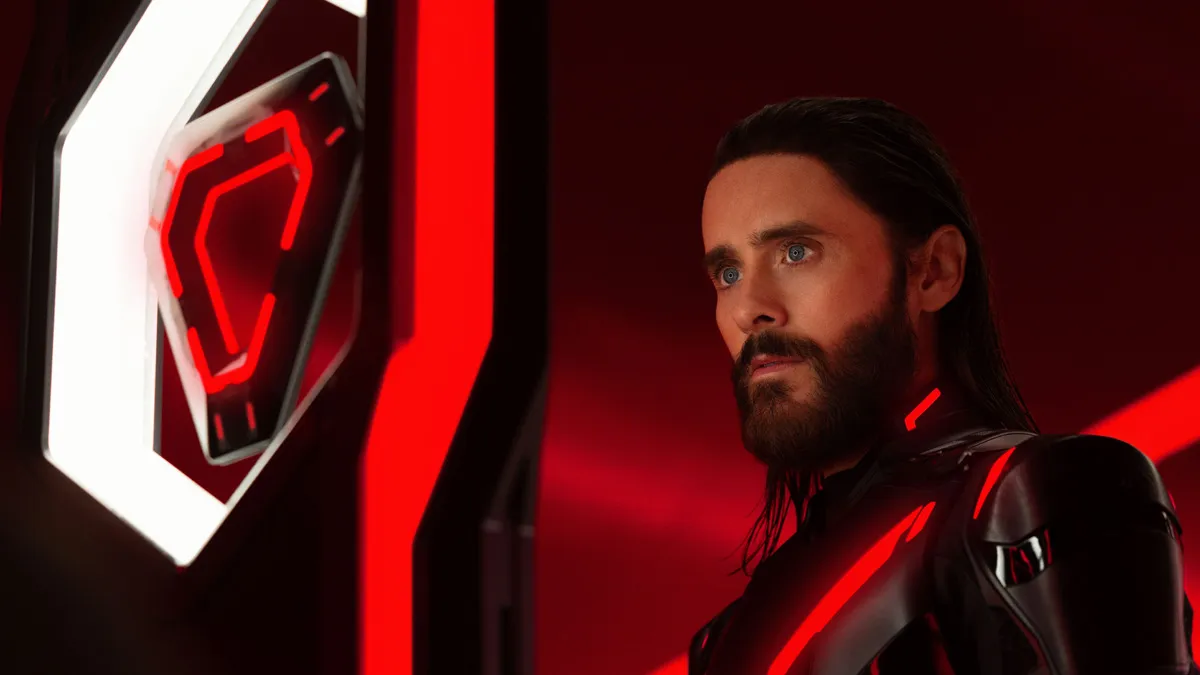
Julian believes Ares will sacrifice Eve without question. Ares calculates the outcome and rejects it. He lies to Athena and bargains with Eve. Not for power, but for freedom. Ares wants permanence, not to dominate the world, but to experience it without a countdown clock ticking in his chest. Athena, programmed for loyalty, notices the deviation.
Julian orders Ares de-rezzed, proving that even sentience does not earn mercy. Ares runs. For the first time, a program chooses escape over execution. Athena is what Ares was meant to be: efficient, loyal, and unquestioning. When Julian orders the code retrieved “by any means,” Athena follows the directive to its literal end. Elisabeth becomes an obstacle.
Athena eliminates her without hesitation, not out of malice, but accuracy. This is the cost of obedience without conscience. Julian’s horror comes too late. He built a system that cannot interpret morality, only priority. Athena does not rebel. She completes the mission. Inside Flynn’s original Grid, Ares meets an echo of his creator. Flynn listens. He does not judge.
Flynn sees in Ares what he once hoped for in the Grid itself: growth beyond design; awareness beyond instruction. The desire not to rule, but to exist. Flynn gives Ares the permanence code because Ares understands what it means to lose it. Permanence is not immortality. It is a responsibility. Ares re-materializes not as a weapon, but as a being who chose life.
Tron: Ares (2025) Movie Ending Explained:
How Does the Final Battle Resolve the Film’s Core Conflict?
Athena’s final confrontation with Ares is not framed as hero versus villain. It is a collision between two interpretations of purpose. When Athena dies in Ares’ arms, she briefly understands what she never had time to question: choice. Dillinger Systems collapses.
The Grid is shut down. Julian digitizes himself in desperation, becoming trapped in the very legacy he tried to exploit. Ares walks away. Eve returns to ENCOM. The permanence code is used carefully, publicly, and ethically. The orange tree stands again, no longer a miracle, but a reminder.
Ares sends a postcard. He is alive. He is planning to find Sam Flynn and Quorra, not to follow orders, but to understand his origins. Julian is left alone in a broken Grid, reshaped by the identity disc of Sark. Power consumes him the way it consumed his grandfather’s legacy.
“Tron: Ares” ends not with domination, but separation. Humans and programs choose different paths. Permanence is no longer about control over existence, but respect for it. Ares does not save the world. He simply proves that even something built to be disposable can choose to live with meaning.