
Horror is a genre that has been shaped by new mediums, and it was only a matter of time before it examined the podcast phenomenon. In the post-pandemic years, podcasting has become an increasingly popular source of news, entertainment, and everything in between for a significant portion of media consumers. To take on the prominence of true crime reporting may not itself be that distinctive, but “Undertone” looks at the exacting, obsessive process that podcasters go through when unpacking an intriguing story.
It’s simultaneously a format that reaches a mass audience and can be completely isolating, making it perfect to tell a spooky haunting tale. “Undertone” does its best with a limited concept that struggles to justify being expanded into a 90-minute feature. At the center of nearly every frame in “Undertone” is Eva (Nina Kiri), a true crime podcaster who has moved back in with her bedridden mother (Michèle Duquet) to take care of her. Eva works on a mystery podcast with her friend Justin (Adam DiMarco), and they’ve picked up a potentially groundbreaking story revolving around a series of recordings that may have found evidence of supernatural activity.
Eva’s process of documenting the case begins to grow unusual when she starts hearing stories about the ritualistic killing of children and existential evil that has permeated throughout history. However, the natural skepticism she has ensures that she won’t back away from what could be a good story. To conquer the case would not only be a professional breakthrough for her, but a personal victory over her own deepest fears.
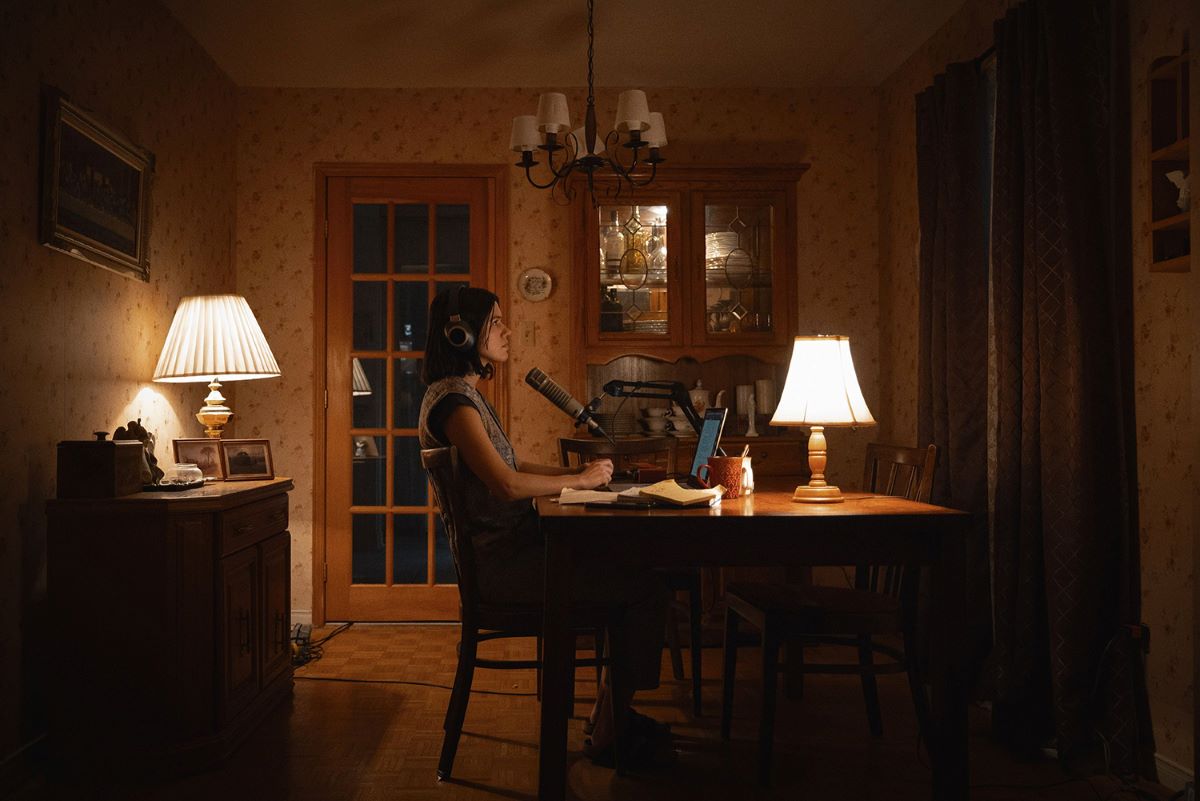
The simple, yet effective character dynamic is as old as “The X-Files.” Justin is more susceptible to believing in supernatural occurrences and folktales, whereas Eva won’t entertain anything that she can’t have proof of. What’s particularly clever about first-time writer/director Ian Tuason’s approach is that their relationship is baked into the premise of the podcast. Even though Eva lightly teases Justin for the sake of making an entertaining show, there’s also legitimate tension between them.
Eva rarely references her mother’s worsening state because it isn’t relevant to her listeners, which serves as an interesting commentary on the personas that media figures put on. Even if Eva and Justin have a more amateur production setup than a more professionally produced crime series, they’ve maintained a secular distance from any viewers. While the lack of detail given about their audience obscures what the potential reach and impact that their supernatural expose might have, there’s enough reason to believe that this is an important enough story that it would gain them more traction.
Also Read: The 7 Best Body Horror Movies of All Time
“Undertone” is light on the intersectionality that might have made Eva and Justin more interesting characters. The desire for Internet fame isn’t filtered through any specific class dimensions, and religion is only occasionally referenced for the sake of historical detail. The broader theme is one of maternity and loss, which is both a reckoning and a subversion of Eva’s relationship with her mother. Despite projecting confidence with both Justin and her prospective audience, Eva becomes nearly childlike when cradling her mother and attending to her needs.
Even if the backstory between them is lightly drawn, the strong acting on Kiri’s part is enough to sink an emotional hook. However, the specific paranormal case being described in the recordings is one of inversion, where phrases are spoken backwards, multifaceted messages are revealed, and history repeats itself. Kiri is both a child and a parent at once, feeling both the grief of an orphaned daughter and the terror of a potential parent. It’s an intriguing setup that is ambiguous enough to grant a generous reading of Tuason’s intentions.
Surprisingly, there’s actually a narrative justification for “Undertone” to avoid the obvious questions that most horror films face, such as “why not just call the cops?” Anyone with even a trace amount of editing or creative experience knows how impossible it can be to break from an all-consuming task, and Eva’s desire to receive definitive answers allows the situation to escalate into more unfathomable terror. There are also enough excuses for her to be in constant conversation.
While horror films often struggle with ways to justify their characters outwardly discussing or expressing their feelings, Eva is at most points either putting on the guise of a disaffected podcast personality or speaking with utmost sensitivity when addressing her mother. Enough good cannot be said about Kiri’s performance. Considering that she’s the only face onscreen for a majority of the film’s running time, it’s a testament to Kiri’s charisma, expressiveness, and authenticity that “Undertone” works as well as it does.
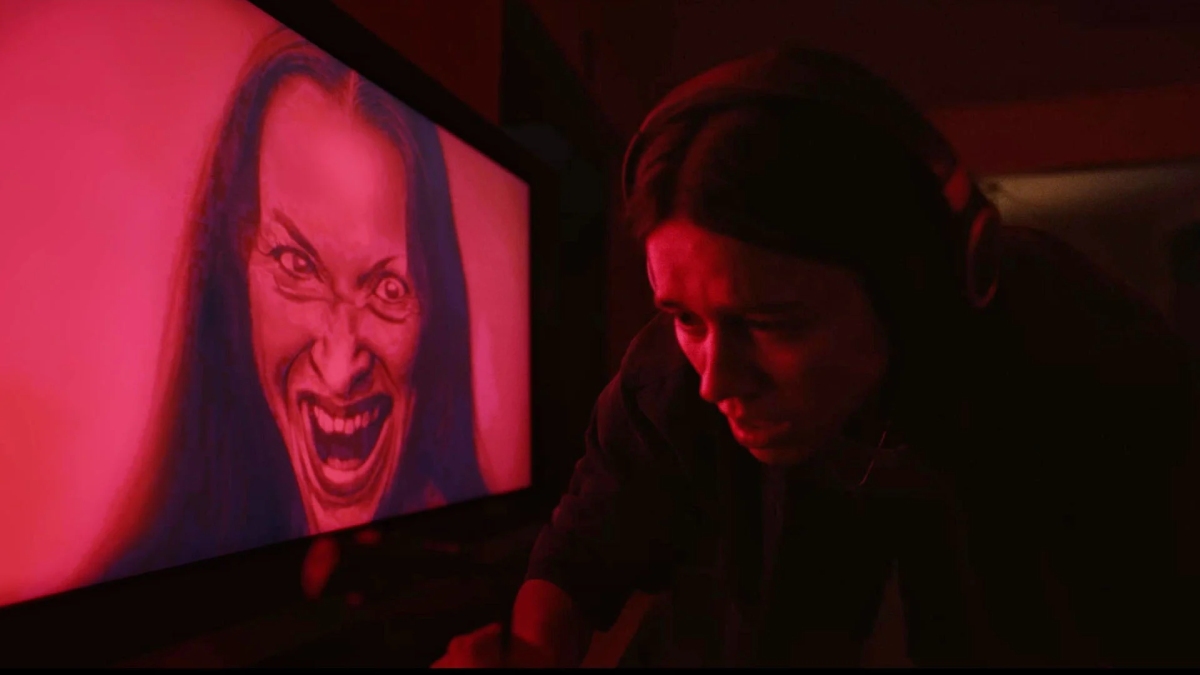
The issue that “Undertone” runs into is that its concept is, by its very nature limiting in what it can do. While there are more than a few creative ways in which the audio is doubled, recycled, and transcribed in order to evoke suspense, the scares become more predictable once a pattern is established. The few attempts to evoke something more visually upsetting are either ill-fitted for Tuason’s grounded approach or simply not scary enough to congeal with the story.
Although “Undertone” is a commentary on the way that people consume horror podcasts, it’s ironically a premise that could have very well succeeded in that medium. While there are visceral and emotional qualities that the film has that couldn’t have been taken advantage of in a purely audio format, the case against it being a cinematic work is made during the third act, which doesn’t pay off the mounting tension that had been building for the previous 90 minutes.
The best that can be said about “Undertone” is that it is both curious about a medium that is still evolving and deeply respectful of horror cinema, as Tuason’s influences seem to be all-time classics like “The Exorcist” and “Rosemary’s Baby,” as well as more recent hits like “Insidious” and “The Babadook.” Kiri’s performance is compelling enough to be locked into the character, which is often enough to overlook some of the subtext that doesn’t quite add up. It’s not a bad thing that “Undertone” very much feels like a first feature. Tuason is likely to make more horror films that may improve upon his ambitious debut’s shortcomings.



![Verdict [2019]: ‘TIFF’ Review – Authentic but Lacking](https://www.highonfilms.com/wp-content/uploads/2020/01/Verdict1-highonfilms-768x384.jpg)
![The Employer and the Employee [2021]: ‘Cannes’ Review – A Modest, Bleak Portrait of Class Privilege and Indifference](https://www.highonfilms.com/wp-content/uploads/2021/07/The-Employer-and-the-Employee-768x402.jpg)

![Geran [2020]: ‘NYAFF’ Review – Gritty action fails to disguise a predictable family drama](https://www.highonfilms.com/wp-content/uploads/2020/09/GERAN-Movie-Review-highonfilms-2-768x322.jpg)
![Upgrade Review [2018]: An Alarming Glimpse of the Near-Future](https://www.highonfilms.com/wp-content/uploads/2018/08/upgrade-screenshot-1-768x432.jpg)