Rian Johnson’s “Wake Up Dead Man,” from the “Knives Out” franchise, flips the narrative on its head in its final stretch. As Benoit Blanc (Daniel Craig) delivers his now-familiar closing monologue, it becomes clear that this was never a fiddly locked-room mystery. The crime that initially seemed contained and clever reveals itself to be part of a much larger scheme.
This time, however, the monologue doesn’t neatly tie everything together. Instead of offering all the answers, the truth emerges through a shocking confession from the most unlikely suspect that seals the fate of the crime and redefines everything that came before. The revelation doesn’t provide closure so much as it unsettles, leaving the audience with far more questions than answers.
Spoilers Ahead.
Wake Up Dead Man: A Knives Out Mystery (2025) Plot Summary & Movie Synopsis
Who is Father Jud Duplenticy?
“Wake Up Dead Man” opens with Benoit Blanc reading a letter written by Father Jud Duplenticy (Josh O’Connor). Through the letter, Jud recounts the incident that led to his reassignment. After a deacon crossed certain boundaries, Jud reacted violently and broke his jaw. As punishment, the Church sends him to a remote parish in Chimney Rock. Officially, Jud is responsible for managing church activities. At the same time, he is quietly tasked with keeping an eye on Monsignor Jefferson Wicks (Josh Brolin), whose congregation has been shrinking in ways that raise concern.
From the moment Jud arrives, something feels off. The church does not operate like a place of guidance. Wicks has turned it into a closed system built on control. Jud begins hearing confessions from Wicks, who speaks repeatedly and casually about his masturbation habits. These confessions carry no remorse and no reflection. Gradually, Jud realises that Wicks has formed a tight inner circle and refuses to allow anyone new into it.
Who all are part of the Flock?
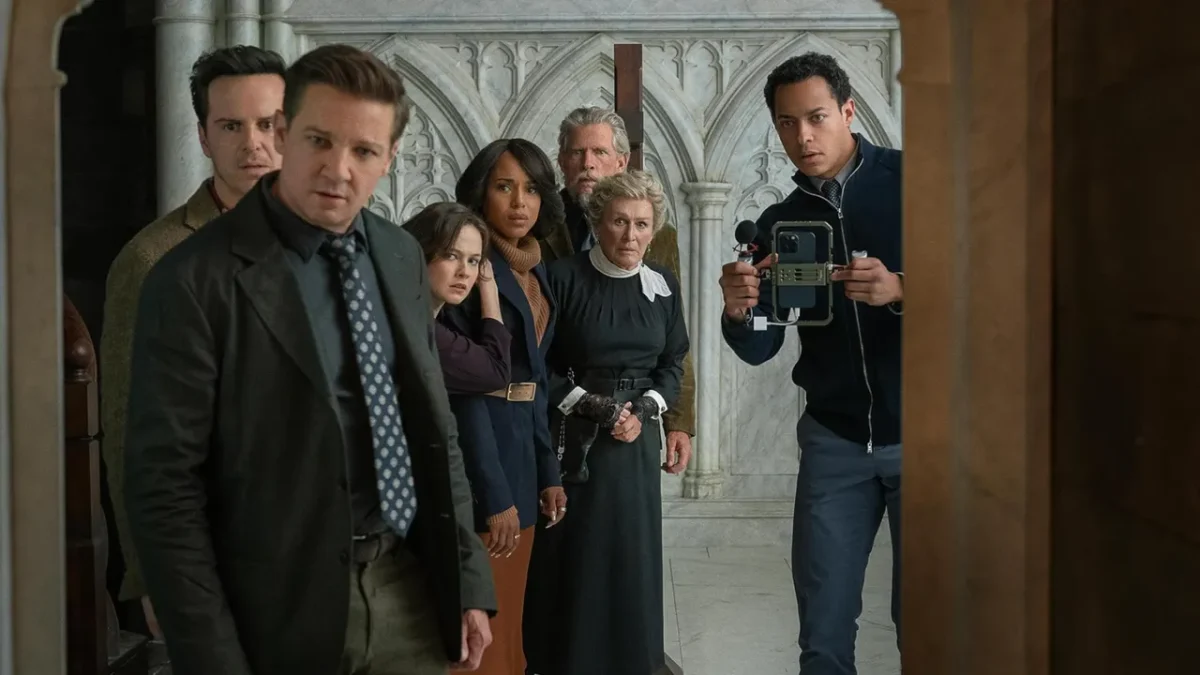
At the centre of this circle is Vera Draven (Kerry Washington), a powerful local attorney who appears to be Wicks’s closest ally. Vera has an adopted son, Cy (Daryl McCormack), a failed politician now chasing relevance as an influencer and vlogger. She accepted Cy into her life when she was ten after her father brought him home one day.
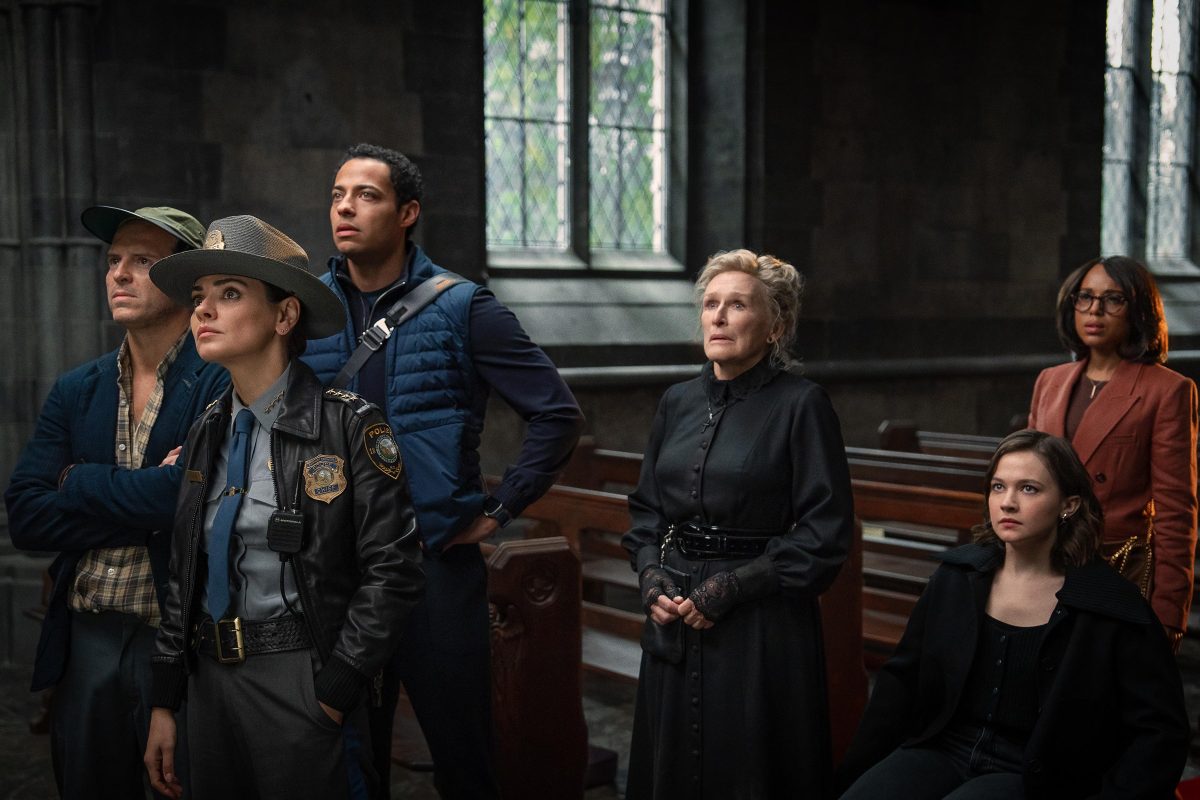
Also part of the flock is Nat Sharp (Jeremy Renner), the town’s doctor. His wife left him and moved to Tuscany with their children, and his rejection has curdled into resentment. Lee Ross (Andrew Scott), a once-celebrated science fiction writer, is also among Wicks’ chosen few. His books were once wildly popular, but declining sales and the fear of irrelevance have affected him with paranoia. Completing the circle is Simone Vivane (Cailee Spaeny), a world-class cellist forced into early retirement five years earlier after a devastating injury.
As Jud settles into parish life, his unease deepens. He reviews Wicks’ medical records and discovers that a past surgery has left the Monsignor physically incapable of an erection. This discovery casts Wicks’ confessions in a disturbing new light. Jud becomes increasingly alarmed by the way Wicks controls his flock. Nat grows openly misogynistic. Lee’s paranoia intensifies. Simone pours large donations into the church, holding onto the hope that faith might bring about a miracle. Meanwhile, Cy begins using the church for online content, misrepresenting its teachings in ways that quickly turn dangerous.
What happens on Good Friday?
Jud reaches a breaking point. He decides that Wicks must be removed and vows to cut him out like a cancer. Before Jud can act on this resolve, Wicks is found dead on Good Friday. He has been stabbed with a knife bearing the Devil’s head, a symbol that immediately casts a shadow over the entire parish. Suspicion spreads through the flock, as each member carries resentment and motive.
However, the focus quickly shifts to Jud when Cy uploads a recorded video of Jud’s threat. The clip goes viral, and Jud emerges as the prime suspect. With his faith, freedom, and integrity under threat, Jud turns to Benoit Blanc for help. Together, they begin peeling back the layers of secrecy, resentment, and control that define Chimney Rock.
As Blanc’s investigation progresses, the situation escalates. Two more deaths follow, each tightening the grip of fear and suspicion. A supposed heavenly miracle further complicates matters, blurring the line between faith and manipulation. Gradually, Blanc uncovers the true motive behind the crimes, one rooted in collective hatred and moral decay rather than a single act of evil. The truth ultimately comes to light through a voluntary confession from the most unlikely suspect, reshaping everything that came before and leaving the congregation and the audience unsettled long after the final revelation.
Wake Up Dead Man (2025) Movie Ending Explained:
Why does Martha kill herself? What Happens to the Jewel?
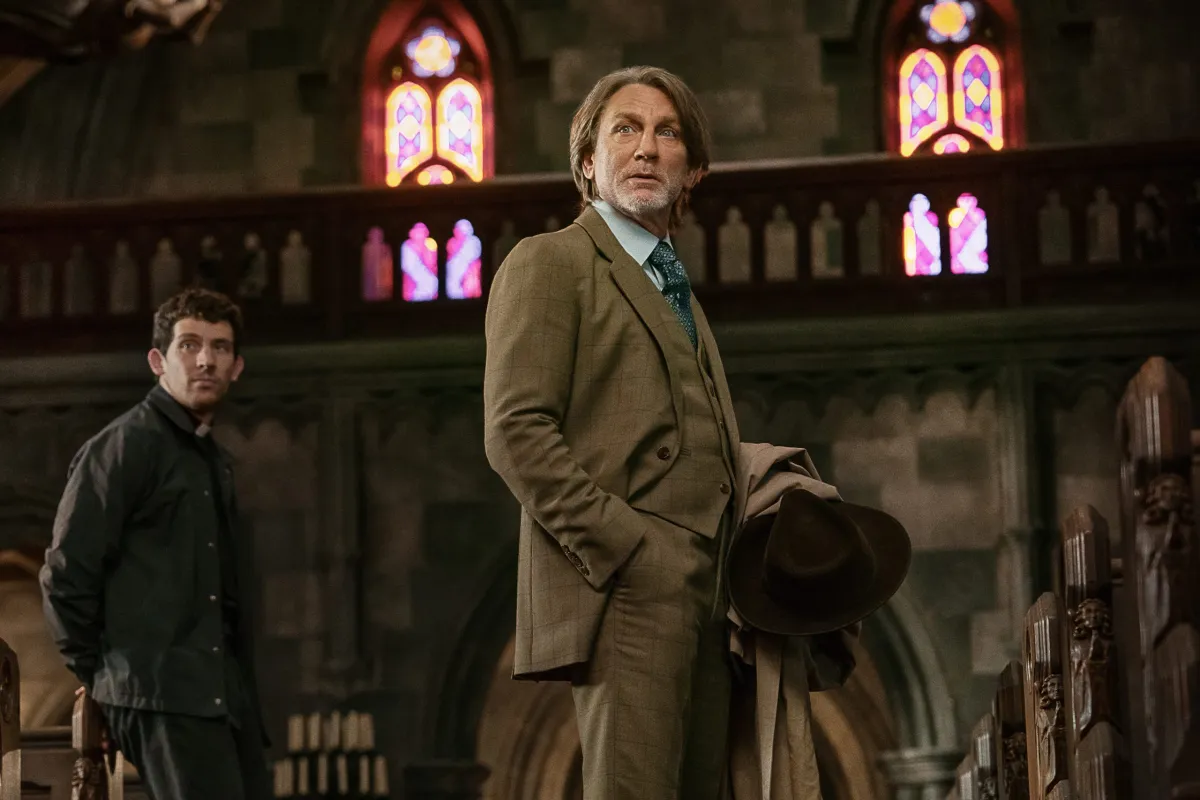
After Jefferson Wicks’ body inexplicably returns from the dead, the investigation unravels even further when the church groundskeeper, Samson Holt (Thomas Haden Church), is found dead soon after. Father Jud believes he understands what happened. Since he was present at the scene and held the dagger, he assumes that he is responsible for Samson’s death. Overwhelmed by guilt and convinced that confession is the only path left to him, Jud insists on surrendering himself. Blanc intervenes before this confession can take place and instead lays out the full sequence of events.
Also Related: The 10 Best Daniel Craig Movies
Blanc reveals that Wicks was never stabbed at the moment he collapsed. When Wicks entered his private chamber in the church to drink, as he often did, the alcohol had already been spiked by Nat Sharp with a powerful tranquilizer. Wicks lost consciousness but remained alive. Nat had arrived with another devil-faced knife. When Jud later came to check on Wicks’ body, Nat prevented him from intervening. Nat then removed the knife already present at the scene and stabbed Wicks with a different blade in order to manipulate the timeline and redirect suspicion.
Even with this revelation, the case remains incomplete. Nat and Samson are both dead, and their deaths do not align cleanly with motive alone. At this point, Blanc turns his attention to the one person who has remained in the background throughout the chaos. He asks Martha to confess of her own free will, and she does. Martha’s confession reaches back more than sixty years.
Jefferson Wicks’ grandfather, Reverend Prentice, was the founding patriarch of the church. When he arrived in Chimney Rock, he was already widowed and raising a daughter named Grace. Grace loved luxury, provocative fashion, and a lifestyle that openly defied the church’s rigid morality. She became pregnant by a drifter, and if she remained under Prentice’s roof, his fortune would legally pass to her. Grace waited for her father’s death, believing inheritance was inevitable.
Prentice, deeply fearful of corruption and moral decay, made a drastic choice. He swallowed his will by encasing it inside a jewel and carried it to his grave. The fortune became unreachable, hidden within his body and sealed underground. Martha, who was close to the family and devoted to the church, learned of this secret and carried it alone for decades.
For sixty years, Martha protected this truth in silence. However, when Father Jud confronts her and urges honesty, she panics. Instead of confessing publicly, she confesses privately to Wicks. That single mistake destabilizes everything. Around the same time, Wicks discovers that Cy is his biological son and accepts him openly. To Martha, this signals danger. She becomes convinced that Wicks will exhume his grandfather’s grave, retrieve the jewel, and reclaim the fortune.
Driven by fear and by her rigid sense of moral guardianship, Martha orchestrates Wicks’ murder and recruits Nat to help her. Her plan extends beyond Wicks’ death. Samson, who loved Martha deeply and unquestioningly, was meant to retrieve the jewel from Prentice’s grave and place it inside Wicks’ casket so that Martha could destroy it forever. However, Samson’s unexpected death shatters the plan entirely. Nat’s involvement escalates beyond control as greed overtakes him.
Faced with the unintended consequences of her actions, Martha kills Nat. Soon after, overwhelmed by grief and horror, she poisons herself. Her suicide was her final reckoning. Martha has lived a life defined by devotion, repression, and judgment. Watching Samson die devastates her because his love was sincere and selfless. In her final moments, she also confronts her lifelong cruelty toward Grace, whom she had branded a harlot and a disgrace while ignoring her own role in perpetuating harm.
After Martha’s death, Father Jud restores the church by placing a new Christ idol where the old one once stood. Grace had destroyed the original idol in rage after discovering that the fortune was lost forever. The jewel, retrieved at last, is placed within the heart of the new Christ figure. It remains sealed inside the church, no longer a source of greed or inheritance, but a reminder of faith corrupted by control and reclaimed through truth. In the end, the jewel does not return wealth to anyone. Moreover, it has now become a symbol of atonement, resting where it can no longer be weaponized.
Why does Nat kill Samson?
Nat kills Samson for one reason, and one reason alone. He sees an opportunity to turn someone else’s carefully controlled plan into a permanent escape for himself. Martha’s plan was precise and limited in scope. After Jefferson Wicks’ death, Samson was placed inside Wicks’ grave. His role was simple. He was meant to retrieve the jewel hidden with Reverend Prentice’s remains and then come out with it. Samson would emerge with the help of Nat, and the jewel would be destroyed. The secret that had haunted the church for decades would finally disappear. No one else was meant to be involved. No additional blood was supposed to be spilled.
Read: Every Rian Johnson Film (including ‘Wake Up Dead Man’) Ranked Worst To Best
That plan collapses the moment Father Jud arrives at the gravesite by accident. Jud, already shaken by Wicks’ apparent resurrection, walks into a scene he cannot fully process. Sensing immediate danger, Nat acts on instinct and strikes Jud, knocking him unconscious. Because Jud already believes that Wicks has risen from the dead, his memory of the incident becomes fragmented and unreliable. Nat recognizes this instantly. He understands that Jud’s confusion can be weaponized.
At that moment, Nat makes a calculated decision. Instead of helping Samson finish Martha’s plan, he chooses to rewrite it entirely. Samson becomes a liability. As long as Samson is alive, the truth about the jewel and the staged resurrection can still surface. Nat also knows that Jud is already under suspicion for Wicks’ murder.
If Samson dies and Jud is found near the scene, the narrative will write itself. Nat kills Samson and reframes the crime in his own mind as a necessity. With Samson dead, there is no one left who can confirm the original plan. Jud, already branded a threat, becomes the perfect scapegoat. Nat believes that Jud will be convicted easily, the investigation will end quickly, and the deeper secret surrounding the jewel will remain buried.
Greed is the final push. Nat convinces himself that the jewel also represents a chance at redemption in his own life. His wife left him, took their children, and judged him as inadequate. The fortune tied to the jewel becomes, in his mind, a way to reclaim what he lost. That temptation overrides any remaining loyalty he has to Martha or Samson.
He abandons the plan he agreed to and designs one that benefits only himself. What Nat fails to consider is the emotional cost of his decision. He underestimates Martha completely and assumes that her devotion to the church will outweigh her attachment to Samson. He does not account for the depth of her love or the devastation she will feel when Samson dies. However, he inevitably triggers Martha’s final reckoning and digs his own grave in the process.
How does Wicks wake up from the Dead?
In “Wake Up Dead Man,” Jefferson Wicks never wakes up from the dead. The illusion of his resurrection is entirely manufactured, and it exists because his body is secretly replaced. When Wicks is first discovered, he is already dead. Nat Sharp’s tranquilizer ensures that the timing of the death remains unclear, but the fatal stab ultimately kills him. There is no moment where Wicks regains consciousness. The so-called miracle begins later, after burial, through a simple process of substitution.
Martha’s larger plan relies on this substitution. After Wicks is buried, Samson Holt is placed inside Wicks’ grave. Samson is meant to retrieve the jewel hidden with Reverend Prentice’s remains and then take Wicks’ place in the coffin. Once the jewel is recovered, Wicks’ body is to be removed quietly and destroyed, while Samson emerges from the grave.
To the outside world, this emergence is meant to appear as Wicks returning from death. Martha intends to control the narrative immediately. She plans to declare that Wicks has ascended to heaven through a miracle of Jesus, leaving behind an empty grave. The resurrection was meant to rekindle people’s faith. The absence of a body would be framed as proof of divine intervention, closing off any demand for further investigation.
Nat is central to selling this illusion. As the town’s doctor, his authority would confirm that Wicks had been medically dead and that no natural explanation could exist for an empty grave. Faith would override reason. The church would regain power and legitimacy, and the story would solidify before anyone could challenge it.
However, this plan collapses when Nat allows greed to overtake him. Instead of preserving the substitution quietly, he interferes with the sequence. His actions introduce violence and chaos, leading to Samson’s death and dismantling the illusion before it can be fully established. With Samson dead, there is no controlled “resurrection,” only confusion and suspicion.
Because the substitution fails, the mystery appears supernatural rather than symbolic. Wicks’ emergence becomes a rumor rather than a doctrine. The narrative Martha intended never stabilizes, leaving behind unanswered questions and escalating deaths. And when Martha confesses, the truth becomes painfully clear. Wicks never rose from the grave. His resurrection was a planned fiction built on substitution, timing, and authority. The miracle was never meant to save a soul. It was meant to protect a secret and preserve control over the church.
Check Out: The Best Josh O’Connor Movie Performances, Ranked
Why does Martha kill Nat?
Martha kills Nat because the final boundary she believed she could live with is crossed the moment Samson dies. Until that point, Martha had justified every action as necessary and ultimately in the service of the church. Nat’s decision to kill Samson and frame Father Jud destroys that internal logic completely.
After Samson’s death, Martha is no longer operating from a strategy. Guilt overwhelms her. She recognizes that the plan she initiated has escaped her control and has turned into something openly predatory. She confronts Nat, expecting denial or fear. Instead, Nat admits everything without hesitation. He confirms that he killed Samson deliberately and that he intends to let Jud take the blame. He frames it as survival and opportunity rather than betrayal.
During this confrontation, Nat reveals one final calculation. He tells Martha that he has already poisoned her coffee. He presents it as mercy. According to him, she will feel no pain and will be allowed to rest. In his mind, this is the cleanest ending. Nat will walk away with the jewel and the fortune, Jud will be convicted, and Martha will disappear quietly, taking the secret with her.
This is the moment that breaks her. Martha’s faith, discipline, and lifelong repression give way to something raw and uncontrollable. She understands that Nat does not see Samson as a loss or Jud as a human being. He sees them only as obstacles. The moral framework she clung to for decades collapses entirely. Vengeance becomes personal rather than righteous.
Martha decides that Nat will not dictate the ending. When Nat looks away, she switches the coffee mugs. Through this act, she ensures that the final act of violence belongs to her. Whatever story the crime scene eventually tells, the truth remains that she chose justice on her own terms. However, killing Nat does not restore anything. Martha has no desire to survive the aftermath. She understands the full weight of what she has done. Her lies set the chain in motion. Her plan led to five deaths. She devoted her life to the church while turning it into a machine that consumed the people around her.
Martha witnessed Reverend Prentice die while clinging to rigid morality. She watched Grace be shamed and erased for refusing submission. She killed Wicks herself and eventually lost Samson, the only person who loved her without condition. Finally, she ended Nat’s life in vengeance. The church she defended for decades now stands as the common thread linking every loss. That realization leaves her with no will to continue. Having reclaimed control in her final act, Martha chooses rest, and her death becomes a surrender to the truth she had avoided for sixty years.
What happens to Father Jud and the Flock?
After the chain of deaths that follows Jefferson Wicks’ murder, the church is left emptied of power games, secrets, and manipulation. Nat, Samson, and Martha are gone. What remains is Father Jud, standing alone in a place that had long confused control for faith. The ending makes it clear that Jud survives because he is morally intact. There was never any malice in his behavior.
Jud emerges as the only character who consistently feels the weight of other people’s pain. He never seeks authority, loyalty, or hierarchy. Unlike Wicks, he has no interest in cultivating a chosen flock or shaping belief to serve his own image. His instinct is pastoral rather than managerial. He listens, he doubts himself, and he carries guilt even when it does not belong to him.
With Wicks gone, the church begins to breathe again. The flock had been psychologically restrained for years, trained to depend on fear, shame, and selective grace. Once that pressure disappears, clarity follows. The people who once orbited Wicks’ authority start making choices grounded in reality rather than superstition or desperation. Simone Vivane no longer waits for divine intervention. Instead of donating money in exchange for hope, she returns to her cello. Her recovery is slow and imperfect, but at least it is real. Lee Ross finds his footing as well.
Also Read: The 10 Best Comedy Movies of 2025
Freed from paranoia and moral stagnation, his writing reconnects with an audience. His success is now earned and not something miraculous. Vera Draven steps into a new phase of her life, no longer defined by proximity to Wicks or the church’s internal politics. Each of them moves forward without needing Jud to lead them. Jud does not rebuild the church as a power structure. He runs it quietly, ethically, and without spectacle. Faith, under his care, becomes personal again, and nothing about his authority is performative.
Cy, however, stands apart. As the only heir connected to the original will, he remains unsettled. His obsession with the jewel continues, and he watches Jud closely, convinced that the truth still lies hidden. What Cy does not know, and will never discover, is that the jewel now rests inside the heart of Christ within the church itself. It has been removed from circulation entirely, transformed from an object of inheritance into a silent symbol.
Benoit Blanc recognizes this balance before he leaves. The mystery is solved, the danger neutralized, and the future stable. Jud will not exploit the truth, and Cy will never find what he is looking for. Satisfied that the story has reached its moral conclusion, Blanc steps away, ready to face the next twisted case when the time comes.
Wake Up Dead Man (2025) Movie Theme Analyzed:
The Exploitation of Blind Faith
The central theme of “Wake Up Dead Man” is the exploitation of blind faith and the damage it causes when belief replaces thought. Throughout the film, faith is not portrayed as inherently dangerous. Instead, the danger lies in how easily it can be weaponized by those who crave control. Jefferson Wicks runs his flock less like a church and more like a cult.
He does not guide people toward spiritual clarity. He conditions them to surrender autonomy. His authority thrives on fear, secrecy, and selective reassurance. Wicks offers promises of miracles, forgiveness, and belonging, but only on his terms. The flock is encouraged to believe without questioning, and that unquestioning belief slowly erodes their moral compass. Their faith becomes transactional, dependent on obedience rather than understanding.
Martha represents a different, quieter form of the same exploitation. Her devotion is absolute, rigid, and deeply fractured. She convinces herself that she is protecting the church and serving Christ, yet her actions are rooted in judgment and repression. Her lifelong shaming of Grace is driven by moral superiority disguised as righteousness. Grace’s only crime is rebellion and desire for a life outside imposed purity. Martha’s faith gives her justification to destroy someone innocent while believing she is preserving sanctity.
The tragedy deepens with Samson. His involvement stems from love and not belief. He trusts Martha completely, and that trust becomes fatal. Martha’s blind faith, mixed with secrecy and fear of corruption, pulls Samson into a plan that ultimately costs him his life. The film makes it clear that faith, when detached from accountability and empathy, does not remain personal. It spreads outward and consumes others.
Every major tragedy in the film could have been avoided through logic, transparency, or simple questioning. However, characters defer to belief systems that discourage doubt. And, it is this refusal to think critically that allows manipulation to flourish unchecked. Father Jud stands as the sole counterpoint. His faith is grounded in redemption, and he never seeks authority. He does not see Christ as a figure of fear or a tool for obedience. He sees faith as a path forward, something that encourages responsibility and compassion. Jud questions, hesitates, and feels guilt. Those qualities make him human rather than holy, and that humanity becomes his moral anchor.
“Wake Up Dead Man” does not condemn faith itself. It condemns the comfort of surrendering thought. When belief is handed over without reflection, it becomes an instrument of harm. When faith is paired with conscience, it becomes a way out.


![Yeh Ballet [2020] Netflix Review – A typical underdog tale laden with umteenth cliches](https://www.highonfilms.com/wp-content/uploads/2020/02/Yeh-Ballet-Netflix-768x427.jpg)