From the second “Without Kelly” (Utan Kelly, 2026) whispers its opening note to its last echoing frame, the film feels less like a story and more like an emotional atmosphere you step into with hesitant breath, and what hits first is this crystalline, almost physical sense of absence and longing that doesn’t shout at you. But it instead settles around your ribs and makes you feel the weight of a mother’s yearning in the silent spaces between the visuals, because Lovisa Sirén’s direction invites us to inhabit her inner geography of love, loss, and the fragile architecture of identity when one of its central pillars is temporarily removed.
In its fifteen-minute span, Sirén transforms what could be a simple narrative about separation into a visceral meditation on what it means to be tethered to another human being in mind, body, and spirit. It’s a tether both nurturing and haunting, and through that lens one starts to notice how every choice, from the lingering shrug of a gaze to the rhythm of footsteps on an empty street, feels charged with an unspoken language of anxiety and devotion that cinema rarely renders so keenly. It’s so quietly intent on capturing the whisper of a pulse rather than the thump of a plot point.
The story, centering on Esther having to leave her daughter Kelly in the care of the father for the first time and then navigating the long ache of that absence through the night, could’ve been simple. However, Sirén and cinematographer Christine Leuhusen craft it so that every moment feels like an excavation of feeling, where the camera feels with Esther, tracking her in close, urgent compositions that make you sense her thirst for connection like a physical ache, sometimes tender, sometimes jagged. Even when everything in the frame looks calm on the surface, human emotion defies tidiness.

What sets “Without Kelly” apart is the quiet discipline with which it stays inside its central moment instead of reaching outward for drama. The film does not add subplots or emotional peaks to make the separation feel important. It trusts that the moment already is. Sirén builds the film around attention rather than action, allowing meaning to surface through time passing and through Esther’s repeated movements within the same spaces. We watch her enter her apartment, move from one room to another, sit, stand, pause, and wait, and each of these ordinary actions feels slightly altered by the fact that Kelly is not there.
“Without Kelly” is a meditation on the ways love persists in absence. At the same time, it also examines how memory, embodiment, and anticipation shape our experience of time. Chairs, doors, and even the light from a streetlamp become markers of absence. Yet they also carry traces of presence: the faint impression of a child’s laughter, the imagined weight of a hand reaching for hers. In this way, the film explores memory as a living force, one that shapes perception as much as physical reality. The spaces we occupy are never neutral. They retain the imprint of those we care for, and absence only sharpens that effect.
So, the film also draws attention to embodiment in an understated but compelling way. Love is presented as a bodily experience: the rhythm of a heartbeat that quickens with thought, the way hands linger in the air as if expecting touch, the restless pacing that inhabits quiet rooms. In these moments, the absence of Kelly is felt as something physical, a tension that runs through the body rather than being confined to thought or emotion. There is an almost literary precision here, reminiscent of Woolf’s ability to transform domestic spaces into vessels of psychological and emotional life.
The physical intimacy, we find, far from conventional or sensationalised, functions as an intimate study of connection, embodiment, and feminine experience, while subtly resonating with Esther’s identity as a mother. The scene does not present desire as performance or conquest, but as a deeply lived and attentive presence, where every gesture and movement carries meaning. Esther inhabits her body fully, aware of her breathing, the pressure of touch, and the quiet rhythms of proximity, while her awareness extends simultaneously to her memories and ongoing maternal care.
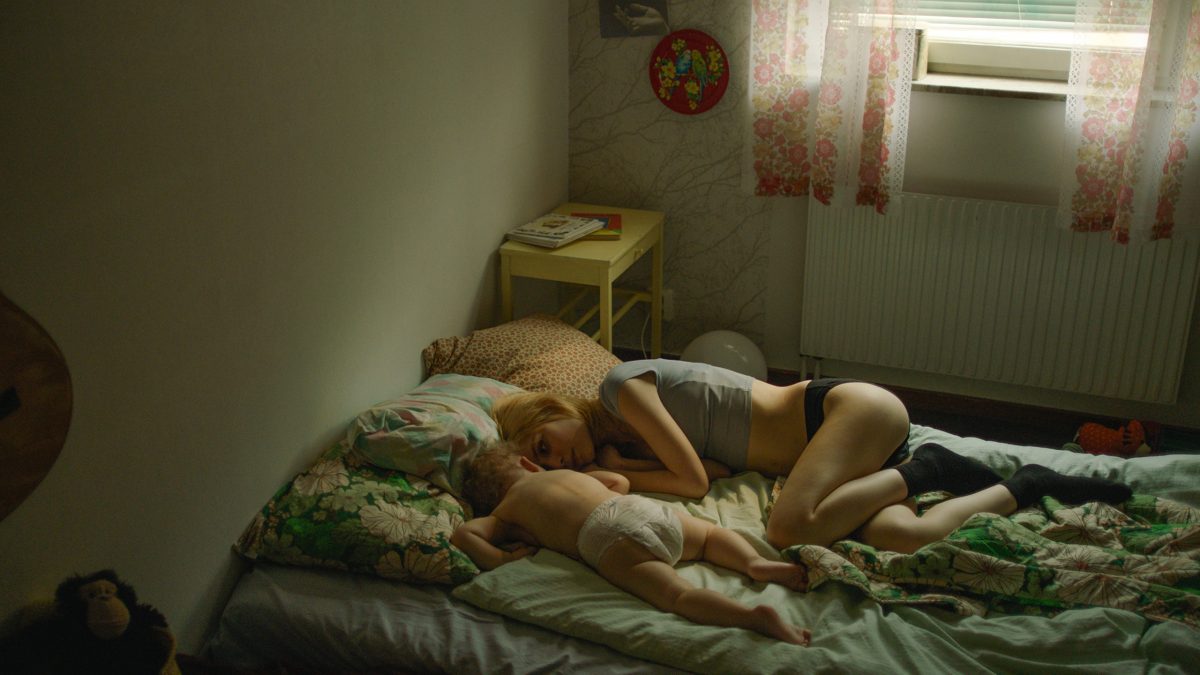
Her bodily experience of desire exists alongside the imprint of Kelly’s absence, suggesting that motherhood and sexual intimacy are not separate spheres, but overlapping registers of attention, memory, and relationality. The tenderness she brings to her partner mirrors the attunement she has developed as a caregiver, and the scene frames this continuity with subtlety and care, showing how love, in its many forms, inhabits the body, shapes perception, and is remembered even when its immediate object is elsewhere.
Sexuality in this context becomes inseparable from memory and corporeal knowledge. Just as Esther’s movements and gestures in the apartment are informed by her daughter’s presence even in her absence, the physicality of intimacy is informed by the traces of maternal experience. Each touch, glance, and pause carries a dual awareness, of the self and of those who have shaped that self through care and attachment.
In this way, the film presents feminine desire as reflective, embodied, and relational, showing that pleasure and tenderness are experienced not only in the moment but as accumulated and remembered, informed by the ongoing rhythms of love and caregiving.
What “Without Kelly” resists most deliberately is the impulse to transform separation into crisis. There is no narrative pressure to overcome the absence, no emotional climax that promises release. Instead, the film treats separation as a temporary reconfiguration of being, something that must be endured rather than solved.
This restraint allows the experience to remain grounded and recognizable. Esther’s love for Kelly does not intensify through suffering, nor does it require expression through visible anguish. It simply continues, steady and unbroken, even when its usual rhythms are interrupted. “Without Kelly” is an emblem of attachment that paints a picture of the articulation of love in the moments of distance, dramatising this truth.




![Incredibles 2 [2018] : An Admirable Sequel to Its Classic Predecessor](https://www.highonfilms.com/wp-content/uploads/2018/06/thumb-1920-927008-768x402.jpg)

![Fighter [2021]: ‘NYAFF’ Review – Paints a Light on the Unseen Battles](https://www.highonfilms.com/wp-content/uploads/2021/08/Fighter-2021.jpeg)