
Nowadays, low-budget horror is associated with quick turn-arounds, kitchy ideas, public domain IP, and a focus on cheap scares and gore. However, “Worm,” the debut feature from filmmaker Ned Caderni, opts for the exact opposite. He spares no time informing the audience of this fact. The film opens with a 90-second overture before presenting us with a singular static shot of the doorway to a small bedroom. Over the course of the six minutes, we see a young, soon-to-be couple returning from a date.
As their evening grows more intimate, their conversation more personal, it starts to feel like we are intruding on a private moment. The longer we hold, the worse we start to feel. It’s a tender and intimate moment that Caderni makes us feel horrid for being a part of. When we finally cut to the next scene, you can’t help but let out a sigh of relief. The opener acts as an audience litmus test. If you found the past six minutes to be enthralling and unnerving, then sit back and enjoy the next eighty minutes of skin-crawling tension and digital terror.
Despite the cute setup, this arthouse horror is anything but romantic. The story is simple: Bella and George are celebrating their first anniversary and decide to go on a little getaway to the Welsh countryside. On the first morning, Bella receives a mysterious email from the address of her high school sweetheart, David, who died suddenly when they were eighteen. This sets into motion a chain of events that turns a romantic getaway into a hellish few days. As the emails become more frequent, Bella becomes convinced that David’s spirit might not be gone, and the relationship between her and George starts to buckle.
“Worm” is very much an atmosphere-first horror film and an effective one at that. The film is soaked in a constant sense of dread. The slow burn unfolding of the narrative keeps ramping up the tension to a suffocating degree. Obviously, the more we learn about their past, the more the feeling of isolation intensifies. The hyper-naturalistic dialogue is laced with a passive-aggressive venom, and after a certain point, every interaction is motivated by paranoia and mistrust.
Caderni’s improv-heavy direction allows leads Freddie Acaster and Joshua Dowden (Bella and George) to turn in incredible performances. The chemistry that both leads have is fantastic, and every argument, odd glance, and moment of ill-fated romance feels very authentic. Bella’s increasingly fragile and distraught state as she slowly realises her true feelings, paired with George’s spiralling insecurity and spinelessness, lends itself very well to the slow-burning horror. The house the couple occupies starts to feel like a cage that is slowly shrinking and shrinking, a powder keg halfway ready to explode.
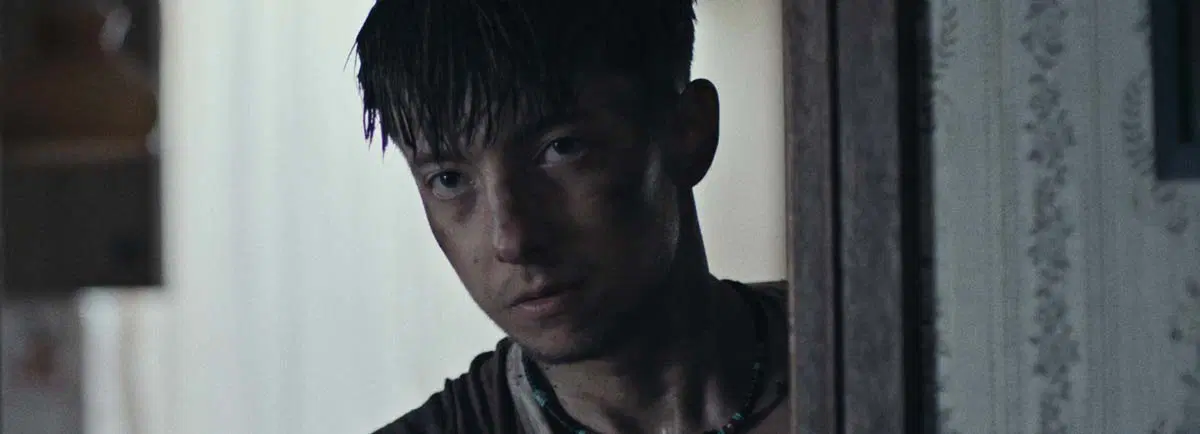
The themes of memory and secrets being kept alive by the digital realm link well with our couple on the rocks. It poses questions of whether we can ever leave our past behind in the digital era, our skeletons and ghosts always haunting us in the form of zeros and ones and grainy webcam footage. In this new world, it’s not a matter of if your secrets will appear like a digital apparition to haunt you. It’s simply a question of when. It pushes relationships to their breaking point, even when you think the noise is behind you, echoing the film’s tagline: ‘Your past isn’t dead, it’s rendering.
Cinematographer Edward Glynne Jones places us at an uncomfortable distance away from the couple, and when paired with the glacial shot lengths, a sense of uneasy voyeurism sets in. The camera and, by extension, the audience are turned into an unwilling predator stalking its prey. This results in skin-crawling moments of voyeuristic horror, capturing the hellish domesticity of this relationship.
The idyllic Welsh coast is rendered almost nightmarish. Our characters always feel so tiny in the frame, dwarfed by the barren landscapes of grasslands, rocks, and water. Their surroundings feel both beautiful and terrifying, with imagery that reminded me of a fresh re-imagining of elements from Bergman’s “The Wolf House,” Weerasethakul’s “Memoria,” and “The Blair Witch Project.”
The mysterious emails Bella receives contain videos of familiar places, yet each piece of footage feels so alien. The majority of the film holds a sterile digital look, a look that makes everything feel so stark, especially paired with the black and white. But when we switch to the videos sent from beyond the grave, the grainy, opaque nature of what we are seeing turns the mundane into something deeply unnerving.
Quite a few recent British indies feel non-committal, hesitant to fully embrace their arthouse tendencies while also holding back from leaning into the genre elements that might give them wider appeal. The result is a wave of films that lack assurance and coherence. This is where “Worm” and director Ned Caderni stand out to me.
Caderni and his collaborators draw on a range of filmic influences, from Bergman, Weerasethakul, Brakhage, and Snow, blending them with contemporary digital sensibilities to create a remarkably assured piece of arthouse horror. There is a carefully calibrated synergy at work, shaping an atmospheric nightmare of a weekend. In an industry with so many barriers to entry, filled with risk-averse films that draw from the same formal lexicon, “Worm” stands out as one of the most refreshing debuts in British arthouse cinema in recent memory.


![The Last Queen [2022]: ‘Venice’ Review – A Highly Engrossing Period Drama from Algiers](https://www.highonfilms.com/wp-content/uploads/2022/09/The-Last-Queen-2022-1-768x416.jpg)
![Moving On [2019] Review – A Tender Family Drama Reminiscent of Hirokazu Kore-eda’s Works](https://www.highonfilms.com/wp-content/uploads/2021/10/Moving-On-2019-1-768x432.jpg)