
Storytelling has always been central in human evolution. It’s how we made sense of our world and passed on knowledge to future generations. However, not everyone could have access to these avenues as others. Men who often stayed in power maintained that power by controlling how these stories were shared, focusing on their random acts of heroism while avoiding any blame.
It persists to date, where technocrats are taking charge of the media to suit their agenda and to portray themselves in a particular light. Julia Jackman’s “100 Nights of Hero” addresses the power and importance of storytelling in the same vein, where women take charge of their stories by preservation. It explores that theme through a farcical romp based on Isabel Greenberg’s graphic novel.
Jackman’s script doesn’t place itself in any specific historical setting and doesn’t declare itself as a takedown of any particular era either. That allows it to introduce a timeless indictment of male privilege, tonally similar to the Elle Fanning-led series, “The Great.” The story hinges on the dynamic between Cherry (Maika Monroe) and Hero (Emma Corrin), two polite and docile figures in a royal palace. Cherry is introduced as someone who acts only as she is expected or told to, thus shy and reserved to a fault. Hero, who works in the castle, is her close friend, devoted to her well-being, unlike her husband Jerome (Amir El-Masry), who remains frustratingly absent from her life.
Hero fulfills her duties as a doting maid. Yet, despite the expected subservience, she doesn’t shy away from standing up for Cherry when Cherry can’t. It becomes clear early in the film that Hero is defiant and ready to fight the world if need be for Cherry. She appears to be the antithesis of Jerome, who is defined by his eternal absence.
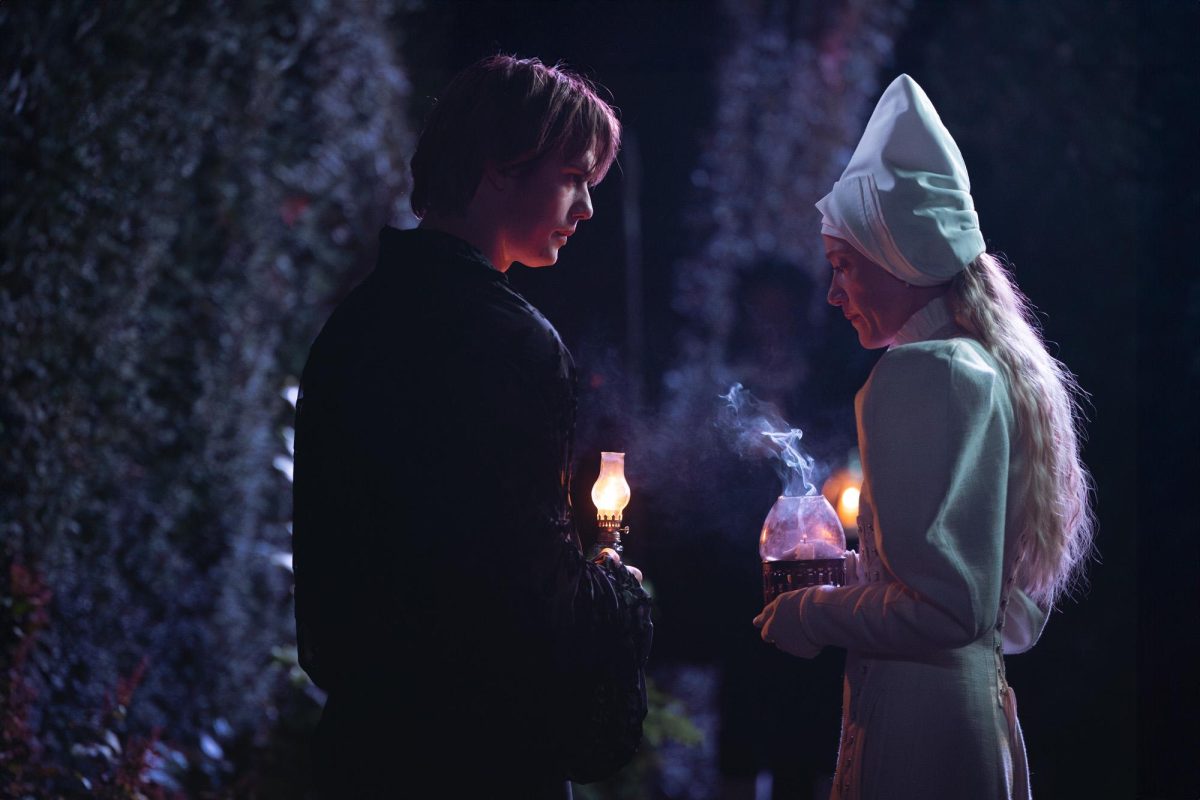
Her dynamic with Cherry is complicated further when Manfred (Nicholas Galitzine) arrives there, almost as a replacement for Jerome. He appears as per the classic image of a knight in shining armour, hunky and endlessly appealing. Yet, he is far from a savior. He is haughty with a boundless, unearned confidence, owing to his male privilege more than his physique. So, we must have seen a version of him somewhere around us.
Also Read: Why Punch-Drunk Love (2002) is the Greatest Romcom of All Time?
Manfred’s arrival throws Cherry in a bind. On one hand, there’s this conventionally irresistible man, who seems willing to be with her in ways that Jerome may never be. Yet, there’s Jerome, with whom she is dutifully bound as a bride. She lives in a world with not even an illusion of free will, where choices are always made for her.
There’s no scope for imagination since women are barred from even the usual avenues of education and are demeaningly reduced to being means for procreation. Jackman’s film may not be the first film to address these dehumanizing notions toward women and scrutinize male privilege, but it’s one of the most stylistically intriguing for sure.
Jackman paints this whimsical world with Susie Coulthard’s fascinating costume design, filled with a variety of textures, shapes, and colors that enhance its overall appeal. They draw our attention through their innate oddness or austerity, which also helps with the film’s narrative tone. A character appears vulnerable, resolute, or docile in certain situations, even through their garments.
Xenia Patricia’s cinematography builds on that stylistic framework through light and framing choices that convey the inherent tenderness or humor of the moment. You feel the sheer absurdity of Manfred’s cognitive dissonance, mistaking his naivety for heroism, through how he is positioned in frames, even before Galitzine could say a word.
The film, however, falters due to its undefined narrative tone. It begins Cherry’s story in an absurdist fashion, similar to Olivia Colman-led “The Favorite,” but never becomes a similarly full-bodied satire. It occasionally switches gears to a more personal nature, employing a more sincere approach to present the intricate moments in Cherry and Hero’s lives.
These narrative beats, although effective in isolation, don’t fit comfortably with the film’s otherwise outlandish nature. They shed light on central themes of bodily autonomy and the rhythms of intimacy through a mix of sensible direction and grounded performances, mainly from Corrin and Monroe. Yet, they don’t go seamlessly with the rest of the film, bordering on absurdism.
It inadvertently affects the film’s dramatic momentum. It never builds up to the level it should, leaving you with a well-intentioned and ambitious yet underwhelming experience. The second act in the script pales significantly in comparison to the final beats when the film distills the thematic essence through a didactic yet dramatically satisfying finale.
That’s partially because the characters are seldom analyzed psychologically, leaving them with barely any attributes beyond the obvious. It may not be the case with Greenberg’s novel, but it is with the adaptation, which leaves you wanting more from this cinematically appealing but dramatically uneven film that doesn’t reach the depths of its timely themes.



![Dealer/Healer [2017]: NYAFF Review](https://www.highonfilms.com/wp-content/uploads/2017/07/Dealer-Healer-768x432.jpg)
![The Story of Southern Islet [2021]: ‘Locarno’ Review – Malaysian ghost-tale conjures an enchanting spell](https://www.highonfilms.com/wp-content/uploads/2021/08/The-Story-of-Southern-Islet_6-768x512.jpeg)



![T for Taj Mahal [2019]: ‘Jagran Film Festival’ Review – A Sisyphean struggle to provide education](https://www.highonfilms.com/wp-content/uploads/2019/09/T-For-Tajmahal-768x403.jpg)