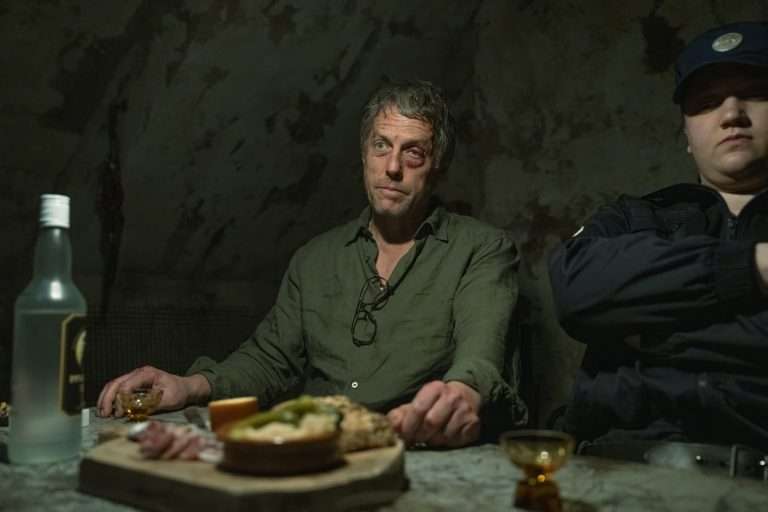
Television in the 2020s has become increasingly preoccupied with identity, specifically the fragmentation of the self, the split between who we are internally and the versions of ourselves we present to the world. While this isn’t a new fixation, recent shows like “Severance” or even reality competition series “The Traitors” have brought it back into focus, forcing audiences (or contestants) to look twice at the people on screen and question what’s beneath the surface.
It’s hard not to link this renewed interest to the pandemic and the dual lives many of us found ourselves living. And it’s no surprise that “Pluribus,” a series built around the aftermath of a global infection, resonates so strongly within that cultural moment. Vince Gilligan, who reshaped prestige television with “Breaking Bad” and later “Better Call Saul,” now turns to his most ambitious project yet: “Pluribus” (stylised as Plur1bus).
“Pluribus” centers upon Carol (who previously played lawyer Kim Wexler in “Better Call Saul”), a misanthropic fantasy writer who, with the support of her partner and manager Miriam, tours bookshops selling the latest in her series to adoring fans. Carol is successful, wealthy, and like Stephen King’s creation, Paul Sheldon, utterly miserable.
Carol’s misery deepens when a virus from outer space causes everyone to join as one. Everyone loses their sense of self, personality, or societal role, becoming one unified brain. And the catch? Carol is immune, along with twelve others. It’s a unique “Twilight Zone”-type premise which calls back more to Gilligan’s “X-Files” days than anything from the world of Walter White.
From the first episode, you would be forgiven for pigeonholing Gilligan’s premise, which, despite its prescient, seemingly COVID-inspired ideas, was thought up over a decade ago. Early on, it all feels a bit “Contagion” meets “Invasion of the Body Snatchers.” But, as it unfolds, genre meanders and contorts, with sci-fi and horror making way for a mash-up of comedy, drama, and noir. The concept is horrifying. But this grimness is tempered by the mystery, humor, and queasy bleakness of the premise as a whole – creating an unusual potpourri that feels tonally unique whilst embracing the inspirations of others.
Despite its steady pacing, a constant threat hangs over Carol. The collective, whoever or whatever they are, is trying to undo her immunity, and the show reminds us of this through an on-screen timer that tracks every passing hour or day. It gives the show a restless urgency, never allowing the viewer to sink into casual watching. As the narrative gathers momentum, Carol’s purpose sharpens; she must uncover what happened and how to reverse it. A methodical author well-versed in world-building, she approaches her own crisis like a post-modern detective, and in these scenes the sci-fi softens, giving way to a distinctly noir edge.
At first glance, “Pluribus” sounds like it could slip into heavy-handed metaphor, being a cautionary tale about enforced harmony or the perils of everyone getting along. The premise risks feeling preachy, but the show sidesteps these traps. Despite its pandemic backdrop, the audience won’t think of COVID once. What “Pluribus” does instead is imagine a world that appears perfect and functional and then asks what that perfection costs.
Beneath the surface lies something sinister, the infected population reduced to vessels, their bodies worn like costumes by a higher intelligence. It’s a post-pandemic inversion of “The Matrix,” where humanity isn’t simply controlled but repurposed, and every familiar face around Carol is a reminder of a terrifying new order hidden behind a smile.

Gilligan has insisted that it’s not about AI, but the genius of the premise is that it’s as allegorical as you want it to be. Gilligan and his team are just as invested in exploring philosophical thought experiments, forensic details, and sci-fi noir as they are in holding a mirror to the modern world. The careful balance between character, allegory, emotion, and philosophical fun is exactly what makes the show tick.
The satirical edge comes from the immune group, a mini-society that makes up the only people on Earth with recognisably human traits. They’re fallible and frustrating, and several refuse to believe anything about the new world needs fixing. In them, the show finds its satire, in which their flaws and divisions mirror our own far more than the society surrounding them.
In this group of 13, the parable (or Plurible?) is most clearly defined. “Pluribus” is a show about what it means to be human, and the struggle ingrained in clawing out of hardship. The infected collective, this vast, hive-like consciousness that now encompasses almost everyone on Earth, embodies the opposite of humanity. It is terrified of violence, incapable of lying, and unable to stomach the volatility and unpredictability that come with individual experience. The collective becomes a portrait of what we are not.
And this is why the series is ultimately Carol’s story. It is so engaging because we see everything through her fractured perspective. She is excluded from the unified whole, not by choice but by biology, and in the overwhelming scale of that collective, she becomes the outsider. Even among the group of survivors, she remains an outlier. That singularity becomes both her burden and the show’s central philosophical spine.
This is where “Pluribus” becomes such a fascinating creation. Rather than using doubles, mirrors, or fractured selves, the traditional tropes for interrogating identity, Gilligan flips the concept. He imagines a world in which there is no double at all, no ‘other’ to project onto, only the grim emphasis on the singular. Carol’s isolation becomes the emotional engine of the entire story. The tension between her internal turmoil and the collective’s cold, immaculate harmony gives the show its most compelling character drama.
The appeal of the premise is therefore dual. On one hand, the world of “Pluribus” sparks an endless stream of questions: What is this joined consciousness? Who caused it? Where did it come from? How does society continue to function? The logistical and philosophical possibilities are almost inexhaustible. On the other hand, the show never lets those questions overshadow Carol’s personal descent into fear and loneliness. She is unique, and the show never stops reminding us of the crushing weight of such isolation.
What makes “Pluribus” so compelling is that Gilligan and his collaborators manage to do something many high-concept shows fail to achieve: they ask the right questions, and they let their characters behave like actual human beings. For all its mind-bending ideas, the show feels grounded, anchored in a relatable reality. The metaphor doesn’t float above the narrative; it is ingrained in its pulse. In the end, that is what gives “Pluribus” its power: an outlandish, gripping yet grim, sci-fi conceit that is as much a source of escapism as it is inseparable from the world we live in today.