A screaming, small girl with her hands raised in the air, her clothes burnt to the last thread, with smoke descending upon a blue sky, an image that seared into the minds of millions all over the world. The photograph, now known as the “Napalm Girl” and published under “The Terror of War,” features nine-year-old Phan Thị Kim Phúc as her burnt skin peels off while she escapes a napalm bombardment with other kids. Nick Út, an Associated Press photographer who had travelled to the village of Trảng Bàng, captured the haunting moment, South Vietnamese forces allied with the United States of America, dropping napalm bombs on friendly troops and poor villagers.
What followed were widespread discussions, protests, condemnations, and a Pulitzer Prize, among many such accolades for Nick. The 52-year-old photograph is now a staple in photography courses, part of major exhibitions, and has a legendary status for its photographer. Netflix’s Bao Nguyen-directed documentary, “The Stringer: The Man Who Took The Photo,” disagrees with this official narrative.
The now-controversial documentary follows a two-year investigation into Carl Robinson’s claims. Carl was the Saigon photo editor for the Associated Press at the time, a media giant that has made multitudes of iconic photographs through the decades. Many would say AP made its reputation with its coverage of the Vietnam War.
What should have been another stressful day, as brutal war images made it to the lab to be processed, Carl’s life would be changed forever. He was responsible for providing photographs with captions and attributing them to whether a stringer or a staffer took them. Horst Faas, the legendary Bavarian photojournalist known as a tough taskmaster, was leading the team. In a single moment, one instruction from Faas, and one photograph has carried a dark truth for five decades now.
As Carl says, “I have carried this burden for the last 50 years, and I have never gone public”. According to Robinson, Nick Út, the then 21-year-old Vietnamese photographer who had earlier lost his older brother to the war during an assignment given by Faas himself, was in fact not the one who made the picture. It was rather taken by a freelancer known as a ‘stringer’ in the corridors of journalism, whose name he no longer remembers.
Also Read: Cinema Against War
The existence of a stringer is rather precarious, paid on a piecemeal basis and never enjoying the security of a staffer. As Gary Knight, the Executive Director and co-founder of The VII Foundation, an Arles-based non-profit for photojournalism and education programmes, which helped make the film, states, “Life of a stringer is a rather fragile existence. All you have is the authorship of your work.” In many respects, a byline is all a stringer has to put a stamp on their work and claim it as their own legacy.
Viewers are introduced to the iconic image and its deep legacy. With immersive editing by Graham Taylor, the visual piece incorporates old newsreels, war footage, photographs, and a beautiful blend of modern editing that pulls at the viewers’ heartstrings. The husband-and-wife team of Gary Knight and Fiona Taylor is searching for a man whose name has been lost to time, with no certainty as to whether he is even dead or alive.
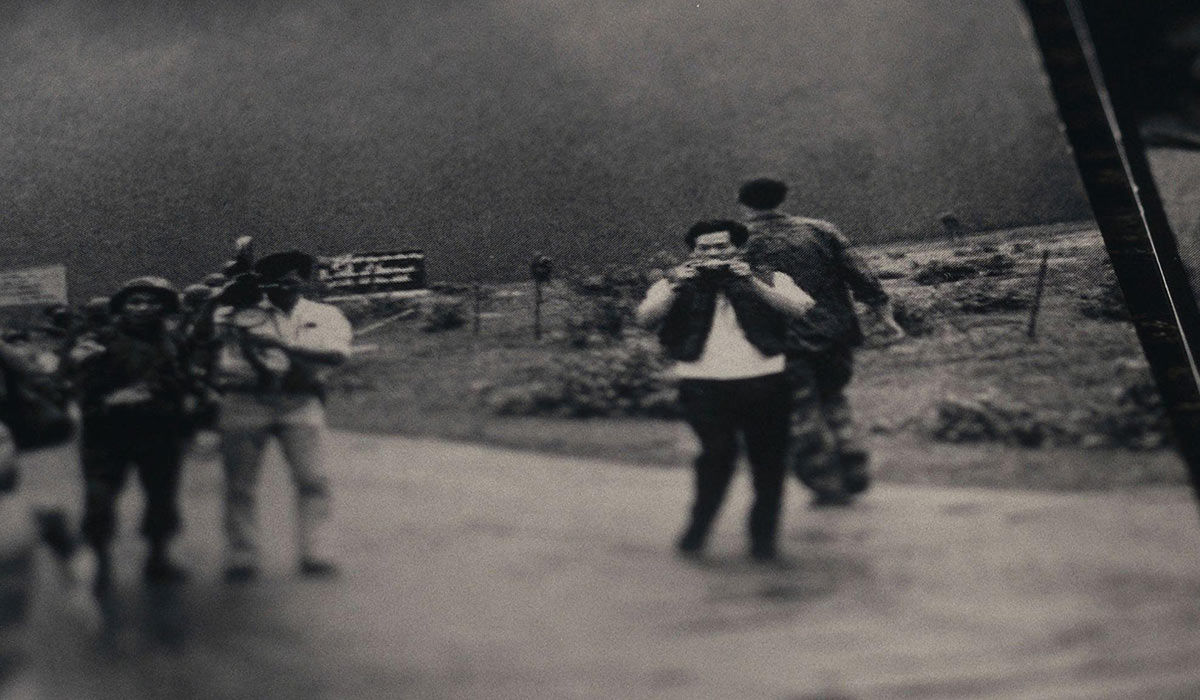
The only trace that remained was the picture of an unidentified man holding a camera within the frame. With the help of Vietnamese journalist Lê Vân — who began circulating calls on Facebook alongside the world-famous photograph — the mystery was finally solved. The man came forward, claiming his work had been stolen for just 20 dollars. He is Nguyễn Thành Nghệ, a trained cinematographer who says he filmed Phan Thị Kim Phúc, aka “Napalm Girl,” as she ran down the road, screaming in terror and pain.
“The Stringer” takes you on an emotional journey of brutality, war, memory, racism, ethics, and the consequences of one’s work being stolen. In photography, position is paramount. Considering these basics, Gary Knight and his team use modern journalistic techniques to determine the photograph’s authorship. Collaborating with Arles-based Index Investigations, a non-profit organization that uses advanced imaging and technology to solve cases of public concern, “The Stringer” tries to authenticate Nghe’s claims.
The film, shot at locations like Saigon (now known as Ho Chi Minh City), Arles, and California, offers lush, beautiful yet grounded cinematography backed by an introspective score that perfectly encapsulates both the sadness and fading away of memories and narratives.
The documentary showcased earlier at the Sundance Film Festival was controversial for questioning the very basis of a legend. Over the years, the accredited photographer Nick Út has spoken about how he saved Phúc after he took the picture. “The Nick Ut rule,” now a tenet of photojournalism, states that a picture always comes second to saving a life. The documentary even questions this narrative. In a 1984 documentary, Phuc’s mother recalls how an uncle actually carried the child and ran to save her life. As weeks turned into months and accolades slowly began to roll in for Ut, only then did Nghệ understood the importance of his image.
Related: 8 Movies to Watch If You Liked ‘Civil War’ (2024)
However, the time for contestation was long gone, and the only evidence, a print handed by Faas to Nghệ himself, had been torn away. In a traditional Vietnamese family, the image that features a nude child was rather taboo. Soon, Nghe’s wife would tear the only print he had. The stress of losing his legacy took a heavy toll on Nghe.
The ever-present question of “What could have been” is always corrosive, and years later, Nghệ and his wife would get divorced. Soon after Lê Vân finally traced him and was able to conduct an interview, Nghe would suffer from a massive stroke. Was it just a prolonged illness, or was the outpouring of grief and letting the truth have its day, too much for him? The audience does not know.
Since the documentary is closely intertwined with memory, it is no surprise that the authorship of the photograph remains fuzzy with claims and counterclaims. However, as Robinson says to a wheelchair-using Nghe in the hospital, “You are my proof, and I am your proof”. The decision of which claim to believe is also left to the viewer.
In the Vietnam War, many of the now-famous footage and photographs that rattled Americans back home were indeed shot by such freelancers. In a communication by the now deceased Faas, which the documentary makers assessed, he clearly mentions the resistance he faced in attributing the Vietnamese photographers and how the names were even made fun of.
Standing over Robinson’s shoulders as he was attributing the photograph, Faas’s now infamous words, “Make it Nick Út. Make it staff,” make more sense. The code of silence in the world of journalism is also explored in the documentary, as television crews and Vietnamese journalists frankly admit that the authorship was an open secret they could not reveal. “I had a family to feed and definitely did not want to lose my job,” says a journalist who claims Út simply did not take the photograph. At the end of this investigation, however, what stands is the Vietnamese reclaiming their legacy, their images, and their narratives.
“The Stringer” has definitely succeeded in putting a spotlight on such stringers who are often marginalised by big newsrooms with no real power over their work. The documentary is dedicated to the workers who keep the machinery of news running — the people whose images fill our newspapers, television screens, and every other medium. For admirers of photojournalism, this is essential viewing, sparking a conversation about iconic images and the deeper scrutiny they deserve.



![The Last Music Store [2016] ‘MUBI’ Review: An ode to the passing time in the moving world](https://www.highonfilms.com/wp-content/uploads/2022/03/The-Last-Music-Store-1-768x432.jpg)