
Max Porter’s 2015 book, “Grief Is the Thing with Feathers,” feels difficult to translate into any other form. That’s mainly because of the way he presents his characters and structures his narrative in fragments, which can make their conversations seem messy and incoherent. Fortunately, that doesn’t happen with the book because he backs it all up with a refined understanding of their anguish. However, that doesn’t reflect in “The Thing with Feathers,” the recent adaptation by writer-director Dylan Southern, where the limitations of translation become apparent quite early in the film.
The roughly 90-minute film, much like Porter’s book, revolves around a grieving widower taking care of his two sons in the wake of their mother’s tragic loss. Shortly after her passing, a crow mysteriously arrives in their lives and becomes the father’s unlikely companion through this ordeal. Benedict Cumberbatch plays the unnamed father, who must bear the burden of parental duties on his own, while grieving his lover’s glaring absence. That’s why the script paints a picture of his profound loneliness as well as his overwhelming grief, which incapacitates him from being in his usual state of being.
Southern, who wrote the script, chose the overarching narrative from Porter’s novella about the dad and the boys’ relationship with the crow, who becomes an unlikely presence in their lives. The crow represents something specific to every one of them, which the script makes clear through small moments in their lives. We see the dad, a creative writer, consumed with his work, where he accidentally realizes a crow-like form. The feathery bird appears now and then in their lives, making them realize the gradual changes in their character, slowly becoming a part of who they are.
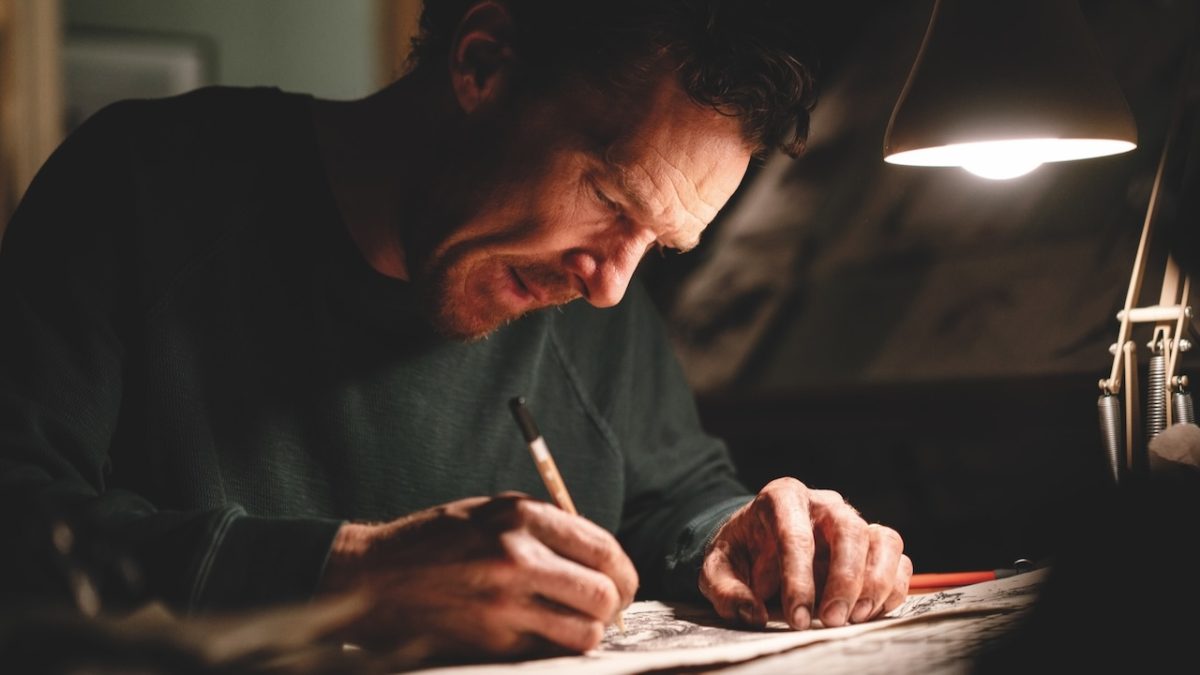
Southern focuses on building the crow’s ghostly presence through audio-visual elements. From the get-go, Ben Fordesman’s cinematography presents the family’s life with a gloomy, overcast tint, keeping the light away from the father’s solitary figure, almost as if it has been sucked out of his life. The interiors, soaked in the dim light of floor lamps, convey the depressing dampness of its texture so well that you can almost smell its unforgiving and inescapable stench. That gloominess is occasionally undercut by the cosy warmth of moderately-lit frames, which appear when characters accompany or embrace each other, or when they reminisce about their mother.
Southern builds this mood with Fordesman’s evocative camerawork, which emphasizes the mother’s glaring absence and the crow’s creeping presence through haunting frames with a gorgeous play of tones and shadows. He also introduces some surrealistic moments depicting the dad’s trauma, where Zebedee Budworth’s score conveys his emotional pain in confronting the absurdity of his situation. Despite all their efforts, the film doesn’t evoke any emotion that is strikingly unfamiliar with respect to its themes. It pales significantly in comparison to what Porter manages to achieve within the span of less than 100 pages.
Also Read: 5 Underrated Benedict Cumberbatch Movies
That brings us back to the difference in the structure of Porter’s book as compared to Southern’s film. Porter divides his book into short chapters, shifting perspectives between different narrators. That helps establish every character beyond what they represent in Porter’s allegorical tale and builds their personhood. It feels sorely missing in Southern’s script, where we don’t get a sense of their character beyond the bare essentials.
The boys seem to be written as an afterthought, leaving them limited to what they mean to the dad as he contends with the gaping hole in his life. Porter utilized their innocent and mischievous perspective just as effectively to offer a deeper understanding of the dad’s bottomless pit of misery. He also imbued the crow with distinguishable characteristics, using it just as much as a character with a flair for comprehending the crisis at hand.
Unlike that, the crow is left simply as a shadowy figure, creeping on them like a tool for jump scares. The only clever decision with presenting this character might be casting David Thewlis in this role, whose unique voice perfectly captures the creaky otherworldiness of the bird’s fragmented chain of thought.
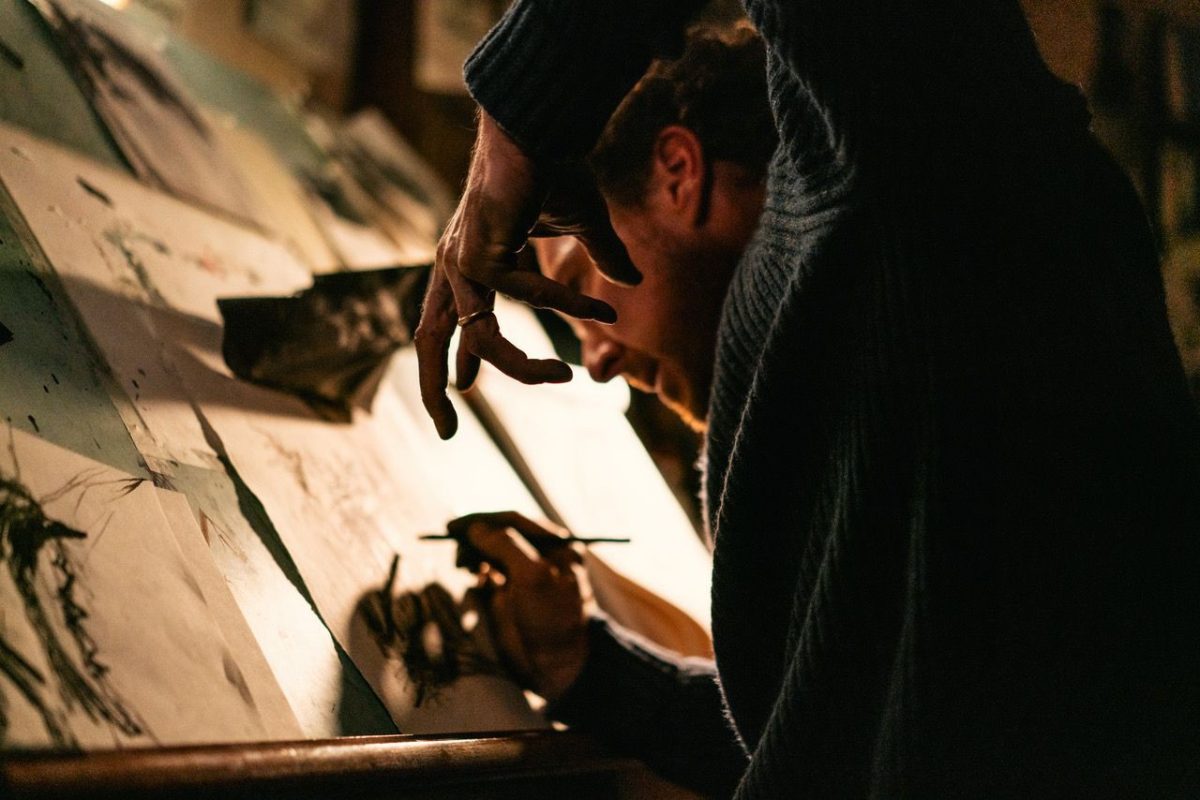
The book also offers a richer understanding of the dad’s relationship with his late wife, painting her life beyond the tragicness of her absence, which is where the film falls flat. There are also bouts of humor in Porter’s writing and a closer understanding of the father’s profession (and its connection with his mourning process) that are non-existent in the film.
Instead, the script simply picks some moments and dialogues from the book, but doesn’t take enough effort to build them into scenes that can leave a lasting impact. Despite a linear narrative with barely any time jumps, the film feels merely like a collection of feeble moments that don’t build up to anything more than a meager attempt at depicting grief.
Cumberbatch does the heavy-lifting here, conveying the dad’s crumbling spirit through a physical embodiment of his enormous pain. Whether he screeches, screams, stares, dances, or weeps in silence, he does it all with such sincerity that it takes us closer to understanding the sheer weight of the dad’s agony. It’s a shame that he is working with a script that doesn’t convey the emotional complexity of his performance. The film is somber to a fault, thinking the mood would be enough to leave us with a pang, while offering us nothing substantial that can linger in our minds.
It’s not that Southern isn’t capable of conjuring something visceral. In fact, you can notice it in his previous work on music documentaries along with Will Lovelace. “Shut Up and Play the Hits,” in particular, showed his skill in skillfully building the emotional rollercoaster leading up to the band’s swansong, filled with candid moments brimming with emotional honesty. Unfortunately, that sense of raw intimacy is missing in this project, where we don’t feel nearly as much for the widower as we feel for the lamenting dance-punk star.



![Saani Kaayidham [2022] ‘Prime Video’ Review – Keerthy Suresh & Selvaraghavan Led Revenge Saga Is Exhaustively Brutal](https://www.highonfilms.com/wp-content/uploads/2022/05/saanikaayitham22042022m2-768x432.jpg)

![Something in the Water: A Kinston Basketball Story [2020] Review – Glories of the past, present and future](https://www.highonfilms.com/wp-content/uploads/2021/01/Something-in-the-Water-2020-highonfilms-1-768x404.jpeg)
![The Lego Movie 2: The Second Part [2019] Review – Everything Is Pretty Decent](https://www.highonfilms.com/wp-content/uploads/2019/02/The_lego_Movie_2_HOF-768x432.jpg)
![For Lucio [2022] MUBI Review: Lucio Dalle’s artistic (and personal) life becomes the focus of this confident documentary by Pietro Marcello](https://www.highonfilms.com/wp-content/uploads/2022/02/For-Lucio-1-768x510.jpg)