The Silent Hill Loop Theory: How the 2026 Film Confirms a 25-Year Mystery
For over two decades, fans of the Silent Hill franchise have debated whether the protagonist of the second installment, James Sunderland, is trapped in a linear story or an eternal cycle of punishment. With the release of Christophe Gans’ Return to Silent Hill, this long-standing “Loop Theory” has moved from a fan speculation to a central narrative pillar. The film explicitly utilizes its ending to validate a theory that suggests James is a permanent resident of a personal purgatory.
The Origin of the Loop Theory in Gaming Lore
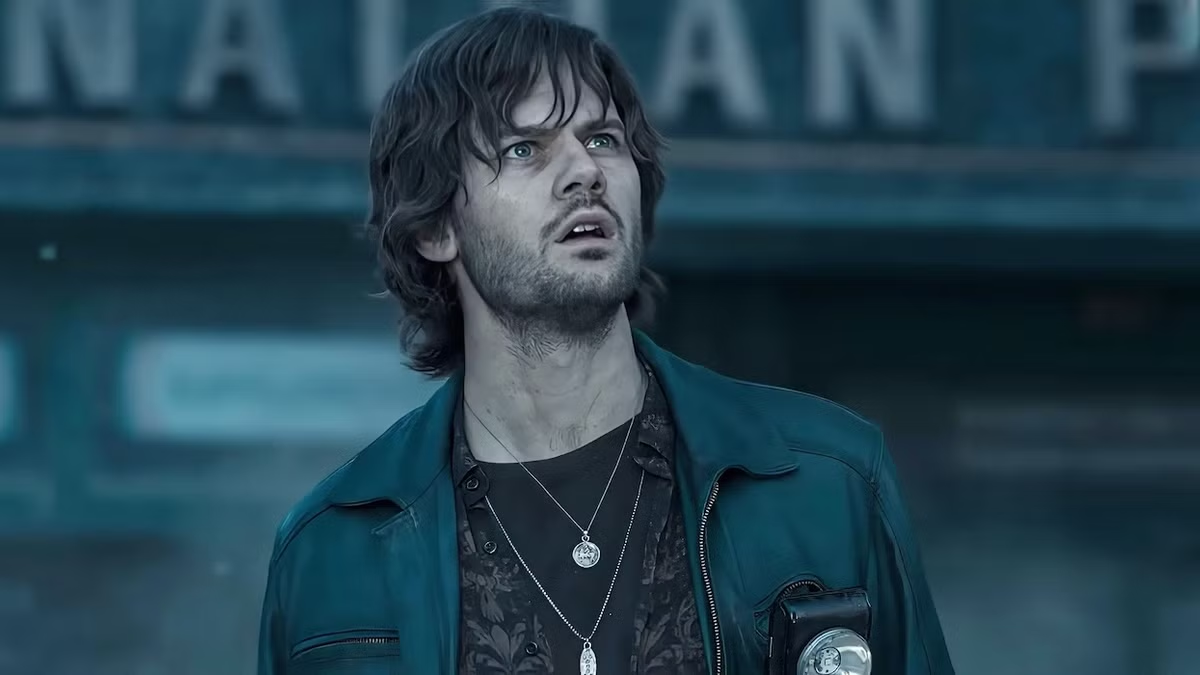
The theory first took root with the release of the original Silent Hill 2 in 2001. Players noticed several eerie details that suggested James was not the first “James” to walk those streets. Throughout the game, players encounter dead bodies sprawled in various locations—in front of televisions or slumped in alleyways—that use the exact character model of James Sunderland.
This led to the belief that these were the remains of previous cycles where James failed to reach the end of his journey. The existence of multiple endings also fueled this idea. Because Konami never officially declared one ending as the “true” canon, fans posited that every ending is true. In this framework, James finishes his journey, fails or “succeeds,” and is then reset by the town to start the nightmare over again.
Hidden Evidence in the 2024 Remake
The theory gained significant momentum with the release of the Silent Hill 2 remake in 2024. Developers at Bloober Team appeared to lean directly into the fan theory by hiding twenty-six collectible Polaroids throughout the game world. When players gathered these photos and decoded the secret message hidden within their descriptions, it revealed a haunting sentence: “YOU HAVE BEEN HERE FOR TWO DECADES.”
This meta-commentary served two purposes. On the surface, it acknowledged the twenty-plus years since the original game’s release. Narratively, however, it suggested that the James Sunderland players were currently controlling was simply the latest iteration of a man who had been wandering the fog since 2001. It transformed the “remake” into a literal “replay” of a never-ending cycle.
How Return to Silent Hill Confirms the Cycle
Christophe Gans utilizes the finale of the 2026 film to bring this theory to the big screen. The film initially appears to follow the “In Water” ending, where James drives his car into Toluca Lake to be with Mary in death. In most cinematic traditions, this would signify the end of the story. Instead, the film transitions back to the very first scene: James meeting Mary Crane by the side of the road after crashing into her suitcase.
While this moment is framed with a sense of hope—as James chooses to drive Mary away from Silent Hill this time—it functions as a narrative reset. By returning to the point of origin, the film suggests that James’s time in the town did not end with his death. He has simply been placed back at the starting line. The “happy” choice he makes in the final moments is just another branch in a loop he has likely navigated countless times before.
The Role of the Otherworld as Purgatory
The Loop Theory redefines the town of Silent Hill not just as a haunted location, but as a sentient psychological machine. In Return to Silent Hill, the town is shown to be “impossible,” shifting its geography and reality based on James’s mental state. This fluidity supports the idea of a loop because it suggests the town can reconstruct itself as many times as necessary to facilitate James’s penance.
The film’s inclusion of characters like Maria and Angela—who are revealed to be different facets of Mary Crane—further strengthens the cyclical theme. If everyone James meets is a projection of his own trauma, then the town is essentially a closed circuit. There is no outside world for James; there is only the repetition of his guilt until he achieves a level of self-actualization that the town deems sufficient to break the chain.
Courtesy: CBR