
Doug Leibowitz (played by Will Brill), the protagonist of Giselle Bonilla’s debut feature film “The Musical,” is what the Gen-alphas of this day would call an incel. So it’s a tough pill to swallow when Doug, with all his might and spite, is able to lead the kids in the film to have a Dead Poets Society kinda protest against the authority. It’s one of the many obvious and wearying moments in Bonilla’s film that feels ballsy and funny from a distance. However, the wonky execution and unsure satirical leanings never truly make it stick the landing.
Anyway, Doug is a failed playwright who likes to believe that his work as a schoolteacher is a placeholder for now. He is quite sure that his dreams and aspirations, which are also about a great fellowship somewhere in New York, will be handed to him just because he is ‘that good.’ Among the many nihilistic tendencies he possesses – his irritating and delusional personality, his inability to take rejection, and the assumption that his self-indulgent writing is some form of intellectual masturbation top the list.
Consider Travis Bickle, as played by a Looney Tunes cartoon that somehow evokes a conservative politician, and you will get somewhere close to what Doug is. Essentially, the conflict that drives this entire enterprise is his breakup with fellow teacher Abigail (Gillian Jacobs). Out of nowhere (or a long time coming if you consider yourself out of Doug’s shoe), she drops a bomb on Doug, saying that she needs a break from their relationship. After knowing him, you might just think that she must have dated him out of pity, but that’s a logic I don’t see the film being interested in.
Instead, it wishes to revel in Doug’s paranoia that soon turns into revenge when he gets to know that Abigail has swiftly moved on from him and is now dating the school principle Mr. Brady (played by Rob Lowe). Talking about intellectual masturbation, Bonilla’s male characters are essentially performative adults who have no idea what their existence means. Mr. Brady is the kind of shrewd older guy who thinks that being progressive means traversing through the cancel-culture by being hip. He carries a Stanley Cup everywhere he goes, can be seen working out when he is not subtly sticking his nose in everyone’s business, and possibly drinks a matcha latte off-screen.
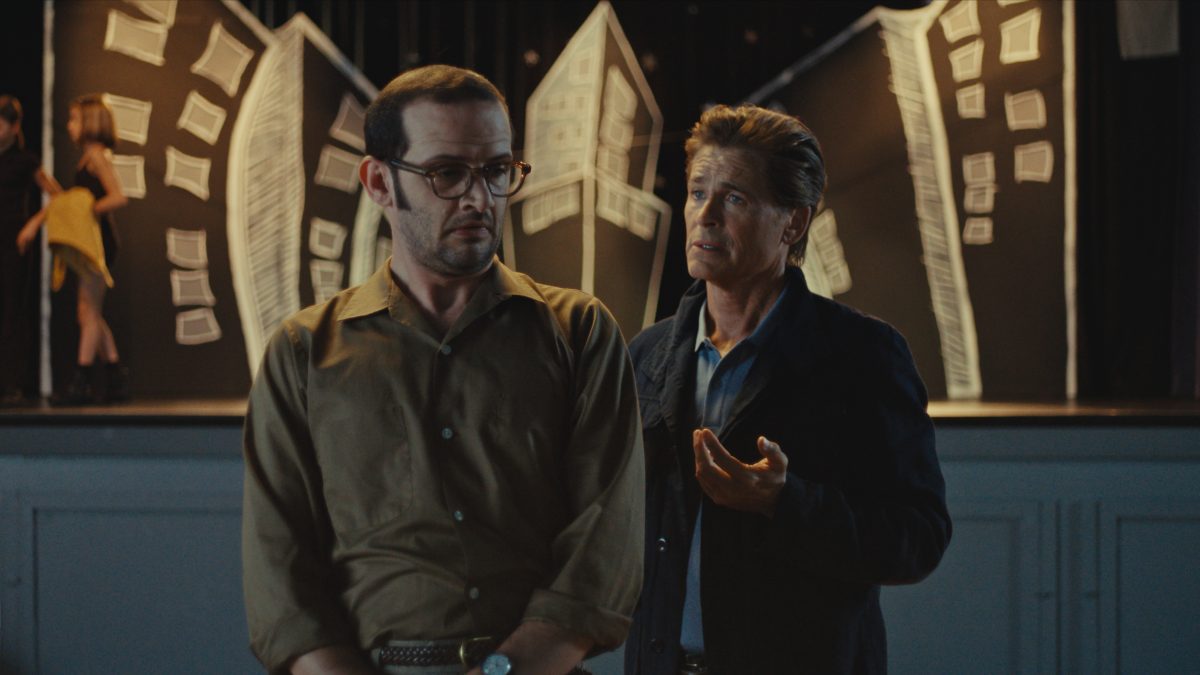
So, even though you care less for Doug’s messed-up existence, you are in on the game between him and Mr. Brady. The film’s foundation lies in Doug’s secretive play where he is rounding up a young cast of kids to do an original play, an offensive and seriously dated musical on the tragedies of 9/11. Except, he is also claiming to prepare his actors for a version of West Side Story (which is, in itself, problematic to a tee).
Now, “The Musical” is smart enough to carefully drive through these things in tendium. But since the foundational elements of the script written by Alexander Heller are all so up in the air, nothing comes to fruition. The tonality of the story within the story – the self-seriousness of a noir placed alongside a mixture of parody and satire never gels up to make something that is even half as intriguing as the premise might promise initially.
Eventually, the biggest downfall of “The Musical” lies in the overstated performance from Will Brill, who is able to create a smug figure that you might want to live inside a cringe-comedy, but since there are so many lofty themes tossed in, he is never able to settle. Nothing against debutant director Giselle Bonilla, but this isn’t a film I would remember her by.



![Sirens [2021]: ‘Sundance’ Review- A necessary but thinly developed anthem of resistance](https://www.highonfilms.com/wp-content/uploads/2022/01/Sirens-Sundance-Review-1-768x432.jpg)
![Western [2018] – A Quietly Powerful Tale of Cross-Cultural Connection and Male Ego](https://www.highonfilms.com/wp-content/uploads/2019/02/Western-2018-768x416.jpg)
![War [2019] Review – A Surprisingly Entertaining Bollywood Actioner](https://www.highonfilms.com/wp-content/uploads/2019/10/War-Movie-768x322.jpg)

![Retour [2017] Short Documentary On MUBI: A Chris Marker Styled Time Travel](https://www.highonfilms.com/wp-content/uploads/2020/10/Retour-Return-highonfilms-768x432.jpg)