Season 4 of Stranger Things marks a tonal shift from nostalgic science fiction adventure to psychological horror, since in earlier seasons, threats emerged from external monsters, but season four introduces a villain who attacks from within. Vecna or Henry Creel preys upon psychic wounds — guilt, grief, shame, and unprocessed trauma. His victims are not randomly selected; they are the ones who are already fractured subjects whose psychic wounds will be exploited by him to fulfil his mission.
Among them, Max Mayfield’s near-death experience during the now iconic “Running Up That Hill” sequence stands out as one of the most emotionally resonant moments of the series. If analysed within a Lacanian psychoanalytic framework, this scene can be read not only as an escape from supernatural evil, but also as a dramatization of the subject’s struggle against psychic annihilation by the traumatic Real, where music’s role is that of a crucial signifier reanchoring the fragmented subject within the Symbolic order.
Max’s psychological condition prior to Vecna’s attack is central to this reading. After the death of her stepbrother, Billy, she internalizes guilt and withdraws from her social world, isolating herself from friends, distancing herself from Lucas, and even drifting into emotional numbness. Her headaches and nosebleeds signal both physical and psychic rupture.
In Lacanian terms, Max’s connection to the Symbolic — the realm of language, social bonds, and structured meaning is clearly weakening. The Symbolic is what situates the subject within a network of relationships and signifiers, and when that network destabilizes, the subject becomes vulnerable to what Lacan calls the Real or the traumatic dimension that resists symbolization and returns in overwhelming forms.
Vecna operates precisely within this space of the Real. He is never creating that trauma but exploiting what already exists and remains unarticulated. The red, fragmented landscape of his psychic domain resembles a space outside coherent meaning, a void where guilt becomes literalized and amplified. Max floating helplessly in this dimension signifies a subject suspended outside symbolic anchoring as she is caught in what Lacan might describe as a confrontation with an unmediated Real, the unbearable kernel of loss and self-blame that cannot be fully spoken.
Read: Stranger Things (Season 4) Volume 1 Review: Bigger, Pulpier, And Campier With A Thematically Poignant Core
The turning point arrives with the introduction of Kate Bush’s “Running Up That Hill.” The song functions not merely as emotional background but as a signifier in the Lacanian sense as a marker that reconnects the subject to the Symbolic order. In Lacan’s theory, the subject is constituted by signifiers where identity is structured through language, memory, and relational meaning.
When Max hears the song, she does not recall a melody; instead, she recalls her friendships, shared moments, and the fact that she is desired and loved by others, which is crucial, as Lacan famously states that desire is the desire of the Other. The subject persists not through isolated self-assertion but through recognition within the desire of others.
As Max sees flashes of Lucas, Dustin, and Eleven, she is reminded that she occupies a place in their emotional universe and that she matters. Her subjectivity is not self-contained; it is relational. The music becomes a conduit through which this relational structure re-enters the void of the Real. The visual metaphor of running is equally significant. Max does not simply awaken and float back to safety, but she runs through a collapsing, red, nightmarish landscape.
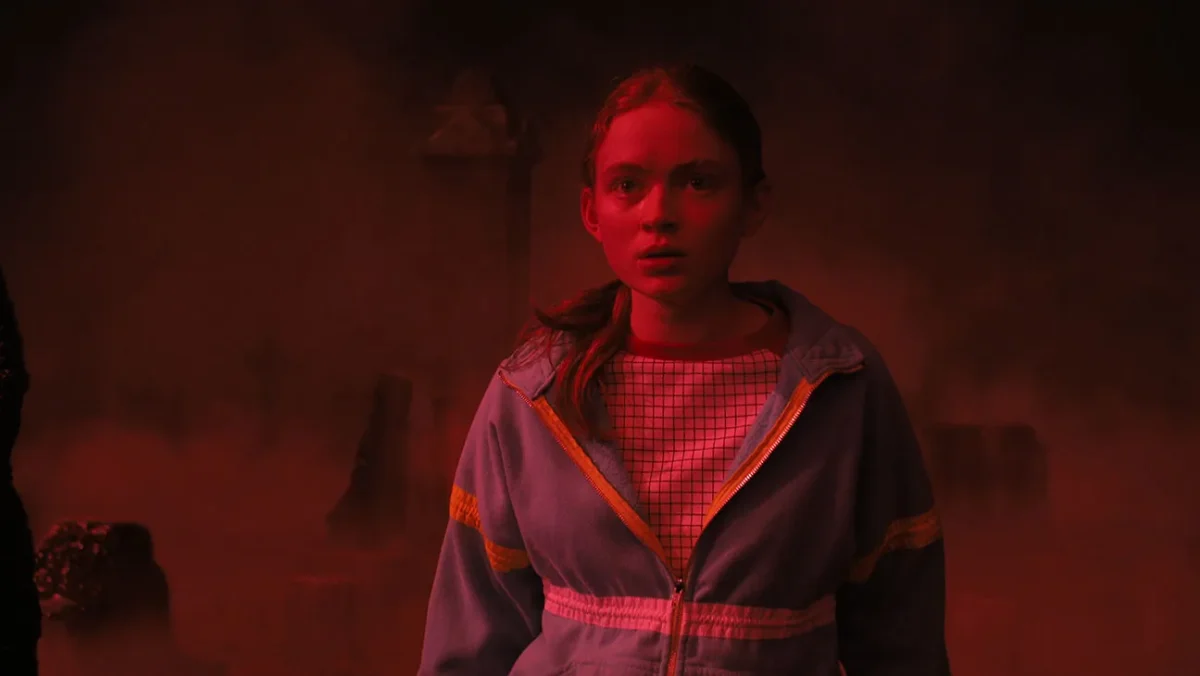
This run represents an active reassertion of subjectivity, for she is not passively rescued. She is actively choosing the movement to be saved. In Lacanian terms, she chooses to remain within the Symbolic rather than surrender to the engulfing pull of jouissance, the excessive, self-destructive enjoyment bound up with guilt and psychic pain. Vecna tempts his victims into surrender, promising relief through annihilation. The Real, in its traumatic intensity, can paradoxically offer a perverse form of stillness, but Max’s run rejects that stillness.
The scene resonated profoundly with contemporary audiences, particularly younger viewers. In a generation accustomed to using headphones as a private refuge, the image of music as a lifeline felt intimate and recognizable. However, the power of the scene extends beyond generational identification as it accurately captures the fragile structure of subjectivity itself. The earphones operate almost as a portable Symbolic device as a way of carrying relational meaning into moments of isolation. When the music plays, it interrupts the closed circuit of guilt and reopens a path toward intersubjective connection.
Also Read: Stranger Things (Season 4) Volume 2 Review: A Thrilling Battle To Beat Vecna That’s Offset By An Anti-Climactic Epilogue
Importantly, this escape does not signify a permanent cure. Later developments in the season complicate the hope of the scene. From a Lacanian perspective, this is consistent, as the Real cannot be permanently eradicated. Trauma returns, and the subject remains split. The earlier victory was not a final resolution but a temporary stabilization of psychic structure. The Symbolic can be reasserted, but the Real continues to insist at its edges. Thus, the “Running Up That Hill” sequence dramatizes a fundamental psychoanalytic truth where the subject survives not through solitary strength but through symbolic belonging.
Max’s confrontation unfolds on two levels at once: Vecna appears as an external antagonist, while the deeper struggle takes place against the unassimilated guilt she carries within herself. Her escape does not resolve the conflict through a simple moral victory; it marks a refusal of psychic dissolution. Music operates as the signifier that rethreads her into the web of language, memory, and desire through which her subjectivity is sustained.
Ultimately, the scene’s enduring impact lies in its portrayal of the precariousness of subjectivity. In the red abyss of the Real, Max nearly loses her symbolic coordinates. The intervention of music restores her position within a shared world. Running toward her friends, she runs toward the Symbolic itself — toward language, relation, and life. In Lacanian terms, she does not escape simply by force of will. She escapes because she is called back by the desire of the Other, and she answers that call.