I travelled to Bruges in my younger days. I drank the beer, ate the waffles, and snapped pictures of the swans gliding down the canals as though they owned the place. And it’s exactly what it appears to be: a lovingly preserved medieval city. A chocolate box comes to life, and the sort of place that makes tourists go weak at the knees and pull the camera out with Pavlovian predictability. It’s beautiful, and it’s boring. It’s just the sort of place you’d stick two hitmen who have just messed up their first job together and tell them to wait.
Martin McDonagh knew something essential when he chose Bruges as the setting for his 2008 movie, “In Bruges.” It wasn’t opportunistic location scouting, or some quirky directorial whim. Bruges is a character, not a backdrop. But even more than that, it’s a theological statement rendered in Gothic spires and cobblestones. It’s purgatory made manifest; a waiting room for the damned, and every church, canal, and fairy-tale tower is a reminder of what you can’t have. A reminder of what you’ve lost, and probably didn’t deserve in the first place.
Ray, played with a coiled desperation by Colin Farrell, understands it immediately. “Bruges is a shithole,” he announces, as Ken, the philosophical, elder hitman played by Brendan Gleeson, tries to sell him on the cultural significance and medieval architecture. Ray is having none of it. He’s not exactly wrong; he’s just seeing the place through eyes that have just recently witnessed the worst thing they could possibly witness: the accidental killing of a child during his first contract. Bruges isn’t charming for Ray; it’s torture. A place designed to be contemplated, reflected upon, and he’s trapped there with nothing but his guilty conscience and Ken’s honest attempts at sightseeing.
That’s the genius of the movie. Purgatory isn’t supposed to be comfortable. It’s not exactly Hell; there are worse places than Bruges, obviously. But it isn’t Heaven either. It’s just waiting. Being suspended between what you’ve done and what comes next. Being forced to sit with yourself in a city that’s too beautiful to ignore and too stifling to enjoy.
In that context, the medieval architecture Ken finds so enchanting becomes something else entirely. The towers and churches, the carefully preserved historical sites, are monuments to judgment and medieval notions of redemption and sin. They visit “The Last Judgement”, a painting by Bosch, and the symbolism isn’t subtle. It’s a thesis statement hanging in a museum. Pictured there are the damned, the saved, and right in the middle are the hideous punishments waiting for those who have transgressed. Ray stands and stares, barely processing Ken’s commentary as he’s already living in his own Boschian nightmare.
What makes Bruges a perfect place as purgatory is how completely it is preserved. There’s nothing out of place, and nothing allowed to naturally decay or organically evolve. It’s frozen in amber, a museum of itself. This is the appeal for tourists. For Ray and Ken, it’s suffocating. They are caught in a place that exists out of time, with every street corner looking like the last one, and where you can walk in circles, ending up exactly where you started. That isn’t tourism. That’s limbo.
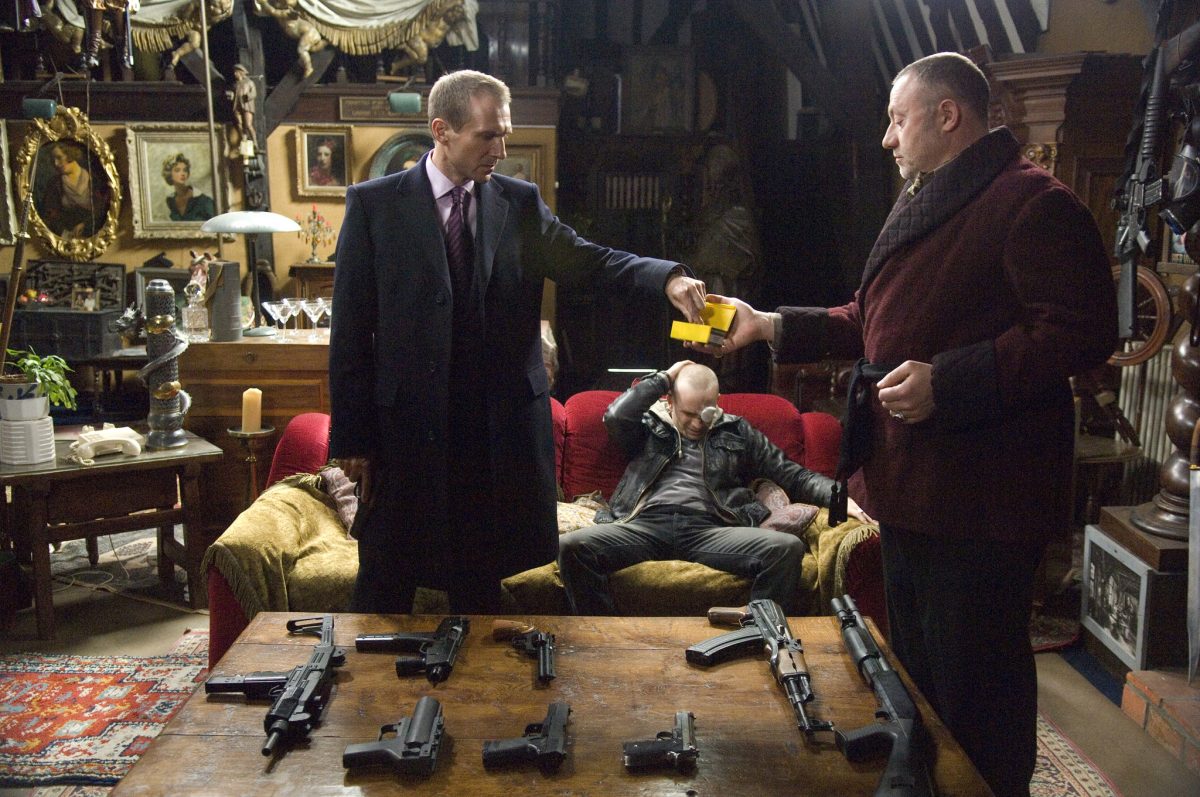
And McDonagh fills this medieval snow globe with just the right kind of supporting characters to reinforce the purgatorial theme. We have Chloë, the damaged local woman who deals drugs and her own mysteries. There’s the dwarf actor, Jimmy, played by Jordan Prentice, filming a surrealist movie about a dream within a dream. Even Harry Waters, Ralph Fiennes’s absolutely terrifying crime boss, is less a traditional antagonist and more an avenging angel. He is a force of absolute moral clarity in a universe where absolute moral clarity has basically given up.
Harry has an Old Testament, medieval code, almost ritualistic in its rigidity. You kill a kid, you pay with your life. No exceptions, context, or appeals process. It’s a moral framework that is at home in the same era as the buildings Ray and Ken are exploring; clear, brutal, and unforgiving. And when Harry finally arrives in Bruges, the city turns into an arena where this ancient code will be played out to its bloody conclusion.
The visual language of “In Bruges” reinforces this reading at each turn. Bruges is filmed in winter, with everything cold and muted. The canals are dark, and the stone buildings darker. Its famous Belfry Tower becomes a recurring motif, a massive structure pointing upwards to Heaven, rooted firmly in the earth, and accessible only with a long and difficult climb. Ken makes the ascent twice. First, he’s playing tour guide and pointing out the view, the Virgil to Ray’s Dante.
The second time, he’s climbing it to die, making a choice that might redeem him, literally throwing himself from the approximation of Heaven to earth. That scene, Ken’s fall from the tower, is McDonagh at his most operatic. It’s visually stunning, dramatic, and loaded theologically. Ken has made a choice. He believes Ray deserves a chance and that killing him for Harry would be wrong. He believes some sins can be atoned for. So he chooses to die instead, falling from the highest point in Bruges, and McDonagh makes sure we feel every foot of that fall.
But the thing about purgatory, and the reason it’s such a rich concept for McDonagh, is that it’s predicated on the possibility of redemption. It’s what separates it from Hell. Yes, you’re suffering, and absolutely paying for what you’ve done. But there is a door, narrow as it may be, that leads on to somewhere else. The question isn’t whether you deserve redemption; in this movie, the three leads all deserve a firing squad. The question is whether redemption is possible structurally, whether the universe grants second chances, and if there is ever any escape from the consequences of your actions.
Ray’s crime of killing a child is the movie’s moral event horizon – the absolute worst thing. The unforgivable sin is both in Harry’s code and Ray’s own view. The kid haunts him, literally, appearing to him in hallucinations. Bruges has become the place where he has to sit with what he’s done, and can’t run away from it. The beauty of the city becomes accusatory. It says, look at this place, look what exists in the world. Look at the beauty you destroyed.
Ray’s attempted suicide, one of the movie’s most devastating scenes, brings this all into sharp relief. He can’t live with what he’s done. Bruges has served its purpose: he’s been forced to confront himself, and he’s found himself wanting. The gun to his head, sitting in a playground, is Ray’s verdict on himself. Although he was also about to kill him, Ken intervenes, and that interruption becomes significantly philosophical. Ray doesn’t get to make the call about ending it. He’s still in purgatory, and his suffering isn’t over. He’s still awaiting judgment.
For all his wit, violence, and profanity, McDonagh is working in a deeply Catholic tradition here. Judgement and redemption, guilt and penance, they aren’t just themes, they’re the architecture of the movie. And Bruges itself, filled with Catholic churches and medieval moral frameworks, is the ideal venue for working through these ideas.
The ending of “In Bruges” resists easy interpretation and is exactly right. Ray most likely survives, loaded into an ambulance after Harry’s self-inflicted punishment when he accidentally shoots a dwarf he mistakes for a child. “I really, really hoped I wouldn’t die,” Ray tells us in voiceover. It isn’t redemptive or triumphant exactly, it’s just faint and desperate hope that maybe purgatory has a way out after all.
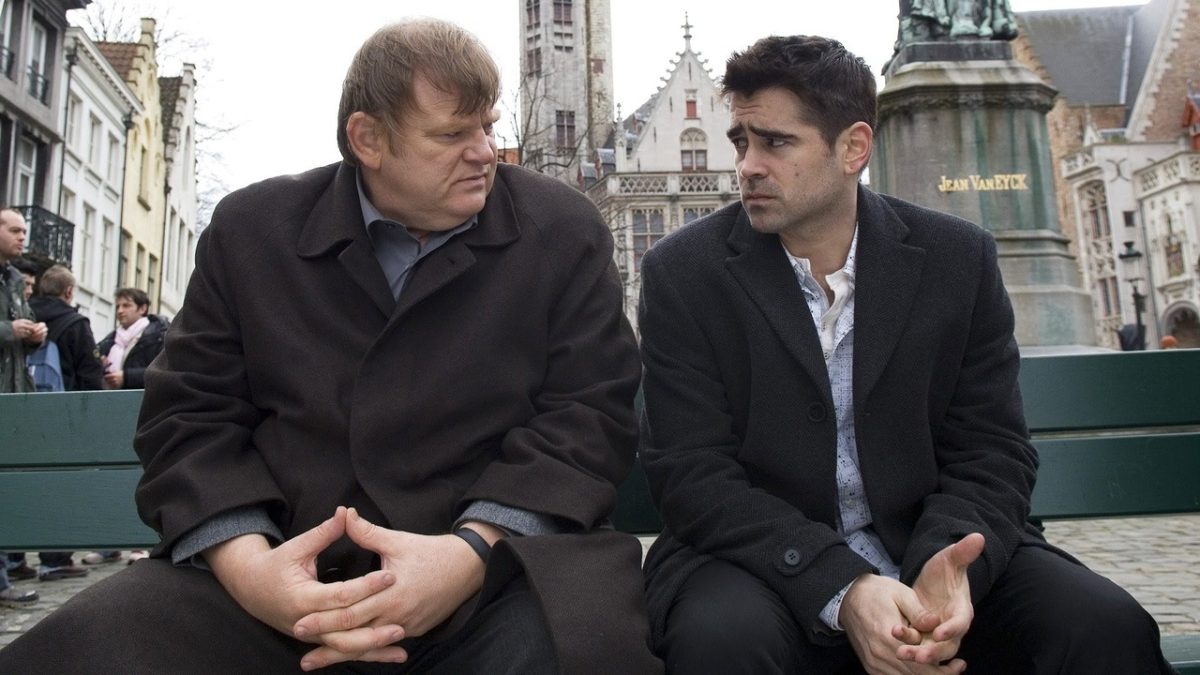
What McDonagh created is more than a simple morality play. It’s a meditation on whether morality plays even make sense anymore. Do medieval notions of redemption and sin work in a modern world of hitmen and collateral damage? And he chose to set this meditation in the most medieval place he could find in Europe, a city that is almost a theme park of its own history, perpetually in conversation with its past.
Bruges itself doesn’t judge. The city just is – an indifferent and beautiful stage for human drama that’s seen it all before. Churches stand where they stood 600 years before. Tourists still arrive and take pictures. And sometimes it seems, hitmen come to wait, suffer, and just maybe find something close to grace in the unlikeliest of places.
I find myself thinking about Ray’s hatred of Bruges, and insisting it’s a shithole, despite all evidence to the contrary. He isn’t wrong to hate it; he’s supposed to. It’s purgatory. If it were pleasant, it wouldn’t be purgatory. It would be early parole. The city’s beauty and insistent charm, the fucking swans: all part of the punishment. You’re in paradise, pretty much, and you can’t enjoy it. Surrounded by beauty you don’t deserve and grace you can’t accept.
That is the moral landscape McDonagh created. A city where the damned are made to confront themselves against the backdrop of medieval splendour. A place where questions of guilt and innocence play out on cold canal water and Gothic shadows. Redemption may exist there, but it sure hasn’t been earned. It’s brilliant, really. It’s profane, violent, and funny, but underneath it all is something truly theological, something grappling with what it means to live with your actions.
And it could only happen there – in Bruges. A perfect, preserved, purgatorial little city. Had McDonagh chosen anywhere else, it would have been just a location. But there, every cobblestone serves as a reminder, and every church bell is a call to judgment. Modern and medieval crash together, beauty and violence, damnation and the merest possibility of grace.
Would I go back to Bruges? Yeah, of course. The beer’s good, there’s very impressive architecture, and you can see it all in a weekend. But I think I’d see it differently, now. The way McDonagh saw it. As a state of being, not a destination. A condition to endure. Yes, it’s beautiful and historic. But also, in its own way, a sort of hell. Purgatory, anyway. Depending on where you’re standing, it’s the same difference.