Stitched together from about 20 different sources with the same precision as the lumbering, gold-hearted monstrosity who seeks a courtship with its namesake, Maggie Gyllenhaal’s sophomore feature “The Bride!” is hardly the most faithful rendition of the “Frankenstein” mythos we’ve had to date. Not that such a prospect is necessarily to the film’s detriment—we just got a fairly loyal version of Mary Shelley’s seminal novel from Guillermo del Toro, and it was about as lively as its pre-revival titular creature—but in seeking to breathe life into the spirited, empowering disposition that Shelley’s persistent legacy ostensibly represents (as the film will point out in mere moments, Shelley wrote “Frankenstein” on a dare), Gyllenhaal’s decidedly punk interpretation of her source author’s legacy is bound to turn a few heads until neck bones snap with a sadistically delectable crackle.
For the actor-turned-director, this provocative attitude comes in the form of a literal dialogue with Shelley, whose words have echoed from beyond the grave just as Gyllenhaal’s version quite literally speaks to her audience from a monochromatic limbo as she seeks out the motive in the story that rattles in her brain like, as she puts it, a tumour or a dream.
The resulting ‘30s-coded, fever-dream experience is akin to a sort of improvisational self-therapy session that quickly (d)evolves into a self-initiated surgery, desperate to excise that purpose clinging to the brain stem before the blood gushes ceaselessly from the incision. But for “The Bride!”—and this perhaps is to the film’s detriment—that sputtering blood flow is more than welcome; its endless, blinding stream is the non-negotiable means by which this town will be painted crimson red.
From the very first moment that our purgatorial Shelley (Jessie Buckley) begins to channel the mind of her would-be literary creation, Ida (Jessie Buckley again), it’s clear enough that the symbiosis at play is one borne entirely from the rubble resulting from the crumbling of these narrative walls. Shelley’s thick English timbre invades the decidedly American Ida in the midst of a swinging, mob-enforced shindig in the heart of Chicago. Her sudden outburst leads to a prompt eviction from the premises, where her squirrelly boyfriend’s (John Magaro) attempts to calm her down result in a ragdoll tumble down a flight of stairs. And just like that, before we could learn anything about her, she’s six feet under.
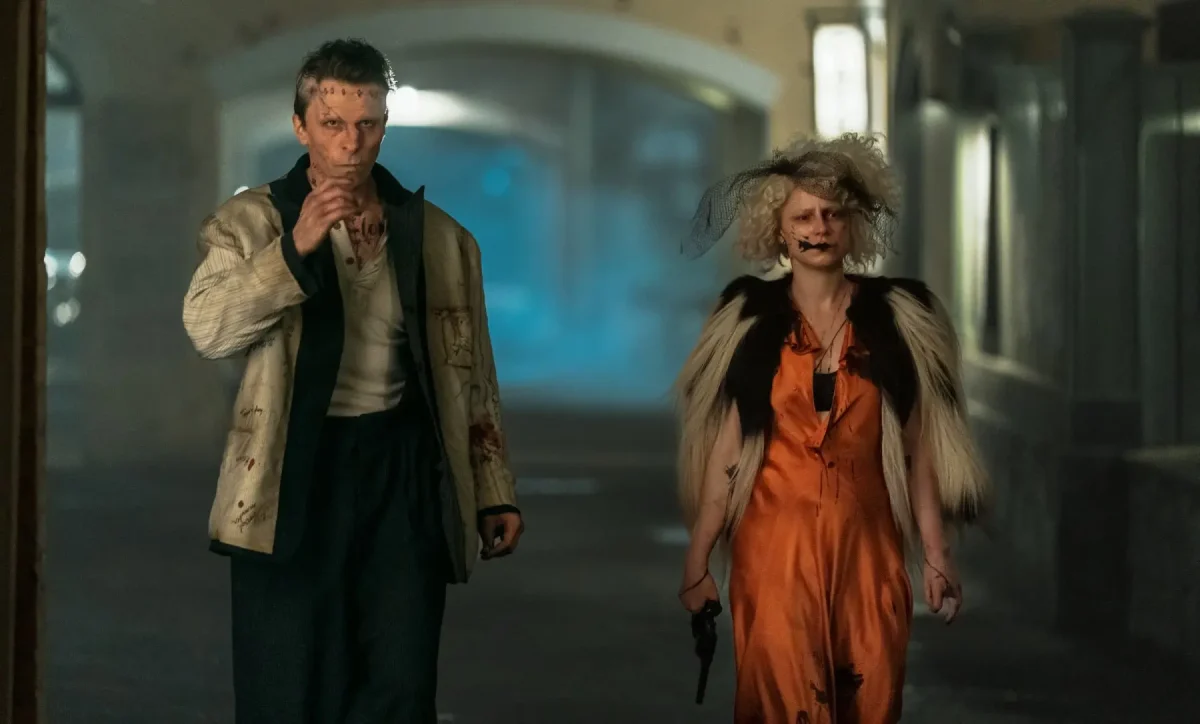
Her departure coincides serendipitously with the arrival of a hulking but timid stranger named Frank (Christian Bale), who drops in on a Dr. Euphronious (Annette Bening) with a simple request—well, simple in concept rather than execution. Cursed with a reanimated corpse and none to share in the life of zombified solitude he’s forced to endure, Frank, like the Frankenstein of Shelley’s original work, seeks a companion, and Ida’s fresh cadaver just so happens to be the perfect candidate.
This much is despite her exceeding perfection, both as far as appearance (Frank is instantly hesitant when he discovers that the body they’ve dug up is “too beautiful for him”). Her spitfire persona was enlivened with a few currents of electricity by way of sacrilegious experimentation. As Shelley continues to penetrate the framing device in a direct dialogue with her reanimated counterpart (who has conveniently forgotten her past), “The Bride!” revels in the continuous shift in personality that comes with this woman’s quest for self-actualization. She’s got a second chance and the same lust for life; the question is what she will do with it.
As it turns out, a whole lot and a whole little, as Gyllenhaal’s script moseys its way through a proto-“Bonnie and Clyde” outlaw story at the same time that it attempts to interrogate the societal structures placing women at the mercy of a predatory patriarchy. If the frequent instances of challenged consent aren’t enough, then a late-film monologue that features Buckley shouting out “Me too! Me too!” will surely drive that point home.
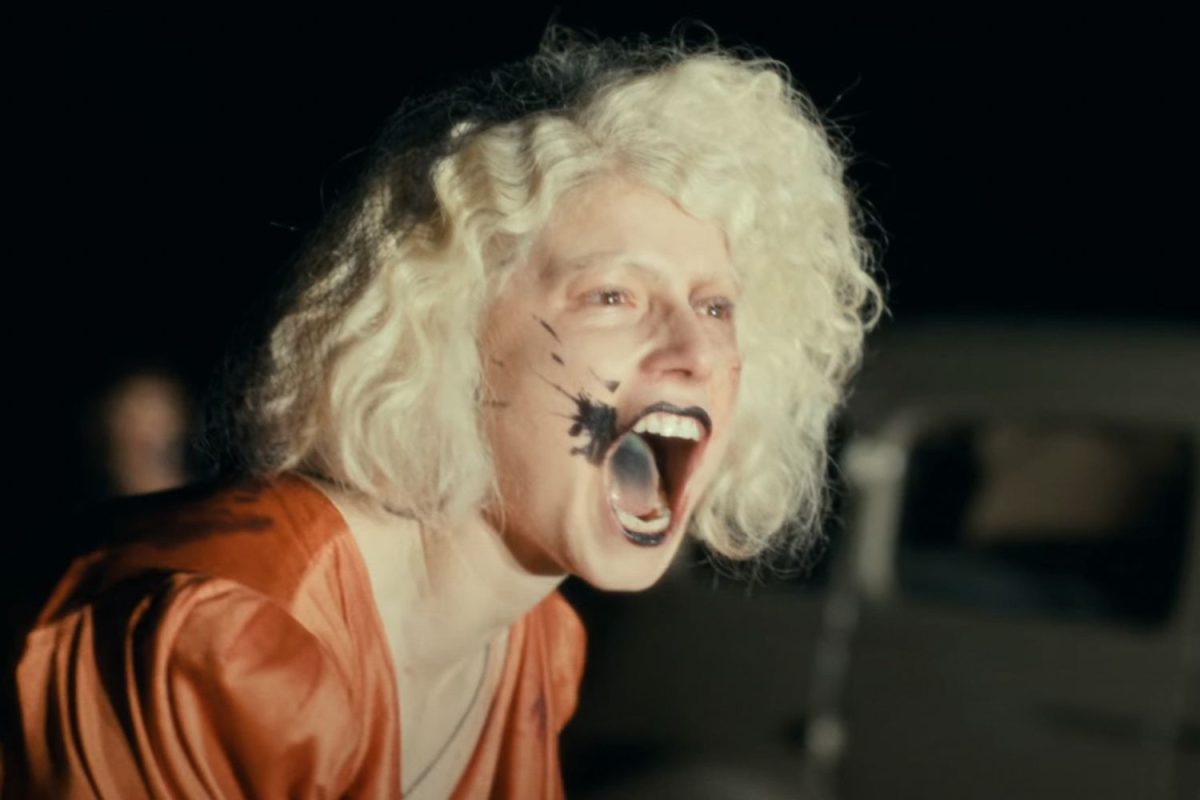
Suffice it to say, “The Bride!” is at the mercy of a frantic vision just as much as the surrounding ensemble is at the mercy of its titular runaway’s dominating temperament. Buckley’s mercurial fire shines through every moment of vocal freneticism that indicates the presence of a woman whose vicious confidence belies a deep-seated anxiety at the structures she recognizes to be well beyond the scope of a sassy gal with a smoking revolver.
Gyllenhaal’s interpretation of rebirth is one that sees curiosity and utter terror in constant dialogue, and Buckley’s unrelenting vigour channels that volatile mixture into a role whose uncertainty becomes its saving grace in a surrounding film that proves equally unsure of its eventual discovery of what keeps a heart beating.
“The Bride!” is on fire whenever Buckley and Bale are feeding into their mutually assured self-annihilation—and the subsequent doses of tenderness that come from a real desire to feel that fire’s warmth when icy flesh begins to meet—but Gyllenhaal’s means of reckoning that sobering societal drive towards alienation with a more tonally encouraged taste for anarchy comes together about as cheekily and incoherently as you might expect for a film that casts “Triangle of Sadness” standout Zlatko Burić as a mob boss named Mr. Lupino. (“Ida,” “Lupino”… get it?)
“I’m revolting,” the Bride states to her undead lover, and the following assertion of the statement’s double-meaning—“…Like insurrection, mutiny, coup”—is lobbed at you before you’ve ever had a chance to parse it out on your own. It’s difficult to tell whether such moments of overzealous thematic mapping are the result of a clear studio/creative divide in the lab for an auteur-driven, lavishly punk period-piece, or the result of a feverishly eager voice still parsing out where the lines should be drawn in finding nuance within her ambitiously carefree pet project. For Gyllenhaal, it seems enough to let those lines splatter all across the cold, dead cheek in a show of gleeful disorder, but eventually, the artifice of that perfect stain—unchanging amid so much sweat and so many tears—may just overtake the spontaneity it supposedly embodies.