
Pradip Kurbah’s “Ha Lyngkha Bneng” (“The Elysian Field”) is a quiet, meditative work on the philosophy of communitarianism made straight from the heart that ardently beats for the cause of humanity. Taking the thread that binds all human lives and experiences together – in the face of uncertainty and change – as its core narrative layer, the film forages through a spectrum of human emotion to depict the lives of the only remaining residents of a small Khasi village.
The year is 2047, and we are in a remote Khasi village, where a bus serves as the singular node of connection between the world of the village and the outside. The last remaining residents, Livingstone, Miss Helen, Maia, Friday, Complete, and Promise share a ritualistic rhythm that binds their presence and life in the small village. The place is no longer the place it used to be – the houses like structures remain, but the homes have shifted many years ago. The stories are alive, but the people who had lived them are long gone.
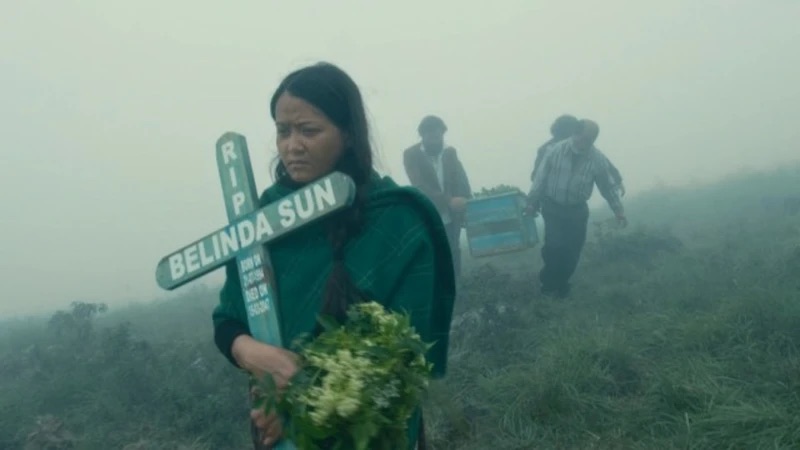
“Ha Lyngkha Bneng” is built on the interplay of such opposites. The contrasts are deliberately ingrained into the fabric of the story such that they feel intrinsically belonging to the unbothered existence of the villagers. For example, the film is set in 2047, but it is also deeply rooted in the memories and the stories of the past. Also, there’s an unspoken sorrow in the soft touches of humour. Similarly, light and darkness, presence and absence, joys and sorrows, and most importantly, life and death coexist as inescapable realities that define daily life in the village. Power outages, funerals, the shared laughter, and the small celebrations – all embrace and hug each other as the inhabitants share their grief and joys in an acknowledgement of their communitarian spirit.
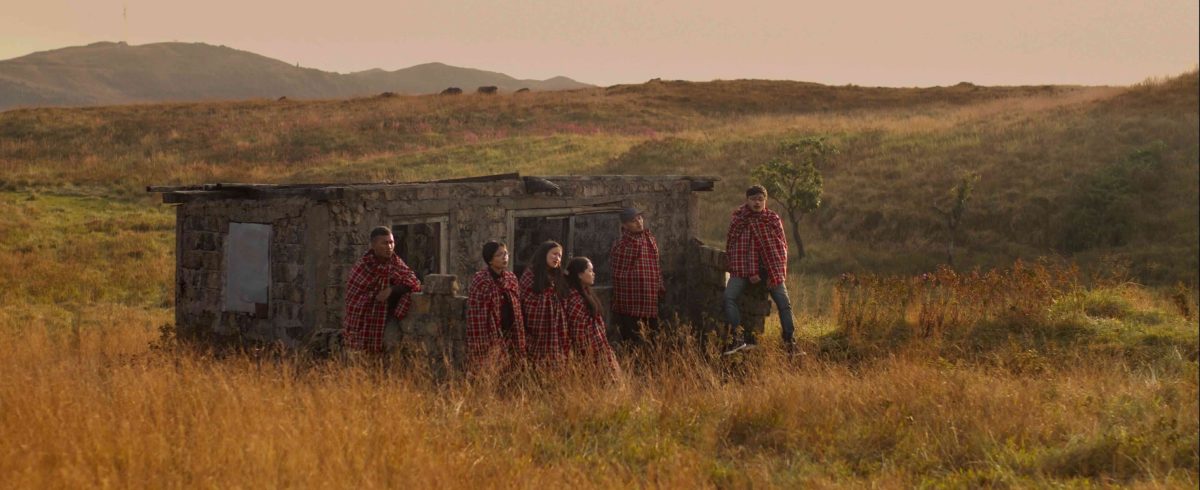
In this regard, what can be best understood about Kurbah’s vision of the film is that these contrasts are positioned as an elemental texture of life itself. This is why they are inseparable from the endurance and intimacy of those who remain. Kurbah’s lens, often lingering in painterly stillness across the green fields and the lonely hills of the distant, transforms the film’s landscape into a visual embodiment of the enduring nature of human beings to connect. It observes the passage of time through the changing seasons, showing the subtle shifts of existence.
In contrast to that, the interiors of the houses are cracked and worn out. This evokes the feeling of returning to a childhood home long after the grandparents who once filled it with warmth have passed – the walls remain, but so does the absence. In this way, the film bridges the situations of its distant characters with viewers through intimacy and an emotional connection that is raw, clear, and felt deeply and personally. Even as the narrative stretches across the wide landscapes, the film draws the audience into a private and tactile pulse of life. It’s a small film, but its visual scope is very wide and spread over the vastness of the serene landscape that it feels like an entire world in itself.
Moreover, beneath its philosophical layer, the film is also a study of the absurdities of daily existence. Even a bit of alcohol can go a long way, as the fixing of the electric transformer and then the inverter serves as an ironic beat of monotony. The presence of the choir and the symbolic bus represents a kind of liminal space – between the tangible and the metaphysical, as if the village itself exists on the threshold of worlds. That is the beauty of “Ha Lyngkha Bneng.”
On the other hand, Kurbah’s political commentary is not very subtle. “Ha Lyngkha Bneng” strategically calls out the systemic neglect and uneven development of the modern world as the villagers continue to struggle for uninterrupted power supply and mobile network coverage in the larger narrative of progress. But the best part is that this critique never eclipses the humane story of the film.
The only negative for me was the runtime of the film. While the film is undeniably immersive and spiritually contemplative, its narrative could have benefitted from a sharper, more immediate structure. Unlike Kurbah’s earlier “Iewduh,” where some secondary plots like the issues of a sweet seller’s daughter or another girl confronting domestic violence added to the tension, “Ha Lyngkha Bneng” remains purposefully unsophisticated. Nevertheless, even in its sprawling lyricism, the film remains a positively rewarding experience that reminds viewers that love, presence, memory, and solidarity are the truest measures of human life, even for worlds that are on the verge of fading.
A special screening of the film was held at the Kelvin Gold Cinema Hall in Guwahati, Assam, on 28th February 2026, which comes after the film’s successful international journey and its triumphant run at the 47th Moscow International Film Festival in 2025, where it won the Golden St. George for Best Film, Best Director, and the NETPAC Award for Best Asian Film. Alongside these accolades, the film also made a significant impression at the 31st Kolkata International Film Festival (KIFF) and the 30th International Film Festival of Kerala in 2025.
The film stars Richard Kharpuri, Albert Mawrie, Baia Marbaniang, Helena Duia, Jeetesh Sharma, and Merlvin Mukhim. It is shot by Pradip Daimary and edited by Badeimon Kharshiing with sound by Saptak Sarkar, Sumir Dewri, and Sayantan Ghosh. Written by Paulami Duttagupta with Pradip Kurbah, the film is co-produced by Nancy Nisa Beso, Gordon Kharsyiemiong, and Wallam Lyngba with Arpana Kurbah, Marjina Kurbah, and Jova Kurbah as producers.




![Toy Story 4 [2019] Review – A Pixar film you enjoy but do not take home](https://www.highonfilms.com/wp-content/uploads/2019/06/toy-story-4-featured-768x512.jpg)
![The Territory [2022] Review: The Spirit to Fight back shines the brightest in this endearing Amazonian documentary](https://www.highonfilms.com/wp-content/uploads/2022/05/The-Territory-2022-Movie-Review-768x432.jpg)