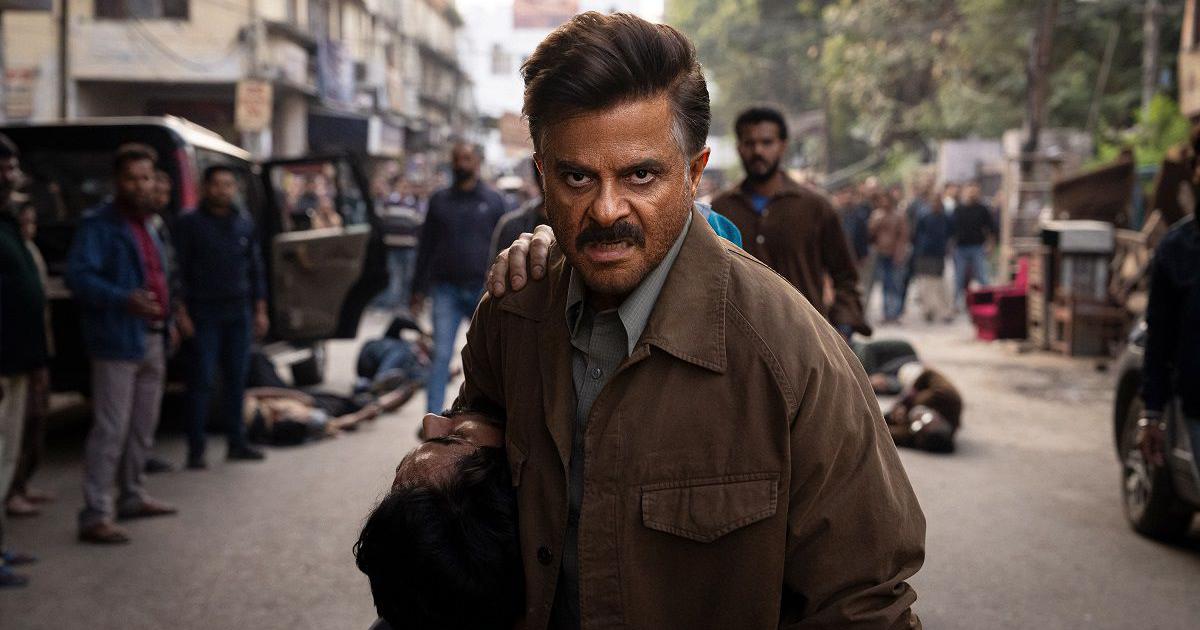
One of the most exasperating things a film does is make a fuss about gender and power, and ultimately being the most awfully and tepidly conservative about it. Suresh Triveni’s latest, “Subedaar,” is cursed with the most stunted storytelling and insipid creative instincts. Beneath every crisscrossing plotline, there’s a stasis tying down all strands. Inconsistency limns the tale of a retired army officer, Arjun Maurya (Anil Kapoor), whose life is further rustled into dynamic motion when he stumbles across a sand mafia after returning home to Madhya Pradesh.
The world of crime, he thought he may have buried and put behind him, rises again, entrenched in deep-set trauma. Memories of his dead wife flood back as he encounters motley complicated situations wherein he has to exert his smarts and intuition. If he doesn’t, he too will get sucked into the widening morass that sees no end.
Arjun’s homecoming is more rife with hurt, devastation, and danger than he could have fathomed. There’s no rest, rather a slinging back into action, as he seeks to take down the mafia and its mushrooming operations. Then he meets Prince (Aditya Rawal), a cocky young man who preens that his actions will have no consequence. He’s padded up with the power of his stepsister, Babli Didi’s (Mona Singh) sand mafia.
Triveni’s film is waylaid by a slew of cliches, templates, and tropes that cumulatively drain any freshness, danger, or intrigue. There are concerted efforts to be vocal about the trauma and grief of the oppressed, which is cranked up only to be defused in favour of the status quo. It pretends to be progressive and concerned while ultimately and neatly folding into the prevailing terrible chain of inequities without addressing them in any honest, reflective manner. A lot can be split on recent Hindi films that claim and posture to a certain inclusive politics without having the tiniest idea of the sheer complexity of the variegated terrain they rashly cross.
Nowhere in “Subedaar” can you sense an impulse to provoke, dare, or engage with the mafia’s underpinnings, the hierarchies it’s built on and perpetuates. Triveni adds a woman as the antagonist, as if to spruce a gendered drama, but defangs the drama of urgent questions into power, land, and access.
In one of the biggest sins, “Subedaar” reduces a gifted actor, Mona Singh, to mere exhibition of chilling ferocity, not someone with a full-bodied arc or an evocation of thorny struggles. Singh is as committed as possible, but she’s working with a limited scope, so it’s not really gravitational how she fits into the bigger picture.
The filmmaking is lazy and irresponsible. At no point does the film rivet you or make demands on a patient, sustained engagement. There’s a simplistic, banal reduction, a flattening of stakes and edge where proceedings would have otherwise simmered and shivered with nuance and moral bite. The action escalates while the drama plateaus, and interest keeps dipping with every turn. The direction isn’t just staid, there’s a turgidity blanching all scenes and frameworks. It’s a preponderance of dullness that the film is straining against.
When men clash, what remains of the women? Can they be unscathed in the trail of destruction, rage, and spite? Would their souls remain intact, or do they also get deeply enmeshed in the spiralling vengeance? Does anything about the women remain recognisable or salvageable? There’s also Radhika Madan essaying a woman defined by how much she’s battered and fights back with equal gusto and daring.
But it’s again too little, developed in vague, impersonal strokes that don’t fold into the storytelling. These jarring insertions don’t advance any meaningful, scabrous critique of the patriarchal politics that the town is a hotbed of. The mafia butchers, an exercise designed merely for exhibitionism within the film’s logic, since it has no propensity for examining the violence, the impulses it rides on.
Women take after the ways of men, their brutish, cold nastiness. It’s an inculcation, a repetition that is severed from self-scrutiny. What we get instead is an anaemic portrait of a sanguinary town, riddled with tokenistic images of people attacking each other venomously but in a shallow, uninvolving fashion. There’s no desire to interrogate the circumstances, the cycles of violence that have racked the town.
As much fine restraint Kapoor can summon with all his might, the film is overeager to foist him with starry trappings, a heroic gaze that does no favours in this narrative that also aims to be grimly rooted. As a result, there’s an atonal juxtaposition that never quite sits well. Triveni isn’t clear or precise about the positioning of his characters, the moral and political landscape in which they interact. “Subedaar” wants to say something about a country slipping off into utter mayhem, but it’s too fuzzy and broad to hone its targets on anywhere specific and piercing.




![Churuli [2021]: ‘Tokyo International Film Festival’ Review – Lijo Jose Pellissery’s Folk Horror Is A Trip Worth Taking](https://www.highonfilms.com/wp-content/uploads/2021/11/Churuli-4-highonfilms-768x432.jpg)