
There’s a lot to be petrified about the state of our world, as Kenya-Jade Pinto’s debut feature, “The Sandbox,” testifies. Every speck of our civilisation is rapidly falling apart in a relentless grind of the persecution of marginalized and immigrants, as governments resort to unsparing surveillance to pad up their hateful, narrowing projects.
There are teeming stretches where it dives deep into the digital mechanics, where it’s almost too overwhelming and clinical. But the human and emotional stakes are gradually amped up once it shifts its focus to mammoth disasters on the sea, where boats and ships carrying migrants are forced into capsizing by nations’ nefarious border policing. There’s denial, lack of accountability, with nations shirking owning to the horrors they commit.
“The Sandbox” is about the ever-pervasive monitoring gaze we have unleashed on ourselves, that might very well be our collective undoing. Everything is being tracked, but the bravery is held up by a few daring, generous volunteers scanning international waters for sinking boats that are of no concern to any country.
These volunteers are the sole bastions of hope. Surveillance isn’t so much a spectre as an insistent reality, stalking every facet of how individuals and communities navigate contemporary times. It’s surpassed being a menace to exerting control and supremacy over how people make decisions and hold onto the fragile fibre of their lives.
In no time, surveillance advances hungry and ravenous on every remaining frontier of our destiny, encroaching without caution or apology since it has the backing of the biggest administration. It doesn’t remain a nightmare so much as it becomes a terrible reality we learn to constantly contend with, fight so that it doesn’t snap the few residual snaps of love and comradeship in the lives we navigate with fellow beings. Surveillance introduces and tightens animosities, cutting down on cordial ties and aggrandising a collective paranoia in its most vicious avatar.
“The Sandbox” is ambitious, formidable, and many-pronged. It goes after an entire apparatus, drawing several threads and arriving at how nations use surveillance to manipulate their own failures. There’s a vast reckoning with geopolitics and how it connects intricately with immigration. How do we grapple with the detritus of manipulative, coercive narratives that drive us deeper into isolationism? The documentary pokes at the entire grid that arranges xenophobia and weaves in surveillance as its primary weapon of countering.
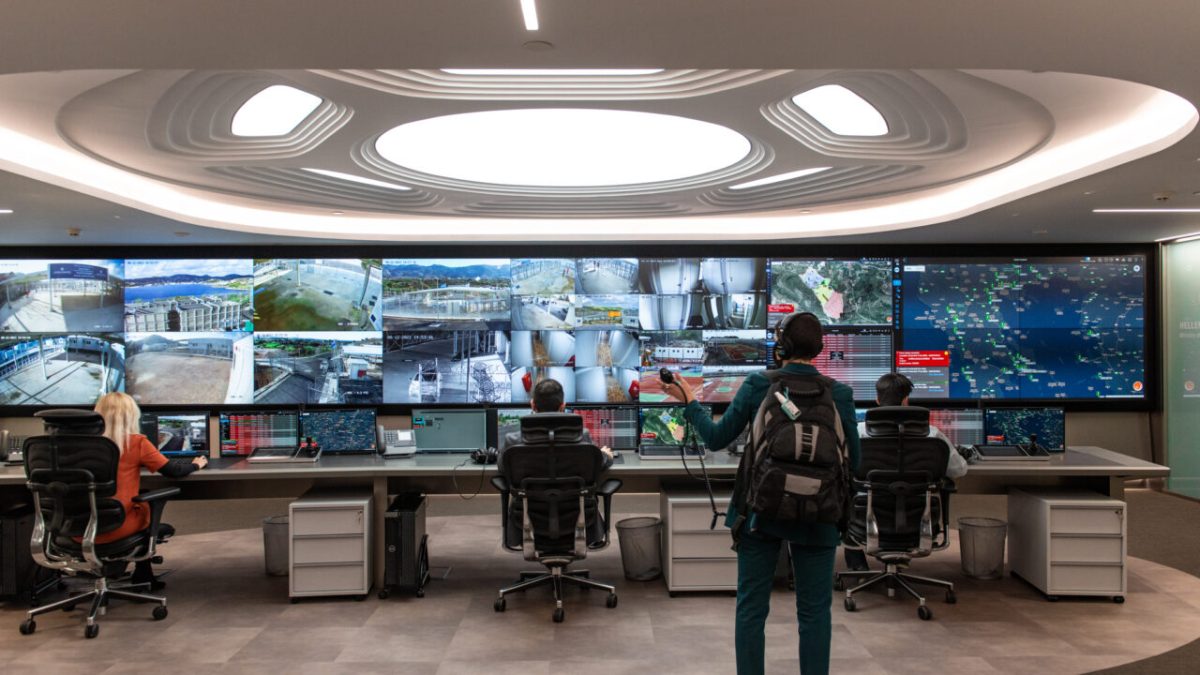
Narratives around migration and security must be interrogated and taken apart. The documentary constantly examines the ends of such narratives that create fissures and chasms, and all sorts of dangerously fabricated notions around safety. Nation-states wash their hands of responsibility by ascribing the biggest danger to immigrants entirely. How does the logic of violence structure perpetuate seep into daily life itself? The documentary mounts a wide range of questions that attack every vector that is attributed to monitoring.
There are scores of people targeted and brutalised under the excuse of suspicion for a nation’s security. It licenses governments to round up humans as immigrants without papers. Every tool of watching is being deployed to go after people with a lens of scepticism. Walls are erected between nationalities that advance their individual prerogative of aggression and existential personhood.
Criminality is easily slung between one nation and the other, the battery of insinuations rampant and divisive, and far more entrenched than citizens would instantly believe. Credibility is slain, and there’s a bloody race to compete with other narratives. Trust is vanquished, or rather, it becomes a contest between the official and independent accounts. The documentary asserts with valence and conviction what we need to be alert to, the lies our governments spin.
Which of the two is allowed to prevail depends on complex factors. The nation, the political, bleeds ultimately into the personal. There’s no escaping the intense connections wrought among these, even as we may wish to deny the scale of the onslaught.
The film covers a lot of ground, across sectors and a breadth of terrain, closely prying through surveillance that gathers its might in the guise of biometrics. What may begin under the concerted front of providing relief has curdled into something far more sinister and unrelenting in basic survival. There’s no aid, only further aggravated terror for the vulnerable caught moving between countries.
“The Sandbox” could have done well in interweaving a few more intimate accounts, but it has an undeniable indicting force. It knows its searing points of contact, especially where political dispensations look away from, and citizens and migrants get caught in a stranglehold. How do we get away from the manufactured narratives and learn to reignite our humanity? This documentary is an urgent, blazing wake-up call.



![Good Omens Amazon Prime Review [2019-]: Armageddon’s Funny Side Up](https://www.highonfilms.com/wp-content/uploads/2019/06/Good-Omens-Amazon-Prime-768x512.jpg)


![The Sacred Spirit [2021]: ‘Locarno’ Review – A Dazzling, Mysterious Supernatural Fantasy](https://www.highonfilms.com/wp-content/uploads/2021/08/The-Sacred-Spirit-1-768x416.jpg)

