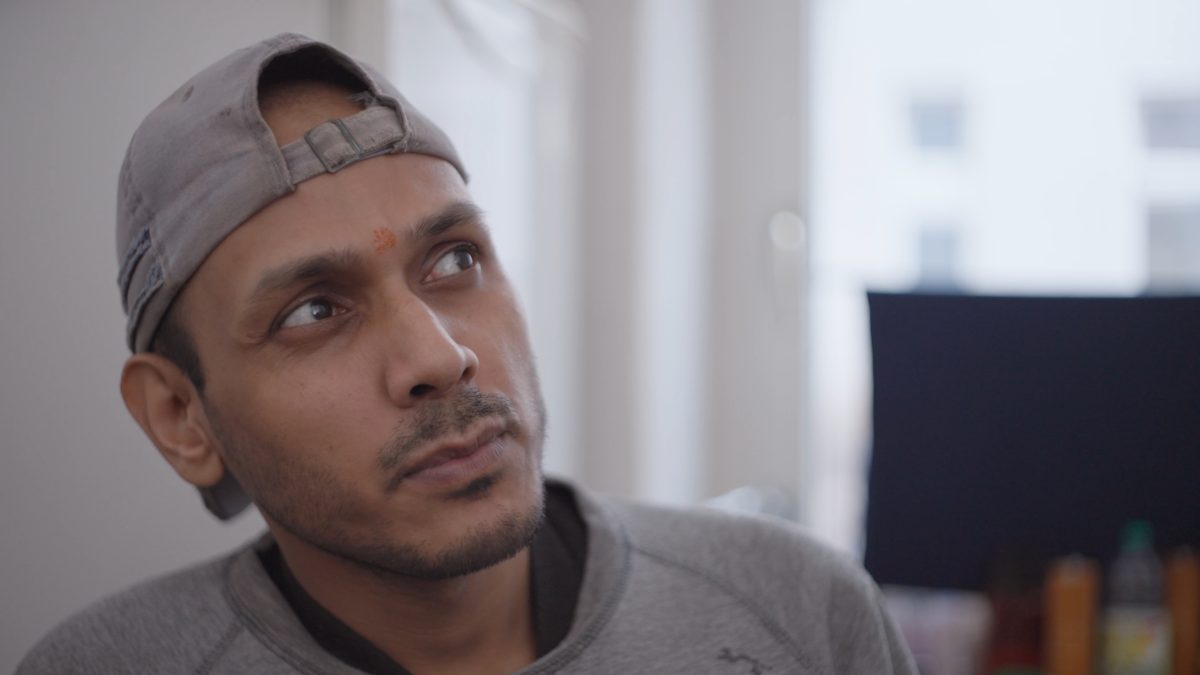
Debarun Dutta’s Berlin-set short film “The Delivery Guy” slowly enters a space where movement itself becomes a metaphor for suspension. The act of delivering food across unfamiliar streets begins to mirror a more interior delivery of selfhood, identity, and belonging that never quite arrives.
This short film lingers long after it ends in a quiet, almost unassuming way, revealing how labour can hollow out identity even as it promises survival. It shows that a job that appears transactional on the surface begins to seep into the psyche until the individual is no longer distinguishable from the service they provide.
The protagonist, cycling through the cold, impersonal cityscapes, defies being a mere object of pity. He embodies a figure suspended between worlds, carrying with him the residue of a home that is now abstract and a present that refuses to solidify into anything resembling stability. The film’s exploration of identity crisis accumulates through repetition of the same routes, the same deliveries, the same brief, almost invisible interactions with customers who rarely register his presence beyond the function he performs.
This repetition begins to suggest how labour, especially within the gig economy, is a structure that reorganises one’s sense of self into something fragmented, provisional, always contingent on the next order, the next rating, the next shift. There is also an undercurrent here that complicates the often romanticised notion of migration as upward mobility. What the film quietly foregrounds is the hierarchy.
It is embedded within labour itself, where certain jobs, particularly those occupied by migrants from the Global South, are implicitly coded as second- or third-tier, not necessarily in terms of skill but in terms of dignity, visibility, and recognition. This coding operates through a system that renders such workers perpetually replaceable.
Their individuality dissolves into the anonymity of service. It is perhaps this anonymity that the film interrogates most effectively, asking, without ever explicitly stating it, what it means to exist in a society that depends on your labour while simultaneously refusing to see you as a full participant within it.
The German context becomes crucial here, as a site of tension between historical narratives of labour rights and the contemporary realities of gig work. Germany is often associated with a strong tradition of unionisation and collective bargaining, where even a small group of workers can theoretically organise and assert their rights.
The film hints at the ways in which these structures are circumvented in the gig economy, particularly through the use of subcontractors, as the director later notes, which diffuse accountability and make it difficult to locate responsibility within a clear legal framework. This diffusion is embedded within the protagonist’s everyday experiences, where the lack of job security, the constant threat of dismissal, and the bureaucratic complexities surrounding visa extensions create a condition of precarity that is both economic and existential.
What emerges, then, is a portrait of labour that is deeply entangled with questions of legality and belonging. The ability to remain in the country remains tied to continued participation in a specific sector, effectively trapping the individual within a cycle that offers little room for mobility or transformation. The film does not dramatise this entrapment through overt conflict. It lets that pressure surface in small ways—hesitation, silence, decisions put off—until they gather into a quiet, suffocating weight.
There is also a subtle but significant contrast drawn between different migrant experiences, where refugees from regions such as Syria or Afghanistan are shown to have, at least in some cases, access to institutional frameworks that enable legal contestation. Whereas workers like the protagonist often find themselves navigating these systems alone, relying on individual settlements rather than collective action. This distinction serves to illustrate the uneven distribution of resources and support within migrant communities, further complicating the notion of solidarity that is often assumed to exist among those who occupy similar socio-economic positions.
The refusal of the film to perform resolution in any conventional sense, as if it understands that closure, in stories like these, would feel less like a sense of comfort staged for an audience that expects relief. The film chooses to remain within the incomplete, allowing its moments to taper off rather than culminate, allowing its conflicts to exist without the obligation of being solved.
It begins to resemble life more than narrative, where progress rarely announces itself, and victories arrive quietly, if at all. When they do appear, they are modest, conditional, and often quietly absorbed back into the same structures that produced the struggle in the first place, so that nothing ever feels entirely transformed.
This restraint arrives as a refusal to simplify what is inherently layered. And because of this, the film never slips into the easy language of messaging or instruction, never arranges itself into something that needs to be “understood” in a singular way. It creates a space where observation takes precedence over conclusion, and meaning is gathered almost incidentally, through fragments.
Even the way the city is filmed begins to participate in this sensibility, with its wide, open streets and endless routes that suggest possibility at first glance. Yet gradually begin to feel enclosed, almost airless, as if the very expanse of the space is what makes the individual within it feel so diminished, so difficult to locate.
This duality of candor that contains within it a subtle form of restriction becomes central to how the film understands movement, because the protagonist is always in motion. Yet this movement rarely translates into progression, instead circling back into itself, guided by the demands of labour, legal conditions, and the unspoken hierarchies that determine who moves freely and who moves because they must.
It is within this tension, between the illusion of freedom and the reality of constraint, that the film seems to settle most deeply as a condition. That extends beyond its immediate setting to touch upon something more diffused and difficult to name, where work, migration, and identity begin to overlap in ways that persist in that uneasy middle space where life continues, unresolved yet unmistakably real.
The film’s final refusal to provide easy resolutions or moments of catharsis is, in this context, one that aligns with its broader commitment to depicting reality in its most unembellished form. Victories are partial here, temporary, and often overshadowed by the persistence of structural constraints. It is precisely this restraint that allows the film to avoid the pitfalls of moralising or didacticism, instead inviting the viewer to inhabit a space of observation where meaning emerges gradually, almost imperceptibly, through the accumulation of details.
Even the visual language of the film contributes to this effect, with its emphasis on movement through urban spaces that feel at once expansive and claustrophobic. It presents a kind of freedom that is constantly undercut by the boundaries imposed by labour, legality, and social perception. In this interplay between movement and restriction, the film locates its central tension, one that resonates beyond the specific context of Germany to gesture towards broader questions about the nature of work, migration, and identity in a globalised world.
What ultimately makes “The Delivery Guy” so compelling is that it articulates, with remarkable subtlety, the conditions under which such questions arise, allowing its protagonist to exist as an individual. His experiences, while shaped by structural forces, retain a specificity that resists generalisation.
So, the film creates a space where the viewer is invited to confront the complexities of a reality that is often overlooked; it is a reality in which the act of delivering food becomes inseparable from the ongoing negotiation of identity, dignity, and belonging. The distance between origin and destination is measured not in kilometres but in the quiet, persistent dissonance of living a life that is always in transit, never fully arriving.
What this delineation ultimately gestures towards, without ever overstating it, is a larger, more familiar narrative that exists beyond the film’s immediate frame. The quiet architecture of aspiration shapes many middle-class imaginations, particularly within the Global South. Here, going abroad is often understood as a linear movement towards stability, dignity, and self-realisation. It is often a promise that carries with it the weight of familial expectation of financial hope, and of a carefully constructed belief in upward mobility. The film subtly unsettles this belief by placing alongside it the realities that such dreams often encounter, where the transition from one context to another rearranges precarity.
This is not presented as a dramatic “reality check” in the conventional sense. It is presented as a gradual recognition. In tracing this arc, the film does not negate the legitimacy of aspiration, nor does it reduce migration to disillusionment. It holds both in tension, allowing the dream and its interruption to coexist, revealing how the desire to move forward often carries within it an encounter with structures that are far less accommodating than imagined. It is within this coexistence of hope, labour, and the slow recalibration of expectation that the film locates its most enduring resonance, leaving behind a recognition that feels at once specific and widely shared.




![The Guilty [2018] Review – A Brilliantly Layered Claustrophobic Thriller](https://www.highonfilms.com/wp-content/uploads/2018/12/The-Gulity_HOF.jpg)
![Autumn Girl [2022] ‘Netflix’ Review: An impressive biopic that is entertaining and interrogative](https://www.highonfilms.com/wp-content/uploads/2022/03/Autumn-Girl-2022-768x432.jpg)
![No Bears [2022]: ‘IFFK’ Review – Jafar Panahi’s self-referential, introspective autofiction on artistic freedom condemns Iran’s repressive regime](https://www.highonfilms.com/wp-content/uploads/2022/12/No-Bears-2022-Movie-Review-768x432.jpg)
![Sutliyan [2022] ‘Zee5’ Review: This Mellow Tale of Familial Bond is Flawed but Watchable](https://www.highonfilms.com/wp-content/uploads/2022/03/Sutliyan-Zee5-3-768x327.jpg)