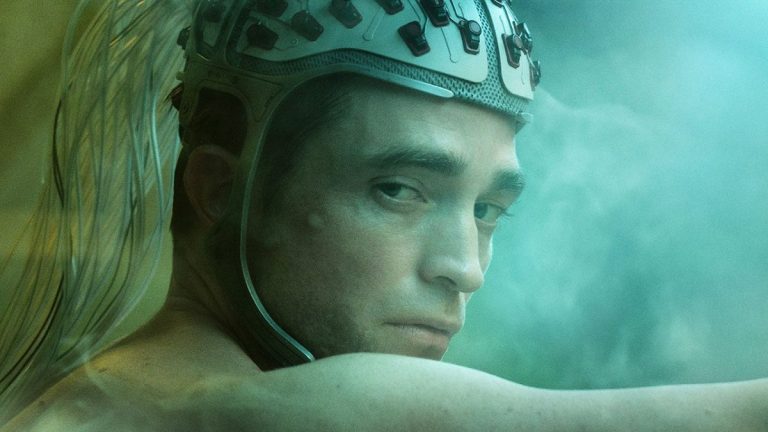
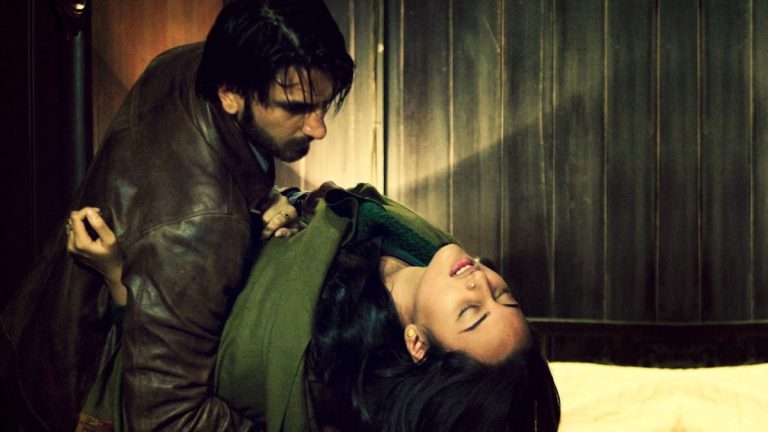
After creating the modern indie classics “Good Time” and “Uncut Gems,” Benny Safdie confirmed that he and his brother Josh were no longer working together creatively. Benny went on to co-create and star in “The Curse” with Nathan Fielder, while also taking on notable acting roles in “Oppenheimer,” “Happy Gilmore 2,” and “Are You There God? It’s Me, Margaret.” He then directed Dwayne Johnson in “The Smashing Machine,” the actor’s most serious dramatic turn in over a decade, which received mixed critical response and modest box-office returns. Around the same time, it was announced that Josh Safdie would team up with new cultural juggernaut Timothée Chalamet on “Marty Supreme”.
Josh’s creative team on “Marty Supreme” largely reunited the Safdies’ longtime collaborators. Much of the core group behind their earlier work returned, including screenwriter-editor Ronald Bronstein, costume designer Miyako Bellizzi, composer Daniel Lopatin (aka Oneohtrix Point Never), and “Uncut Gems” cinematographer Darius Khondji. While both brothers retained casting director Jennifer Venditti, Benny’s approach diverged sharply. “The Smashing Machine” marked the feature debut of composer Nala Sinephro and continued Benny’s collaboration with “The Curse” cinematographer Maceo Bishop, their third project together.
Despite both “Marty Supreme” and “The Smashing Machine” being unconventional attempts at the sports biopic, it was clear from the get-go that both directors’ visions felt almost polar opposite in execution and style. However, after letting the dust settle on both these films, I’d argue these solo directorial outings have a lot more in common than meets the eye.
Both films draw from real lives: “Marty Supreme” is inspired by table tennis legend Marty Reisman, while “The Smashing Machine” adapts the documentary of the same name that chronicled the rise and unraveling of MMA pioneer Mark Kerr. More importantly, each film interrogates the perils of ambition — the personal cost of dreaming beyond one’s limits, and the strain such obsession places on relationships and inner life.
It’s very compelling that both “The Smashing Machine” and “Marty Supreme” focus on the act of losing and how one reacts to failure. In the first act of both films, our protagonists end up losing a big title that both the audience and the characters believed they would easily win. For Marty Mauser, it’s losing the British Table Tennis Open to Japan’s Koto Endo; for Kerr, it’s losing to an illegal move in a big title MMA fight in Japan.
Kerr’s troubles at home — his turbulent domestic life and battles with addiction — contribute directly to his difficulties in Japan. Those personal struggles bleed into his professional career, eroding his focus and leaving him mentally unmoored. He’s shown to be a gentle, kind, and ambitious man, buckling under the weight of trying to have it all. Only when things are at a sense of equilibrium is Mark able to excel, but that is only achieved by the embrace of those around him. Mark isn’t alone in his venture to the top.
He knows that he has the support of his friend and fellow competitor Mark Coleman, his trainer Bas Rutten, and his complicated girlfriend Dawn. After the loss, the film refuses to dress the moment up. The locker room feels empty. Kerr stays behind, slumped on a bench, crying quietly. It’s anticlimactic. A fight went the wrong way. That’s it. The failure lands without ceremony, and the film lets it sit there, awkward and unresolved.
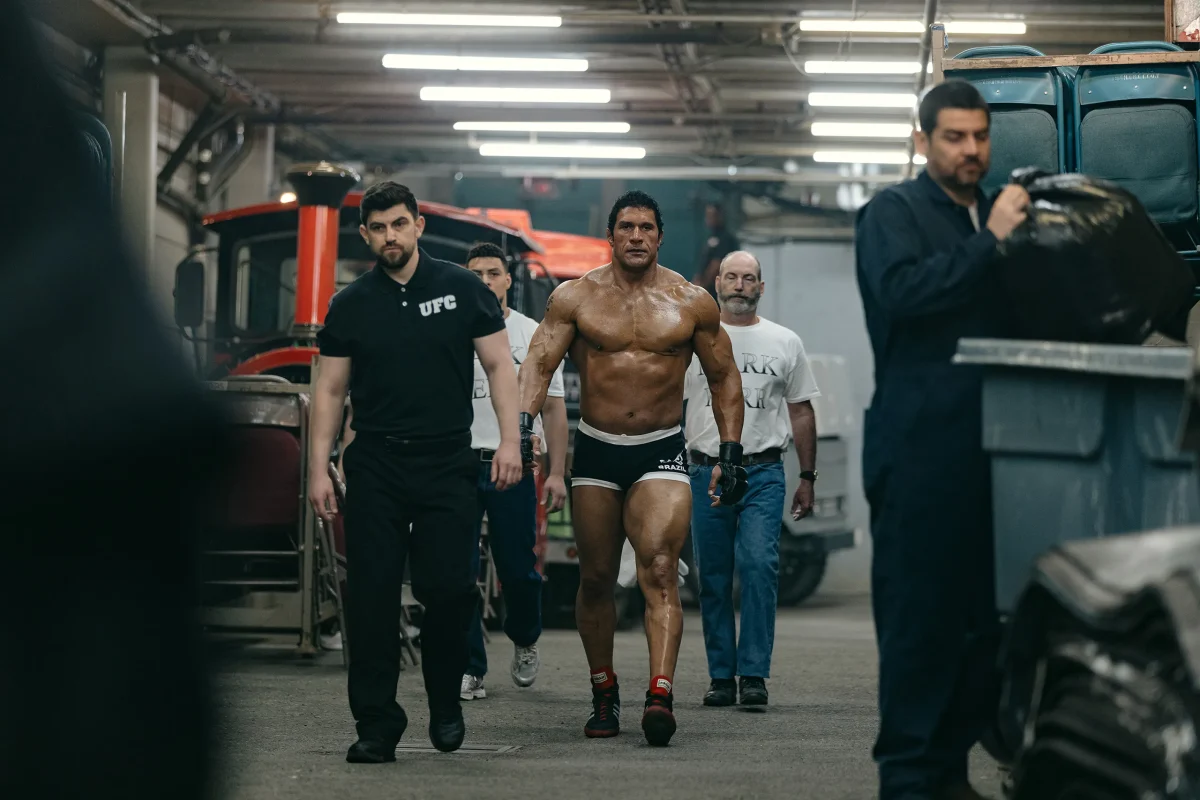
From there, the path forward drags rather than surges. Progress comes slowly and never in a straight line. Training, relapse, recovery, and repetition blur together. Life keeps intruding on the dream, and the dream keeps demanding more than life wants to give. Mark and Dawn circle the same problems, drifting apart and pulling back together. Kerr and Coleman lose touch, then reconnect, then test that bond again. Support doesn’t arrive once and stay intact. It has to be rebuilt every time. The film accepts that rhythm and stays with it, even when it goes nowhere.
Benny knows that the eventual rise, fall, and rise again of Kerr is as routine as they come, and he leans into these biopic cliches. Reveling in the inevitability of the expected beats, turning what should be spectacle into something more anticlimactic. The subdued jazz score paired with the distant and dreamy 16mm cinematography creates a grounded yet lightly expressionistic tapestry.
The casting of Dwayne “The Rock” Johnson, an actor and wrestler who is only associated with spectacle, is shown as a man struggling to accept losing, and that too in the most quiet way possible. The lack of spectacle with Johnson ends up being spectacle in and of itself. We expect to see him jumping out of a moving car, fighting a bad guy on a train, but here we see the exact opposite.
He’s fighting constantly, both in and out of the ring. But this is countered by scenes of mundanity: Kerr drinking Pepto Bismol due to stomach aches, shopping for souvenirs, and getting his hair done. The filmic equivalent of where The Rock is at in his career, a man learning to accept that he’s lost. “Red One” flopped, Black Adam’s attempted restructuring of the DCU went nowhere, the reviews were getting worse, and so was the box office. Creating the beautifully ironic imagery of a man who allegedly refuses to lose on screen, having to turn in a gentle performance about the struggle to be great, and accepting failure.
The film isn’t devoid of moments where it’s painfully obvious Johnson is trying to show the world he’s a serious actor, but they only enrich the text. Amplifying the inherent performance that is Mark’s domestic life, domesticity becomes another role to be played while chasing the high of the ring. Often resulting in continual anti-climax. At the end of the film, Mark doesn’t win the PRIDE championship; his friend Coleman ends up the victor. This should sting, but Kerr is genuinely happy for his friend. He tried his best, and he’s still a great fighter, just one that’s working towards a better, more balanced life. A victory in and of itself.
Also Read: All Safdie Brothers Movies (Including Solo Efforts), Ranked
Whether the same can be said about Johnson’s attempt at a rebrand is yet to be decided. “The Smashing Machine” was generally well reviewed, won Benny Safdie the best director prize at Venice, and earned Johnson a Golden Globe nomination. However, grossing $21 million against a $50 million budget isn’t a great sign.
Struggling to generate word of mouth and was subsequently shrugged off by both general audiences and film fans alike. The narrative of Dwayne The Rock Johnson’s return to real dramatic films didn’t get enough people through the doors. I mean, who can blame the public for not believing that narrative? He has other dramatic roles lined up, but the next time he’s hitting our screens will be the live-action “Moana” remake.
At its core, “The Smashing Machine” is a dissection of someone a little older trying to achieve a new sense of greatness. Kerr’s story takes place when the MMA and the UFC were in their infancy. Mark’s later career ambitions within this new style of fighting parallel Johnson’s switch to a more artsy, subdued drama.
However, “Marty Supreme” proposes that the pursuit of greatness is a young man’s game, and Timothee Chalamet is destined to be one of the greats. This kind of ambition belongs to the young—the ones who don’t know when to stop. There’s nothing quiet about it. Nothing particularly noble either. It’s loud, messy, and a little embarrassing at times. Just knowing what you want doesn’t mean much. And believing you’re meant for something more? That’s the easy part.
You need to be downright mad to win. For Marty Mauser, it’s the pursuit of greatness above all else. Nothing comes close – not his family, not friends, not the people he loves, or the people who believe in him. Everything is just a means to an end. Chalamet’s Mauser is post war american opportunism personified, the 1950s equivalent of the modern grindset hustle culture-obsessed youngster.
Demanding to be the face of table tennis, he wants to prove that he is not just a great player, but he is the great player. Dreaming of being a brand, a phenomenon, and with that ambition comes a uniquely American arrogance. Early in the film, he proclaims to journalists that he is “Going to do what Auswitchz couldn’t” and “Will drop a third atom bomb on Japan,” when referencing his fellow competitors.
Marty’s self-confidence borders on egomania – his confrontation with Ram Sethi, the chairman of the International Table Tennis Association, occurs due to his dismay that he isn’t being put up in luxury accommodation. He believes he’s the star player, and the fact that he isn’t being treated as such is criminal to him. Marty never once doubts his self proclaimed once in a generational talent, and gets sent into a frenzy by the mere notion of his life being anything but table tennis.
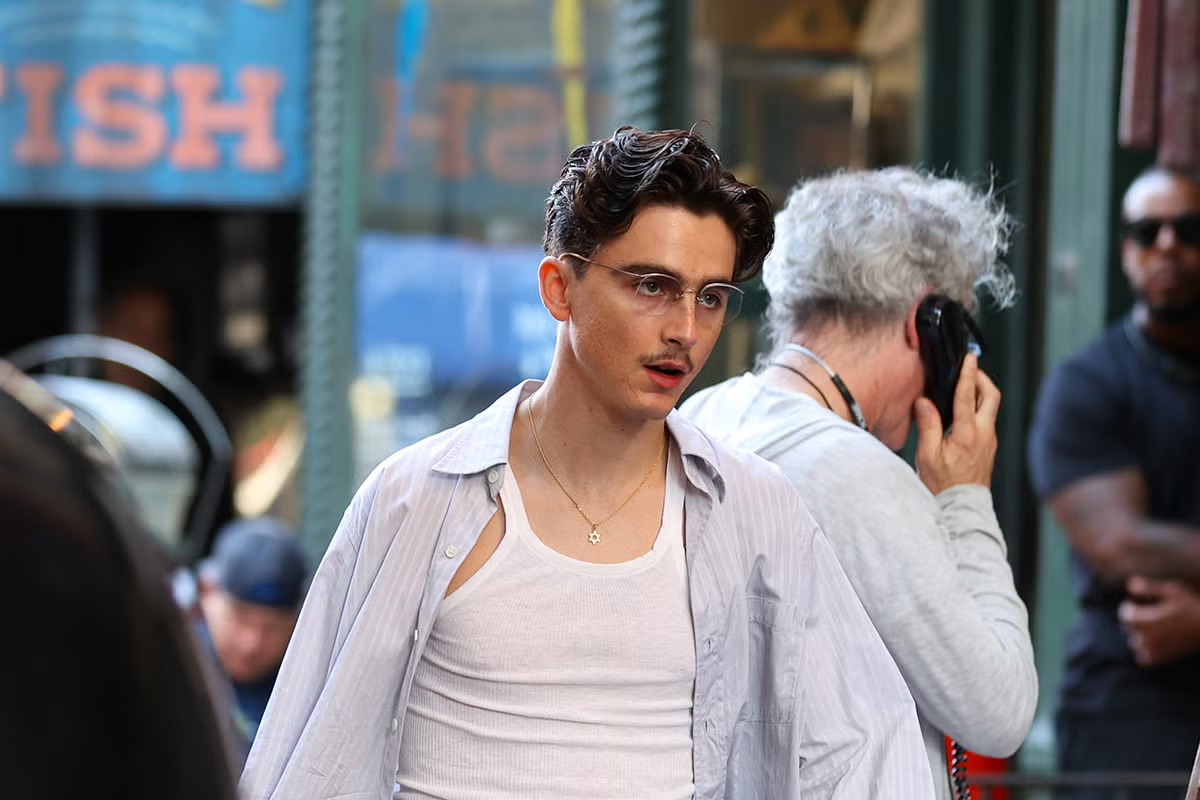
When Marty loses the British Open to Koto Endo, he erupts in a childlike tantrum. What should’ve been an ego death to humble a motormouthed ping-pong player ends up being fuel for a new fire. Marty’s loss turns Endo into a Japanese post war icon of perseverance, and turns Marty into an international joke.
His eventual return to New York reveals that the constant neglect and deceit he has shown towards his friends and family have actual consequences for the youngster, and he is nearly chased out of town. Yet that doesn’t deter him. In fact, nothing will rein him back in his pursuit of greatness. He doesn’t care if he has to lie, cheat, and steal his way to Tokyo to attend the table tennis championship.
Marty’s selfishness and the lengths he’s willing to go to win prove to be riveting cinema. Without a care for anyone else, he becomes a wrecking ball for anyone who is in his personal orbit. The only moments he swallows his aforementioned pride come from sheer desperation to further his table tennis dreams, as opposed to any sense of real growth.
In the lead-up to the film’s release, the internet at first was perplexed by the collection of stunts that made up the film’s marketing campaign: Neon orange blimps, musical collaborations with British new gen rappers, various big dreamers donning the briefly iconic “Marty Supreme jacket,” a surprise screening at NYFF, and the Las Vegas Sphere being scaled by Chalamet himself. Not to mention the string of old-school athlete-esque interviews from Chalamet, out in full force, gunning for both the film and his performance.
The whole campaign was boisterous, maximalist, and unconventional for a 1950s table tennis biopic. But for a film as audacious as “Marty Supreme,” it makes total sense. A marketing campaign focused on dreaming big, life imitating art, to project the character of Marty Mauser into the real world with Chalamet as the vessel. After all, Marty goes on an wild adventure with his friends, gives some incredible interviews, and creates some unique merch, so why shouldn’t the film’s marketing do the same in its goal of being hugely successful?
Chalamet’s performance extended into the press tour, and some of his more outlandish moments raised eyebrows but drew twice as many eyeballs. The brash nature of Chalamet and his character, Marty, is what makes both so compelling to watch. We know the talent is real, but it’s the ego that makes it compelling. Even if, as some speculate, it cost Chalamet an Oscar. That sense of being untouchable—the belief that failure simply isn’t an option—drives everything. It’s a kind of hubris that feels distinctly American.
Only in the aftermath of his bittersweet victory in Japan, when he returns home to meet his newborn son, does he finally care about something that isn’t table tennis. However, it can be speculated that he sees his son merely as an extension of his pursuit of greatness, his winner’s DNA passed on. Or perhaps this is Marty finally starting to grow?
Despite no longer currently operating as a duo, it’s fascinating that these two solo projects end up interrogating similar themes. Formally, “Marty Supreme” is playing some of the prior Safdie hits, but in a 50s period setting with Chalamet’s youthful energy, allowing the film to feel fresh enough. An examination of what happens when you believe that failure during the pursuit of greatness is not an option.
In opposition to this, Benny Safdie’s “Smashing Machine” aims to create a new sense of spectacle with the mundanity of learning to accept failure. These two stories end up acting as a yin-yang to each other, two sides of the coin of dreaming big. Despite being so different, they reach the same conclusion: life is so much more than just winning, and there’s a lot more than what we believe our purpose is.