
Madhuja Mukherjee’s “Deep6” begins to reveal itself when one stops trying to “follow” it in a conventional sense and instead allows its images, repetitions, and ruptures to accumulate like sediment. The film attempts to inhabit the sense of living in a suspended present, a limbo that the director herself describes as a space shaped by “personal and collective dilemmas, desires, despair”. The idea of change feels insufficient, almost illusory.
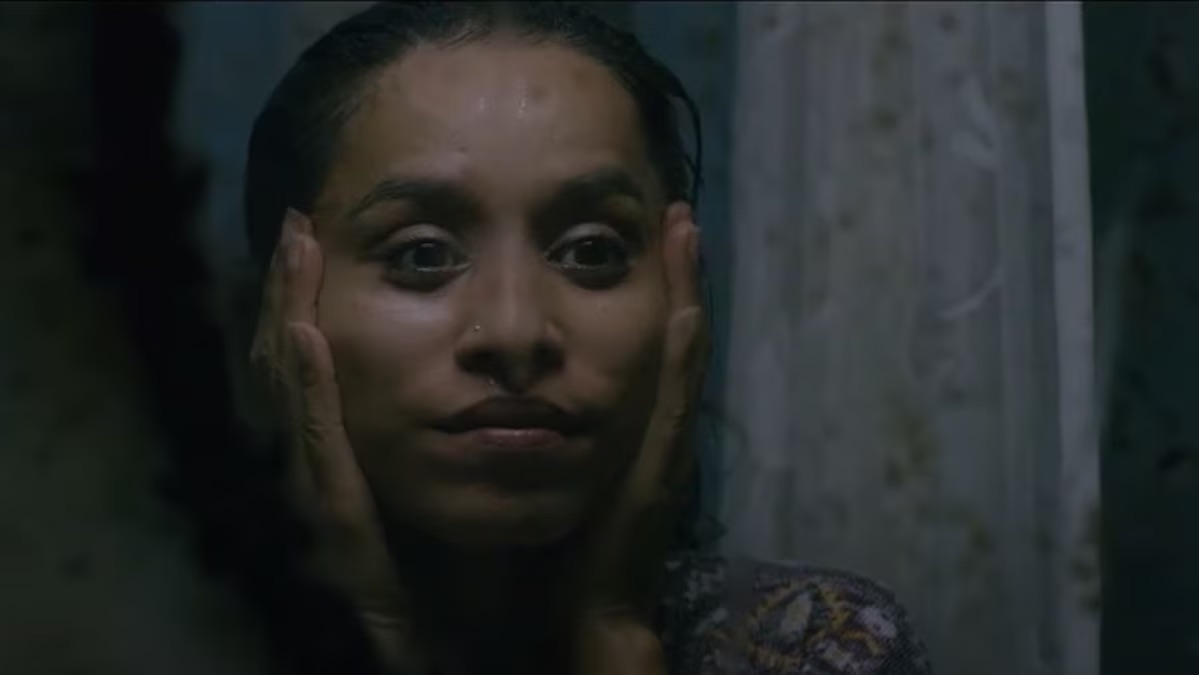
This becomes evident from the very first sequence, where Mitul stands at her grandmother’s funeral, not grieving in any recognisable way but instead appearing distant, almost indifferent, as though the event has already been absorbed into a larger, ongoing fatigue. The film refuses to reduce this moment to a mere character detail. It deepens it when she returns home to encounter her dead grandmother seated with an almost disarming normalcy in the living space.
Here, “Deep6” gently settles into a register where the supernatural arrives as continuity. Within this continuity, the presence of Mitul’s grandfather and brother, figures who begin to inhabit her living space as intimate co-dwellers, starts to form the central grammar through which the film understands memory, inheritance, and everyday life.
Their presence is marked by a quiet integration into routine, as though the boundaries between temporalities have softened enough to allow the past to sit beside the present without demanding resolution. This cohabitation allows the film to explore how histories left behind remain active, shaping the textures of contemporary experience in ways that are often felt rather than explicitly acknowledged.
The grandmother’s reflections—such as her sense that women often have nowhere to go—circulate within this shared space as lived truths shaped by time. When placed alongside her observation that those contemporary to Mitul may not have encountered the same density of difficulty and therefore inhabit the world differently, these thoughts open up a layered perception of resilience as something that is historically situated, evolving with circumstances rather than existing as a fixed measure.
The father’s remarks about Mitul’s late return and her slightly intoxicated state similarly enter this continuum, as part of a familial rhythm where concern, expectation, and perception intersect with gendered identities. When these voices of the ghosts present begin to share the same spatial field, the film constructs a kind of polyphonic domesticity where different temporal registers speak simultaneously, none of them cancelling the other out.
The ghosts of her grandmother and brother, in this sense, function as an ongoing present, their spectrality allowing them to exist beyond the constraints of linear time while remaining deeply embedded in the emotional and spatial reality of the home. This creates a cinematic space where love and loss are not positioned as conditions that can coexist, each informing the other. Within this framework, Mitul’s own movement through the house acquires a particular resonance as she navigates a varied layer of memories that are continuously being activated through these presences.
The supernatural becomes less about what lies beyond the visible world and more about what persists within it, what continues to accompany, observe, and sometimes gently reshape the present moment. It is through this careful and unhurried interweaving of the spectral with the everyday that the film articulates its most essential impulse. The sense of absence transforms into a different kind of presence, one that lingers, converses, and inhabits the same spaces as the living, allowing the past to remain an active, breathing part of the present without ever needing to declare itself as extraordinary.
As Mitul moves across the city, through offices, cafés, tramlines, dimly lit interiors, the film constructs Kolkata as a parallel consciousness, a city undergoing its own disorientation in 2011, when the long-standing Left regime collapses, an event that registers as an eerie continuity where “on the surface ‘nothing’ seemingly happens”, even as everything has already shifted beneath it.
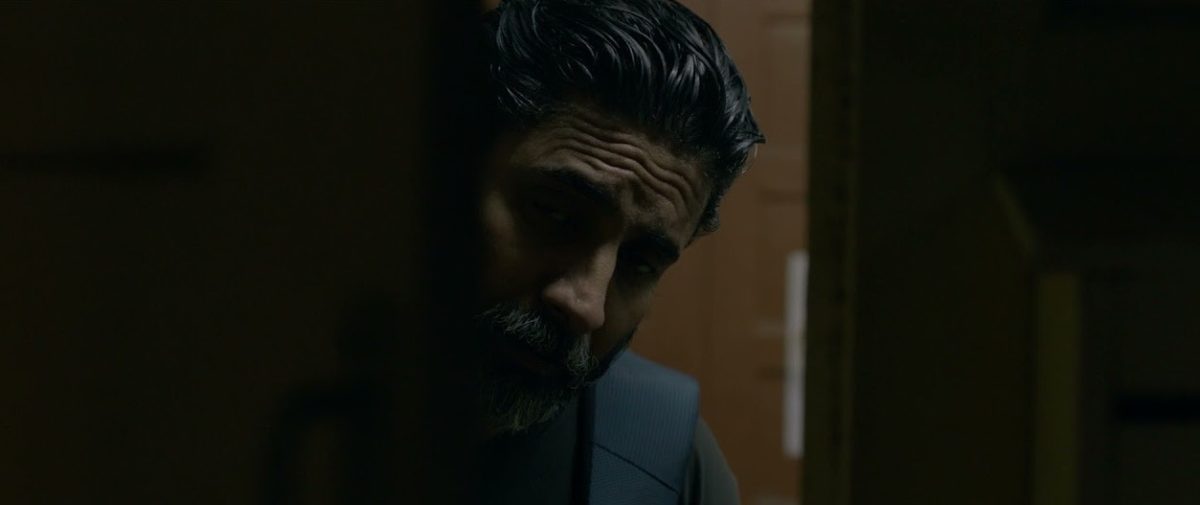
The film locates its central tension because of Mitul’s personal stagnation and her inability to fully detach from Arka, her ex-partner. Arka lingers both physically and ideologically, clinging to outdated political fervour, which begins to mirror the larger paralysis of a society that has lost its ideological anchor without finding a new one, so that scenes between them never quite resolve into confrontation or closure.
They stretch into uncomfortable durations, like the sequence where Arka stands below her balcony on a rain-soaked night, his presence both pleading and intrusive, and the camera refuses to cut away quickly, holding the space long enough for the moment to lose any clear emotional direction, becoming a suspended encounter where past and present collapse into each other.
The recurring scenes in the newspaper office, where Mitul sits at her desk, often silent, researching the American political world, while disembodied voices of colleagues engage in political debates that drift in and out of audibility, create a layered acoustic space where thought, ideology, and lived experience coexist without fully converging. Within this already textured environment, the moment involving the two figures—who intervene in what they perceive as an act requiring regulation—emerges, through Mitul’s gaze, as a quiet negotiation rather than an extension of the broader atmosphere shaped by deeply internalised ways of seeing.
This initial encounter itself is staged without heightened drama, almost as an extension of the city’s everyday rhythms, where different gazes coexist and occasionally intersect. The intervention by these men folds into the flow of the film, becoming one among many instances where meaning is negotiated in public space. Yet when their later appearance as headless figures enters the film’s visual field, the earlier moment is reconfigured.
It is as though the film is gently shifting attention from the act itself to the conditions that make such an act legible in a particular way. The absence of the head, which is traditionally associated with reason, identity, and authority, begins to open up a space where the gesture of regulation appears as something more diffused, almost structural, emerging from a broader network of perceptions. This reappearance defies the functionality of a surreal interruption in the conventional sense, to follow a continuation of the film’s ongoing play between realism and the unreal, where the boundaries between what is seen and how it is understood remain fluid.
What becomes striking is the manner in which it is absorbed into the film’s rhythm, without escalation, without spectacle, allowing it to sit alongside the other fragments as part of a continuum of perceptions that coexist within the same social space. Mitul’s position, then, acquires a particular density as a figure who moves in opposition to these readings. The headless figures, in this sense, extend the earlier encounter, transforming it into an image that holds within it both the specificity of the moment and its diffusion into a wider perceptual field where authority, interpretation, and embodiment are no longer neatly aligned.
So, the idea of the “mask” lingers as something that hides a truer core waiting to be revealed, but as part of the very structure through which reality is experienced and understood. For what is seen, judged, or even protected is always already shaped by layers that do not simply fall away. It is through this subtle yet precise weaving together of image, gesture, and thought that the film deepens its exploration of how reality is constructed, as a series of overlapping readings that continue to shift, reappear, and reconfigure themselves within the textures of everyday life.
The film’s subject begins to extend beyond individual experience into a more diffuse field of shared consciousness, where personal, political, and perceptual dimensions intersect without fully resolving into a single narrative line. Mitul’s rooms, office spaces, and transitional enclosures simply function as containers of suspended time, where gestures do not fully conclude and conversations do not entirely arrive, creating a sense that these interiors are holding onto moments rather than letting them pass.
This is where the contrast with the outside world becomes particularly intricate, because the city is presented as another temporal register altogether, one that continues, circulates, and absorbs. so that what emerges is a simultaneity of motion and stillness, where Mitul’s interior stillness and the city’s exterior flow coexist without resolving into each other, producing a kind of temporal dissonance that the film sustains with remarkable restraint.
There is something quietly overwhelming about “Deep6” that begins to unfold through a gradual thickening of time, where moments do not pass so much as they sediment. And nowhere is this more palpable than in the recurring interior sequences that seem, at first glance, almost incidental – like the dimly lit table where a group of older men sit under a single hanging lamp, their bodies arranged in a loose circle, glasses of alcohol, scattered food, cigarette packets, all placed with an almost careless familiarity. Yet the scene does not simply depict a gathering. It begins to function as a temporal enclave, a pocket where different decades fold into each other. As they speak – “All that revolution and stuff, did we sense it during the ’70s?”
The question arrives as something more unsettling than nostalgia, almost as if the memory of revolution itself is being re-examined from within a present that cannot fully locate its own political or emotional coordinates. When another voice follows with “All hallucinatory pep-talk!”, this dismissal complicates the past. It introduces a subtle doubt about whether what was once felt as intensity, as conviction, might now appear as something spectral, something that existed to affect as much as reality. The camera, in holding this table from a slightly elevated, almost observing angle, allows the men to appear both present and already receding, as though they are inhabiting their own after-image.
The conversation moves without resolution, of whether anyone has witnessed revolution or divinity. A question that quietly expands the scope of the scene, placing political experience alongside metaphysical inquiry, implies that both operate within similar registers of belief, perception, and perhaps even longing.
This is where the scene begins to resonate beyond its immediate dialogue, because it is not concerned with answering whether revolution was “real” or “felt,” but with inhabiting the instability of that distinction. The way the men continue to eat, sip, light cigarettes, their gestures repetitive and almost ritualistic, creates a rhythm that mirrors the film’s larger structure, where repetition leads to a deepening of ambiguity. When he casually remarks, “Didn’t we court at that time or go around College Street”, the memory of intimacy, of youthful movement through a culturally dense space like College Street, examines the frame as a faint overlay, something that coexists with the present without fully animating it.
This coexistence becomes crucial because it suggests that the past is being revisited as a fluctuating presence, one that cannot be entirely trusted yet cannot be dismissed either, much like the political ideals they refer to, which seem to hover between conviction and retrospect. And it is here that the scene begins to echo outward into the rest of the film, particularly into the way Mitul’s present is structured, because the ideological uncertainty that lingers in these conversations does not remain confined to this group but seeps into her household through the ghosts of her past.
What ultimately begins to settle, at least in the way the experience of “Deep6” unfolds over time, is a sense of fragmentation that feels less like a structural limitation and more like a deliberate dispersal of attention. The film resists gathering itself into a singular, cohesive emotional or narrative arc and instead chooses to move through a series of moments, textures, and presences that remain partially unanchored from one another.
This quality, while at first appearing as a kind of looseness, gradually reveals itself as a way of engaging with a world that is itself layered, interrupted, and continuously shifting. It seems to privilege the experience of inhabiting over the act of resolving, allowing scenes to exist with a certain autonomy, so that they do not always build toward a clear culmination but instead echo, refract, and occasionally drift away from each other.
In doing so, it creates a fragmented viewing experience. This becomes particularly noticeable in the way different registers of the spectral cohabitation with the grandfather and brother, the generational voices that move through the domestic space, the encounters in the city, and the interior rhythms of Mitul’s own life, intersect without necessarily converging. The film is less interested in synthesis and more attentive to the coexistence of multiple realities that do not fully reconcile.
Within this approach, fragmentation begins to function as a form of honesty, acknowledging that experiences of memory, identity, and belonging rarely align themselves into neat continuities. At the same time, this dispersal also creates a certain distance, where the absence of a central thread can make the act of holding all these elements together feel like an ongoing process rather than a completed one. The film’s texture acquires its distinct rhythm, one that moves through pauses, repetitions, and quiet disjunctions rather than through linear progression.
The effect is of something that remains open, where meanings continue to shift depending on how one moves through its fragments. This openness allows the film to linger beyond its duration, as individual moments of gestures, images, and lines of dialogue retain their presence even when they are not fully tied into a singular narrative structure.
The fragmentation becomes a way of preserving the multiplicity that the film so carefully constructs, ensuring that no single perspective or experience comes to define it entirely. While this may create a form that feels dispersed, it also allows the film to hold within it a range of temporalities, emotions, and perceptions that might otherwise be flattened in a more unified structure, so that what remains is a constellation of moments that continue to resonate in their own distinct yet interconnected ways.






![Titane [2021] Review – A horrifically tender story about love, rebirth, violence and family](https://www.highonfilms.com/wp-content/uploads/2021/10/Titane-1-highonfilms-768x432.jpg)
![The Tunnel [2011] Review: Undone By Its Weak Ending](https://www.highonfilms.com/wp-content/uploads/2019/09/the-tunnel-cover-768x432.jpg)