
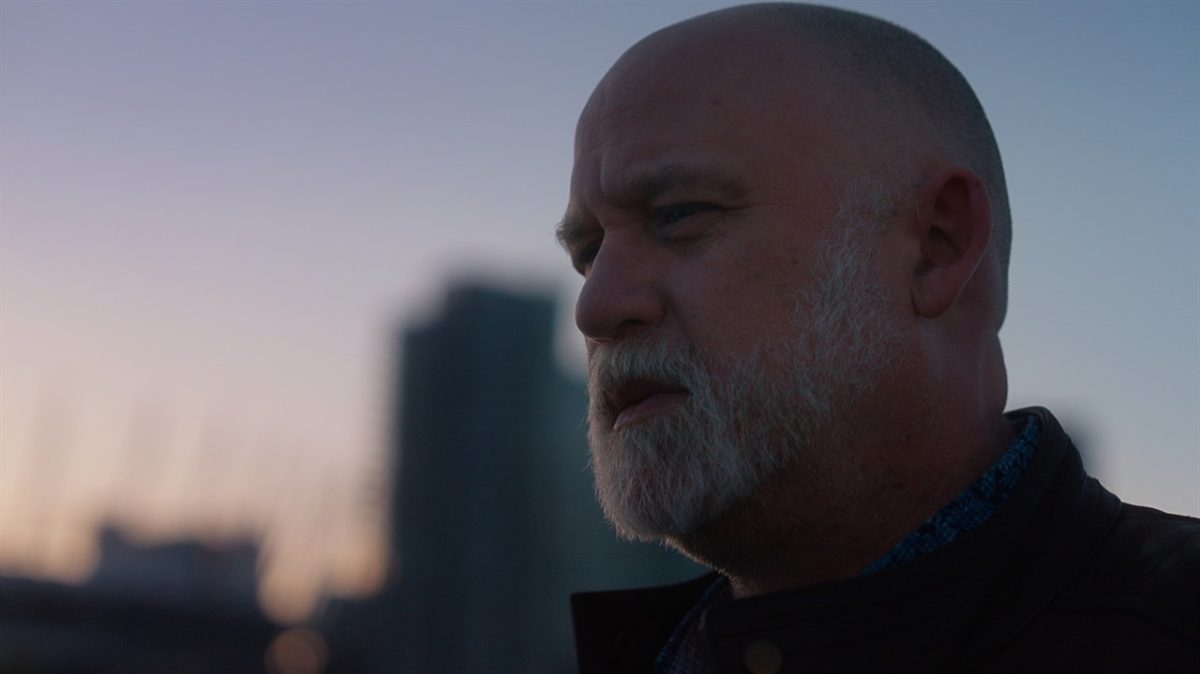
Searching For Drug Peace (2026) opens and closes with Dana Larsen looking out at a beautiful Vancouver landscape at twilight, lighting a joint, his face arranged into something like concern. He is placed there as if he were carrying the weight of a broken society on his shoulders, as if he were some tired reformer staring at the damage and wondering how to fix it. The film may not say this directly, but the image does a lot of work for him. That becomes the problem with the documentary. It keeps looking at Larsen as if he deserves that kind of gravity.
The setup is almost perversely watchable. Larsen runs the Coca Leaf Cafe, a shop where he sells illegal substances openly while presenting himself as an activist for drug reform. The store sells products connected to cannabis, mushrooms, coca leaves, and drinks or snacks mixed with coca leaves or other substances. He speaks the language of legalization and harm reduction. He even talks about the failure of prohibition, complaining about police pressure. Larsen carries himself like someone in public service, but the film keeps showing him as a shopkeeper first and foremost.
The film sees that contradiction, but does not seem willing to make it hurt. Larsen is not only defending a political cause. He is profiting from it. It changes the meaning of almost every scene inside the Coca Leaf Cafe. When he talks about reform, he is also talking about the future of his own business. When he complains about the law, he is also complaining about the obstacle in front of his own storefront. He calls himself an activist, but the question hanging over the film is how much of that activism is also a business plan. The documentary seldom faces it directly.
Instead, the documentary spends most of its time with Larsen at work. There are moments of him speaking, explaining, arguing, but the real center of the movie is the store: the counter, the products, the employees, the routine, the customers, the small rituals of selling things that are not legal to sell. The film offers brief counterpoints from public authorities or specialists, but they feel almost accidental, as if the movie knows it should include them and then rushes back to the more attractive material: Larsen and his circle.
A documentary argues through where it spends its time, not only through what its interviews say. And the time here belongs to Larsen, the center of the frame. He occupies the opening and the closing, alpha and omega. He occupies the shop and, symbolically, the moral space of the film. Even when the documentary shows the streets around him — people visibly in crisis, some using drugs on the ground — those images rarely stay long enough to challenge his worldview.
All of it becomes part of the atmosphere, a sad urban texture around the man the film actually wants to follow. That imbalance bothered me more and more. Larsen walks through a city visibly marked by addiction and collapse, and the film still seems more absorbed by his defiance than by the people pushed to the edge of his argument.
Vancouver’s overdose crisis is not a decorative backdrop for one man’s rebellion. It involves dependency, a poisoned supply, homelessness, grief, and public systems that are clearly failing. Yet “Searching for Drug Peace” has little interest in macro indicators or medical context, and even less interest in developing the voices that might challenge Larsen’s version of reality. It does not need to become a policy lecture. But if it is going to enter the city’s emergency, it has to do more than orbit a charismatic outlaw.
Larsen says, at one point, that he likes being challenged in interviews. The film seems to take that as part of his charm. But inside the documentary itself, he is protected from any real media-style ambush, any serious discomfort, or any moment where his rhetoric has to answer for its own contradictions. He is treated almost like a celebrity within his own small political world. People around him admire the risk, the brazenness. The film watches that admiration more than it interrogates it.
Some of the employees and allies around him make the atmosphere even uglier. There is an outlaw excitement in the shop, a feeling that being compared to drug dealers is not shameful or dangerous, but funny, maybe even cool. The line “be the dealer you want to see in the world” should sour the room. It is grotesque. In a city shaped by overdoses, that phrase cannot just be treated as a rebellious flavor. It should make the film stop and ask what kind of fantasy these people are living in. “Searching for Drug Peace” often lets that fantasy breathe too easily.
Also Read: 15 Great Films with Themes of Addiction, Drugs, and Alcoholism
Jerry Martin’s story should rupture the film. Martin pushes the logic further by selling harder substances, including cocaine, heroin, and methamphetamine. He is also a former user, which makes the entire situation feel less like activism and more like a warning sign everyone is refusing to read. His presence gives the documentary a chance to slow down and reconsider the easy romance of open illegality. The uncomfortable question is what happens when drug reform language starts to sound indistinguishable from the thrill of selling.
Then Martin relapses and dies of an overdose. The film includes his funeral, but even that scene gets absorbed into Larsen’s story. The wake becomes another platform. Larsen stands up and speaks about being even more motivated to continue. I understand grief can make people say strange things, but the documentary should not let that happen so smoothly. It barely registers the obscenity of that transformation: a man dies, and the surviving figure folds the death back into his own mission.
That is the kind of moment that can change a film’s rhythm. Here, it barely does. Martin’s death is treated as a tragedy, but not as a contradiction. It leaves the documentary facing an ugly question: whether some of these people are playing with language while others are playing with their lives. Instead, Larsen and the people around him seem almost incapable of recognizing the hypocrisies sitting right in front of them.
“Searching for Drug Peace” shows people with radical ideas about drugs and gives those ideas a lot of room without asking basic questions of risk and consequence. Cannabis, mushrooms, coca products, cocaine, heroin, meth, and opioids cannot all sit comfortably inside the same political slogan. They do not carry the same risks or create the same forms of dependency. They do not belong to the same debate simply because prohibition has failed around all of them.
The opioid issue is especially alarming. Any conversation about opioids outside hospitals or controlled clinical supervision requires enormous seriousness. The film does not always have that seriousness. It is drawn to bold gestures: the idea of open sale, the self-image of activism. It likes the friction.
The only moment that feels like a real shock comes when police raid the shop and seize much of the product. For once, the fantasy breaks. The employees seem shaken; some leave. The illegal business suddenly looks less like a brave experiment and more like exactly what it is: an illegal business exposed to legal consequences.
In terms of filmmaking, “Searching for Drug Peace” is plain but not uninteresting. Its access is valuable. The camera gets inside the Coca Leaf Cafe and stays there long enough for us to understand the daily rhythm of this world. We see the storefront as a workplace, a stage, a clubhouse, a political symbol, and a commercial operation. That material is strong. The shop becomes the film’s center of gravity. The suffering around it appears in fragments, just like the opposing voices. Larsen appears whole.
A more rigorous documentary might have used the Coca Leaf Cafe as one piece of a larger argument about harm reduction and addiction. This film does the opposite: it uses the overdose crisis to frame the story of Larsen. The opening and closing images bother me because they elevate him. They let him stand before the landscape as if he were reflecting on society’s wounds, when the film itself has shown us that he is a businessman selling illegal drugs without much visible weight on his conscience.
The failure of traditional drug policy is worth discussing. Vancouver’s emergency is worth serious attention. “Searching for Drug Peace” gives too much of its framing and its final image to a man who has every reason to sell himself well. It walks into a world of visible suffering and comes back with a portrait of a provocateur. For a while, that is watchable. After all the contradictions the film keeps absorbing, it is not enough.




![The Dose [2020]: ‘Fantasia’ Review – A slim story anchors an engaging directorial debut](https://www.highonfilms.com/wp-content/uploads/2020/08/The-Dose-La-Dosis-Movie-Review-highonfilms-3-768x414.jpg)
![For Your Consideration: Bastille Day [2016]](https://www.highonfilms.com/wp-content/uploads/2016/12/13016971-768x432.jpg)