There’s a scene in The Pitt, repeated across fifteen episodes of its second season, where Dr. Robby stands in the fluorescent-lit corridor of Pittsburgh Trauma Medical Center, triaging chaos with bureaucratic calm. He doesn’t shout. He doesn’t speechify. He just shows up, episode after episode, for the same fifteen hours, and does the work.
It turns out audiences noticed.
The ratings story of The Pitt Season 2 is not a story about spectacle. There are no dragons, no post-apocalyptic wastelands, no ensemble of Marvel characters colliding in a franchise crossover. It is a story about a hospital, and about how something that looks like endurance turned out to be the rarest thing in modern television: genuine, growing, sustained audience attention.
What follows is an attempt to understand what actually happened, why the numbers matter beyond their impressiveness, and what they tell us about the strange, contested, still-evolving medium of streaming television.
The Pitt Season 2 Ratings: What the Numbers Actually Show

Let’s start with what we actually know, and equally important, what we don’t.
What’s confirmed: Nielsen’s streaming data for Season 2 shows The Pitt reaching 1.21 billion minutes in a single week (March 23–29, 2026) and 1.16 billion minutes the following week, which was the first time it claimed the #1 spot on Nielsen’s overall streaming chart, not just among originals. Warner Bros. Discovery confirmed a Season 2 average of 15.4 million viewers per episode, which they call a 50% improvement on Season 1. The Season 2 finale drew 9.7 million viewers in its opening weekend alone.
What’s murkier: The 50% growth comparison sounds clean until you understand the denominator. WBD’s reported Season 1 baseline of “over 10 million viewers per episode” is a global, cumulative, 90-day figure. Nielsen’s own 35-day US-only measurement for Season 1 put that number at 6.18 million. The article claiming the show is “the third Max original to surpass 1.2 billion minutes in a single week” overlooks Quiet on Set, the 2024 docuseries that hit 1.3 billion, the highest single-week performance for any Max title at that point. And WBD never disclosed the Season 1 finale’s standalone viewership, making any “48% increase finale-over-finale” claim unverifiable.
This matters not to diminish the achievement, which is genuinely extraordinary, but because precision is what makes data useful. The show’s success is real and historic. The imprecision comes from a streaming industry that measures itself on its own terms, releases what flatters it, and presents proprietary metrics as if they were standardized ones.
1.21 Billion Minutes Viewed: Breaking Down The Pitt Season 2’s Record Week
1.21 billion minutes sounds like a number designed to be impressive. It is. But breaking it down reveals something more interesting than the headline.
Nielsen’s streaming measurement counts US television-screen viewing only. No mobile. No tablets. No computers. No international viewers. The actual global audience is substantially larger, Max doesn’t release those figures publicly.
For that week of 1.21 billion minutes, The Pitt had 15 episodes of Season 2 available, plus 15 from Season 1, 30 episodes in total. If viewers watched an average of 45 minutes per episode, 1.21 billion minutes translates to roughly 26.9 million individual episode viewings in a single week. For a show on HBO Max, a service with a smaller footprint than Netflix, this is not a niche number.
The more meaningful comparison is against itself. The Pitt Season 2 never, after crossing the billion-minute threshold, dropped below it. That is almost unprecedented. Shows built on binge-drops spike in Week 1 and crater by Week 3. The Pitt launched at 939 million minutes in Week 1, climbed for three weeks, sustained through the middle of the season, and peaked in its final stretch. The Wrap found that by Episode 12, Nielsen figures placed Season 2 at 8.3 billion total minutes, on pace to easily eclipse the 11.4 billion from the entirety of Season 1.
This is what sustained attention looks like in data form. It’s rare enough to be worth examining.
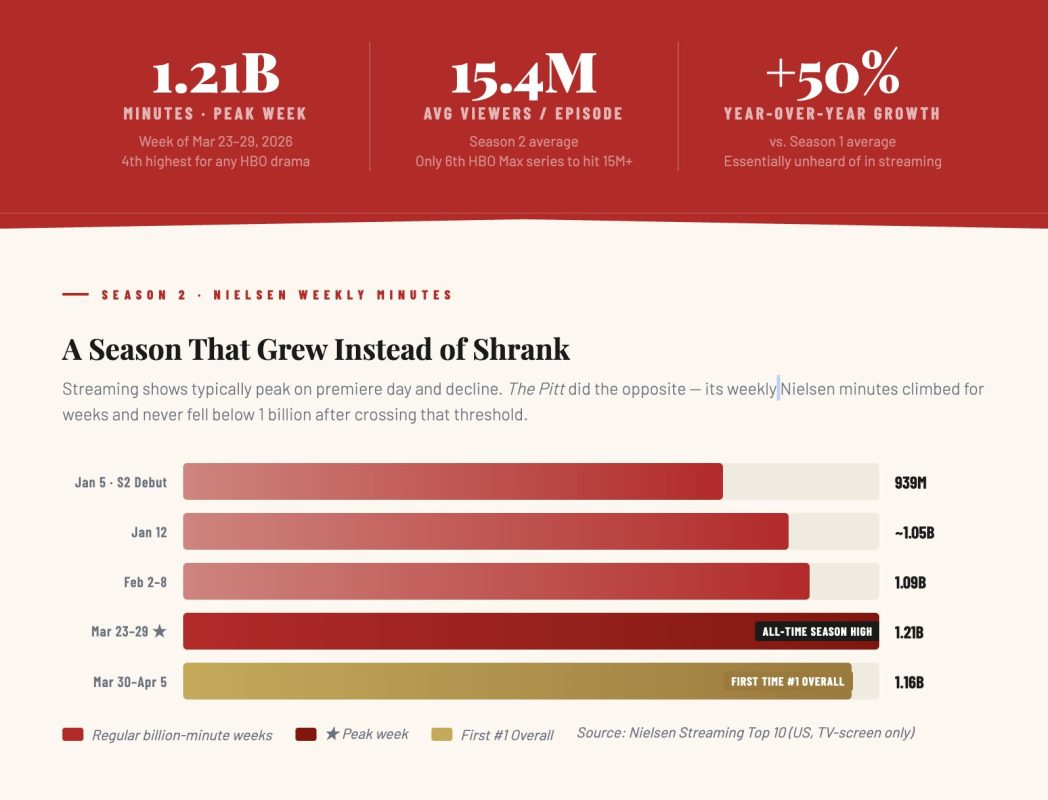
Why The Pitt’s Weekly Release Model Drove Higher Viewership Than Binge-Drops
Here is what the industry has been unwilling to admit clearly: the weekly release model didn’t just work for The Pitt. It may be the reason The Pitt exists as a phenomenon.
Binge-drop culture was built on a seductive premise, give audiences everything at once and let them self-schedule. The data has been telling a different story for years. Netflix’s own internal research (leaked in 2024) showed that shows drop 70–80% of their “event” conversation within 48 hours of a binge release. The shows that dominate cultural conversation for weeks tend to be weekly, HBO’s in particular.
The Pitt‘s 15-episode structure, releasing one episode every Thursday, created a sustained weekly appointment. Each episode functions as an event. Each week’s conversation leads into the next week’s viewing. New viewers can join mid-season without the anxiety of a 30-episode catch-up. The Wrap’s analysis noted the model “gives both fans space to convene weekly in the wake of a new episode as well as a more approachable midseason entry point for first-time watchers.”
The result: The Pitt grew its audience for 13 consecutive weeks in Season 1, and sustained growth through most of Season 2. The season average of 15.4 million viewers included late-joining viewers who started mid-run, a behavior pattern binge models actively suppress.
The implication for the industry is uncomfortable: by giving everything immediately, streamers may have been training audiences to consume and forget, rather than to invest and return.
The Pitt Hits 15 Million Viewers: What That Milestone Really Means for a Non-IP Drama
WBD announced that The Pitt Season 2 became “the sixth current HBO Max series to average 15 million or more viewers,” joining House of the Dragon, The White Lotus, A Knight of the Seven Kingdoms, The Last of Us, and It: Welcome to Derry.
Read that list carefully. Five of those six are fantasy, horror, or IP extensions of globally dominant franchises. The Pitt is set in a Pittsburgh emergency room. It has no dragons. Its characters have names like “Robby” and “McKay.” It does not exist within a cinematic universe.
What it has is craft and an underserved audience.
American medical dramas essentially died as a prestige genre after the early seasons of Grey’s Anatomy made them feel formulaic. ER, the genre’s gold standard, ended in 2009. For fifteen years, the ER procedural was left to broadcast, where it was competent, comfortable, and never very challenging. The Pitt walked into that vacuum not with reinvention but with rigor: real-time storytelling, accurate medical procedure (the show has been praised extensively by healthcare professionals for its fidelity), and a refusal to let personal melodrama displace the actual work of emergency medicine.
The audience that showed up for The Pitt was not a new audience. It was an audience that hadn’t been spoken to well, for a long time.
How The Pitt Season 2 Avoided the Sophomore Slump and Grew Its Audience by 50%
For decades, the second season of a prestige drama has been the industry’s great anxiety. The examples pile up: True Detective, Westworld, Sharp Objects having nowhere to go, Big Little Lies fading fast. Even shows that recovered (Succession, Better Call Saul) saw dips.
The Pitt Season 2 grew 50% over Season 1 by WBD’s own measure. The Season 2 premiere drew 5.4 million viewers in three days, up nearly 200% from the Season 1 premiere.
Several factors account for this, and they’re worth separating:
Awards momentum. Season 1 swept its Emmy categories. Awards attention drives back-catalogue viewing; people discover shows via nomination lists. By September 2025, after Emmys season, WBD said Season 1 was averaging 18 million viewers per episode, up from 10 million at the finale in April. That’s eight months of audience accumulation feeding directly into Season 2’s launch.
The TNT simulcast. Before Season 2 premiered, WBD aired Season 1 on TNT in December 2025, three episodes per week, uncut. Linear television exposure introduced the show to older demographics who don’t have Max but do have cable. Those viewers either subscribed or got Max access via family plans.
Word of mouth, not marketing. Max is not Netflix. Its marketing budget is smaller and its algorithmic recommendation engine less aggressive. The Pitt grew through the oldest distribution channel: people telling other people it was worth their time. The Rotten Tomatoes consensus for Season 2, “all in on narrative excellence, brilliant humanity, and heart-wrenching drama,” reflects the kind of critical consensus that translates into organic viewing.
The healthcare professional effect. Multiple major healthcare publications and social media communities of nurses, ER doctors, and paramedics actively recommended The Pitt for its accuracy. This created an unusual promotional vector: professional communities treating the show as an artifact worth sharing, not just entertainment.
Streaming Viewership Data: What Max Doesn’t Report and Why It Matters
Every number in this analysis comes from one of three sources: Nielsen (TV-screen US viewing, released with a four-week delay), WBD’s internal data (global, cumulative, self-reported), or trade estimates that blend the two.
There is no unified streaming ratings standard in 2026. Netflix, Amazon, and Apple release what they choose to release, when they choose to release it, defined however they want. Netflix counts a “view” as two minutes of streaming. Disney+ counts different engagement metrics than WBD. Nielsen’s measurement is the closest thing to an independent standard, but it only covers US television viewing, leaving out a significant and growing share of actual audience behavior.
This is the context in which The Pitt‘s numbers should be understood. They are extraordinary within the constraints of the measurement system that produced them. The actual phenomenon, the cultural reach, the global audience, the conversation, is larger still, and largely uncaptured.
What we can say with confidence: for a grounded medical drama on a mid-tier streaming service, sustained billion-minute weeks and 50% year-over-year audience growth are not just good numbers. They are essentially without precedent.
What The Pitt Season 2’s Success Reveals About the Future of Streaming TV
The Pitt Season 2 didn’t succeed despite being a slow-burn, methodical, non-IP procedural. It succeeded because of those qualities.
The streaming industry spent the better part of a decade chasing cinematic scale, prestige, franchise, event. The prestige model is expensive. The franchise model is saturating. And the event model increasingly depends on binge drops that spike and vanish before anyone can write about them twice.
The Pitt demonstrated something older and perhaps more durable: that audiences will return to a story week after week if the craft is good, the emotional stakes are real, and the subject matter is genuinely close to people’s lives. Emergency medicine touches everyone. Healthcare anxiety, staff burnout, institutional failure, the particular exhaustion of caring, these aren’t niche subjects.
They’re universal. And The Pitt found a way to make them feel that way, on television, in real time, fifteen episodes in a row.
The numbers don’t tell you why it works. They tell you that it does. Understanding the why requires watching it, and talking about it the next Thursday, with whoever else has been watching.
Which is, it turns out, quite a lot of people.
The Pitt Seasons 1 and 2 are streaming on HBO Max. Season 3 is in production.
Data sources: Nielsen Streaming Top 10 weekly reports; Warner Bros. Discovery press releases; Deadline, The Hollywood Reporter, Variety, TVLine, The Wrap, and Collider trade coverage.