
“Lee Cronin’s The Mummy” is curiously marketed with the director’s name, presumably to avoid confusion with the 1999 film from Universal Pictures starring Brendan Fraser, which is set to have a third sequel in the near future. Cronin isn’t necessarily a big enough name to draw attention in his own right, but his latest take on “The Mummy” mythology couldn’t be mistaken for anyone else’s.
Even the more horror-centric takes on the material, such as the classic 1932 Universal film and the Hammer 1956 classic, don’t have the mean-spirited, overwhelmingly visceral take of Cronin’s latest endeavor. “Lee Cronin’s The Mummy” is an effective calling card for Cronin, featuring inventive filmmaking and a fresh perspective on both supernatural mythology and a broken family dynamic.
However, Cronin’s skills as a director might be better suited for someone else’s material, as the screenplay constantly lets down the characters, creating a repetitive and ultimately exhausting experience.
“Lee Cronin’s The Mummy” follows the journalist Charlie Cannon (Jack Reynor) and his wife Larisa (Laia Costa), who have been staying with their children in Egypt whilst he is on an assignment. It’s after receiving an exciting promotion that Charlie discovers that his daughter Katie (Natalie Grace) has gone missing, with the only clues being an enigmatic connection with a dubious stranger.
Eight years pass, and Charlie and Larisa have raised their son, Sebastian (Shylo Molina), and younger daughter, Maud (Billie Roy), in New Mexico. Soon, they receive a shocking call from the private investigator Dalia Zaki (May Calamawy) that informs them that Katie has been found alive. However, Katie is now in an unrecognizable state after being trapped in an Egyptian sarcophagus, and she carries a deadly curse that could threaten her entire family.
Cronin specifically chooses to cut out the epic scope of prior “The Mummy” adaptations and set it in modern times, which at least leads to a more grounded perspective that’s not steeped in nostalgia. He’s also clever to make the infection of Katie purely accidental. This isn’t a case in which American travelers pay the price for meddling with a culture that they do not understand, as Katie just happened to be at the wrong place when she was preyed upon.
The examination of what a family goes through during an inexplicable, seemingly blameless crisis is well-handled, but the eight-year jump forward does rob the story of the most powerful moments. Larisa and Charlie aren’t established as a stable enough couple before their lives are overturned, making their fractured marriage after the flashforward less dramatic.
“Lee Cronin’s The Mummy” tackles the responsibility of parenthood like that of the director’s take on another famous horror franchise with “Evil Dead Rise.” But the intimate focus is less effective this time around. With “Evil Dead Rise,” there were specific economic and social situations that forced the characters to remain in a dark, contrived area that was clearly handling an evil presence.
Comparatively, “Lee Cronin’s The Mummy” seems to only barely note the professional resources that Charlie would have as a journalist, or the attention he would receive as an international traveler whose child went missing. These are minor quibbles that don’t ruin the film, but “Lee Cronin’s The Mummy” is tightly centered on a select group of characters whose relationships aren’t fleshed out. It’s understood that they are all grieving and missing Rachel in their own ways, but the individual dynamics between each parent and child are only occasionally touched on.
As was the case with Cronin’s previous films, this is a film that maximizes gore and cringe-inducing gross-out moments ahead of truly upsetting psychological drama. There’s fun to be had with Rachel as a demonic presence, as there’s only so much Larisa and Charlie can do once they’ve brought their daughter back into their lives.
However, the fact that Rachel seems to be handed over to them without any thorough treatment or follow-up analysis makes the film uneven, especially when the characters begin to resume their normal lives. There are often shocking moments of brutality and terror that are simply cut off, making it difficult to gauge what the repercussions were intended to be.
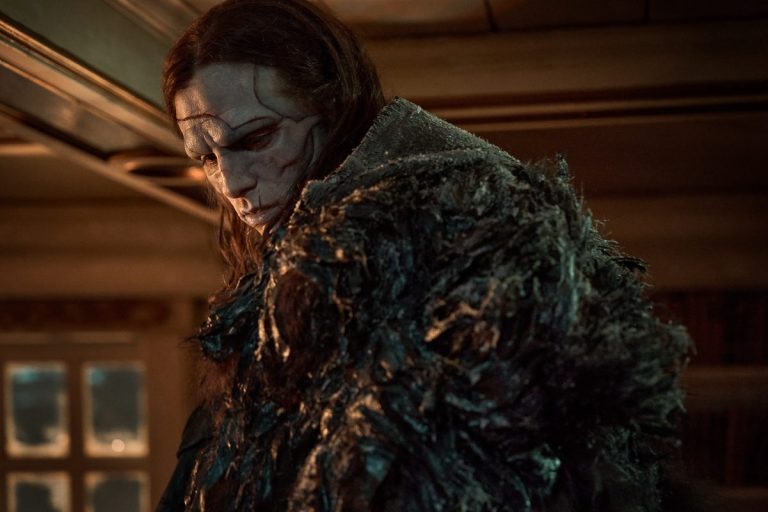
Cronin doesn’t fail to deliver with the effects, as the blend of practical and digital effects is mostly seamless until the third act, which does include some undercooked CGI. There’s always a concern with any film that bears the “The Mummy” name that it could present a villainized portrayal of Egyptian culture.
But Cronin seems eager enough to establish his own mythology that relates to existential evil, not tied to one group of people. Unfortunately, the backstory he’s convinced is not anything that hasn’t been seen in other possession films, and only becomes essential during a few pointless chunks of exposition. Even if it’s distinct from previous versions of “The Mummy,” the film borrows heavily from “The Exorcist” and “The Conjuring.”
The two leads are given relatively even screen time up until the film’s mid-point, in which Charlie is given the brunt of the development, in part because he feels most responsible for Rachel’s initial disappearance. Reynor conveys agitation and anxiety quite well, but Charlie seems to stay within the same emotional range for the majority of the running time.
He’s angry without being unreasonable, caring without being sentimental, and detached without being reclusive. While Reynor is a good actor, he seems unsuited for the role of an emotionally scarred father, even if the chemistry he shares with Costa is strong. As for the child actors, they mostly serve the purpose of being props, and don’t significantly harm or improve the film in either way.
“Lee Cronin’s The Mummy” has individual sequences that rank among the year’s most delightfully grotesque and shocking, but the haphazard editing and weak characterization don’t quite congeal in a coherent way.
The decision to completely isolate the story from any franchise-building mythmaking is admirable, but at times, it feels so contained that the story is restricted. Those interested in upsetting, sadistic body horror will find much to enjoy, but those expecting a rich new entry in a storied legacy might have to look elsewhere.





![The Severing [2022]: ‘Slamdance’ Review – Calisthenics that careen into tedium](https://www.highonfilms.com/wp-content/uploads/2022/01/The-Severing-Slamdance-768x576.jpg)