
My favorite Disney animated films are “Pinocchio” (1940), “Robin Hood” (1973), and “Aladdin” (1992). “Aladdin” has a special place in my heart since childhood. Released in 1992, during Disney’s Renaissance era, the film remains an impressive blend of hand-drawn animation, iconic music, and engaging storytelling from start to finish. At its core, this film offers a familiar story of self-discovery. The protagonist Aladdin, voiced by Scott Weinger, longs for something beyond survival. He is dreaming of a life where he is seen for who he really is, rather than what society labels him.
The primary location of this movie is Agrabah. Jasmine is a standout princess in Disney history. The side characters of Iago, Abu, and Carpet provide comic relief. The villainy of Jafar is both humorous and menacing. And the musical numbers provide emotional weight to the story rather than just being interludes. While the narrative is timeless, what truly elevates “Aladdin” into something legendary is, of course, the Genie. With all of the above working in perfect synchronicity, the film’s beating heart arrives in a puff of blue smoke. The Genie is not merely a side character. He steals the show.
Voiced by Robin Williams, the Genie explodes onto the screen with a force that feels like a cannon. From his first appearance, he announces that the rules of this film are about to be joyfully broken. He does not simply exist within the narrative of Agrabah; he comments on it, mocks it, and ultimately transcends it. What makes the Genie so revolutionary as an animated character is his demolition of the fourth wall.
The Genie does not just wink at the audience. He performs for them. He references contemporary celebrities, political figures, and movie tropes that exist outside of the time period that “Aladdin” is set in. At one moment, he’s a fast-talking salesman, the next he’s a game show host, a psychiatrist, a theater performer, or an old comedian. The character shape shifts not just physically, but culturally. This reinvention makes the Genie feel less like a resident of the film and more like a conduit between the screen and someone constantly winking at the audience. Every scene that the Genie pops up in, he changes his form.
One of these self-referential examples is when the Genie briefly transforms into an impression of Jack Nicholson, complete with the arched eyebrows. It’s a throwaway gag on the surface. Blink, and you might miss it, but it also encapsulates the character’s brilliance. He also turns into Pinocchio, referencing other Disney films. He references Groucho Marx, Arnold Schwarzenegger, and Robert Deniro. This is not humor that exists solely within the realm of Agrabah; it exists within our world.
Must Check Out: 10 Best Robin Williams Movie Performances
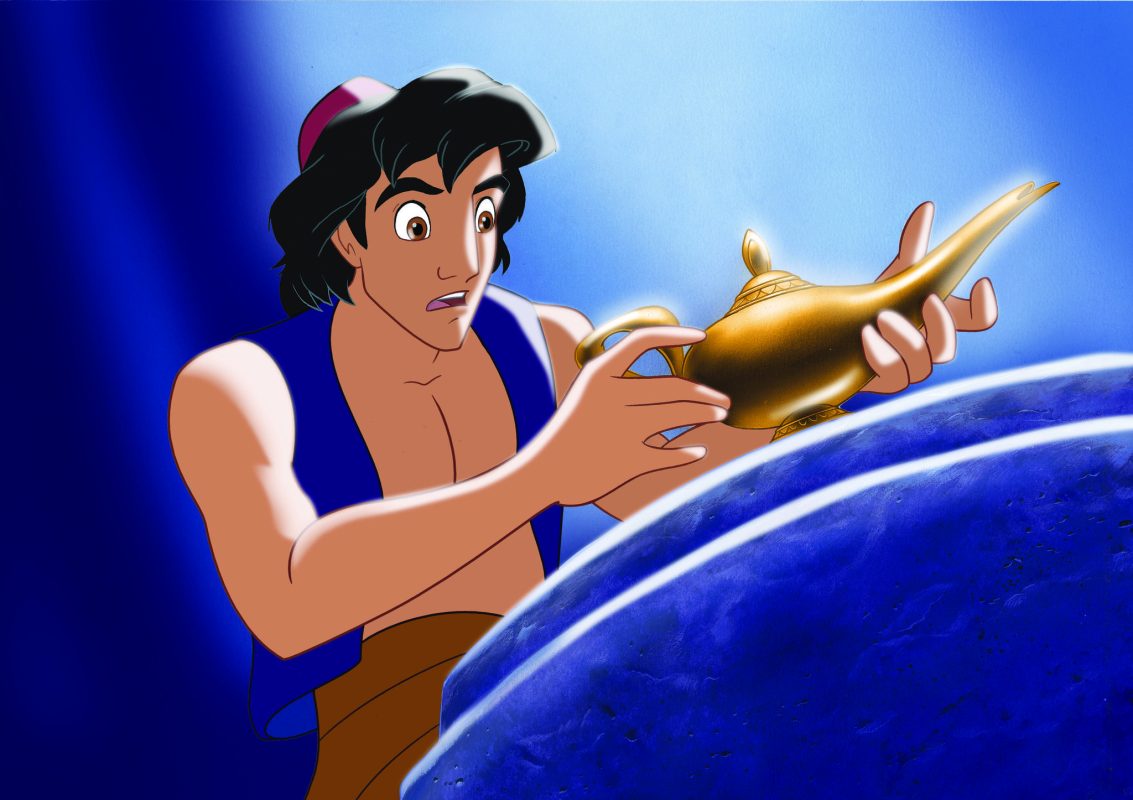
The Genie knows cinema. He knows Hollywood, knows that the audience is watching a movie, and he delights in making that apparent. He has been imprisoned in a lamp and is someone who has seen everything, but has experienced very little freedom. His humor becomes like a coping mechanism, a performance that is born out of isolation. In this sense, the Genie’s comedy is not just funny, but it’s also poignant. He talks constantly to Aladdin because silence would mean confronting his own captivity. Every joke, every impression, every fourth wall break is both a flex of power and a reminder of his captivity in the lamp.
Importantly, the film never allows the Genie’s meta humor to undermine its emotional stakes in the plot. When the time comes for sincerity, when the Genie reveals his longing for freedom, the comedy recedes just enough to let the vulnerability of his character shine through. This is where the fourth wall stops being a gimmick and becomes a tool. Because the Genie has spoken directly to us, joked with us, and acknowledged our world. His desire to be free resonates beyond the story.
The Genie changed the trajectory of animated voice acting, opening the door for more improvisational, name-driven performances, while simultaneously setting an almost impossible standard. Williams set a gold standard in voice acting in the 90s. “Aladdin” trusted its audience to keep up, and in doing so, it respected them.
It also demonstrated that films could be densely layered, operating on multiple cultural frequencies at once. Children could laugh at the slapstick and visual absurdity, while adults could catch the cultural satire and celebrity impressions. And who can forget the third act when Jafar transforms into a giant snake? And he traps Jasmine in an hourglass that is filling up with sand? This movie appeals to many different ages.
Moving beyond the Genie, the film itself is remarkably confident in production. The animation is expressive, the musical numbers are memorable, and the film balances humor pretty well. I am also a fan of the expanded “Aladdin” films and tv series. One of the first games I had growing up was an Aladdin game from the 90s. It was a staple from my childhood.
This broader ecosystem helped cement “Aladdin” not just as a movie, but as a full cultural presence in the world. The sequels and television series expanded the world of Agrabah, allowing more time with the characters and reinforcing how flexible and adventurous the setting could be. I remember playing the Agrabah level in “Kingdom Hearts” (2001).
With its vibrant visuals and platforming challenges, it made the movie feel tactile, as though the world on screen could be explored. For many viewers, “Aladdin” wasn’t confined to a single viewing experience, but it became something that lived across multiple forms of media. That was the brilliance of Disney.
This kind of cross-media longevity deepened the emotional attachment audiences had to the film, making Agrabah feel like a place you could return to. “Aladdin” became a cultural touchstone, revisited through reruns, merchandise, games, and theme park adaptations, reinforcing its staying power across generations.
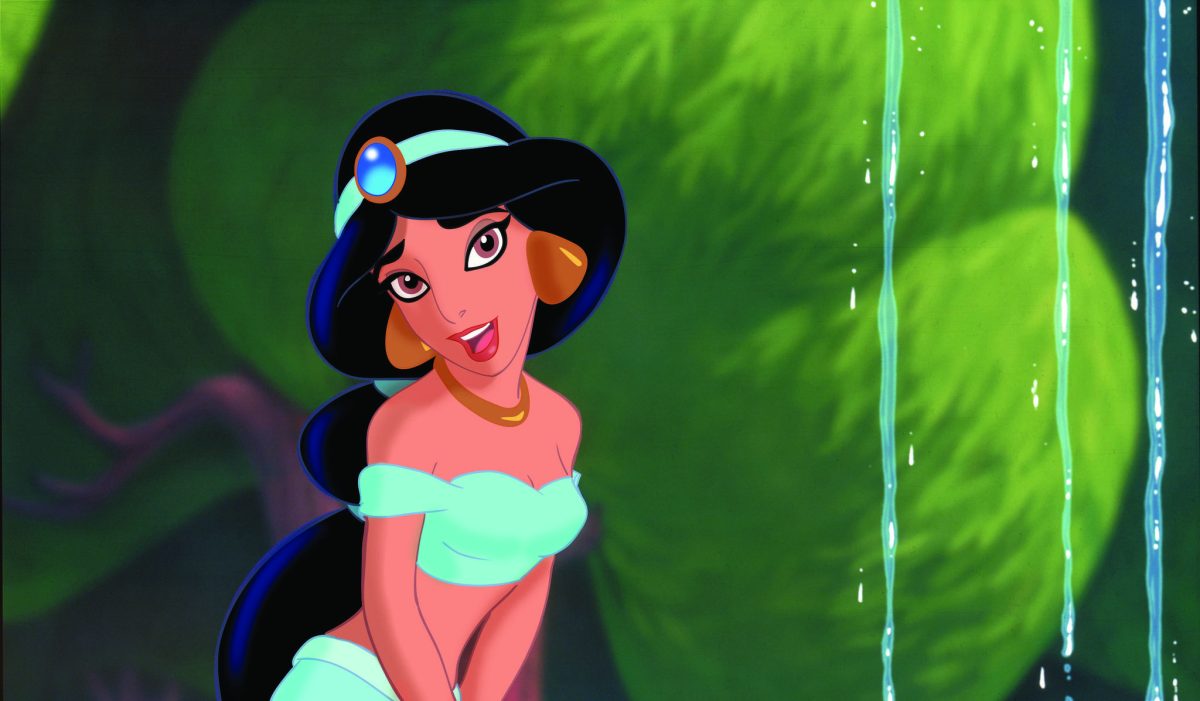
What also deserves recognition is how “Aladdin” handles its thematic arc with a surprising sense of maturity. The relationship between Aladdin and Jasmine is not simply a fairy tale story, but it is a journey rooted in identity as well. Aladdin spends time pretending to be someone else, Prince Ali, believing that his worthiness is something that must be performed rather than lived. Jasmine, in contrast, is one of Disney’s most self-aware princesses, outspoken about her lack of agency and unwilling to be treated as a prize.
This reinforces the film’s central idea that freedom can only exist when truth replaces illusion. Their dynamic feels grounded for a Disney romance, built on mutual recognition, rather than a projection. In this way, the film argues that authenticity is the true wish worth granting. It is a lesson that echoes the Genie’s own longing for freedom. And of course, we can’t forget what it was like being young, watching “Aladdin” for the first time, and seeing Jasmine wearing that red outfit at the end.
Also Read: 10 Best Jack Nicholson Performances
“Aladdin” succeeds because it understands momentum. The pacing is sharp, the humor never lingers too long, and the story moves with a confidence that makes its fantasy world feel alive rather than ornamental. Agrabah is not a static backdrop; it feels crowded, noisy, and constantly in motion, mirroring Aladdin’s restless desire to escape it. Even moments of danger are infused with playfulness, allowing tension and comedy to coexist without cancelling each other out. This balance is difficult to achieve, yet “Aladdin” makes it feel effortless.
The film knows exactly when to accelerate, when to pause, and when to let spectacle become louder than dialogue. That sense of control is part of why the movie still feels fresh decades later, rather than outdated. This constant forward motion keeps the film from ever feeling complacent, even in moments we know by heart. Aladdin’s energy mirrors the unpredictability of its characters, ensuring that the film never settles into routine and instead feels perpetually alive.
My favorite scene in “Aladdin” is the Cave of Wonders sequence, when Aladdin first sees the lion-shaped entrance and descends into its depths to retrieve the golden lamp. The Cave of Wonders is not just an obstacle but a character in itself, speaking in riddles and demanding clarity by insisting that only the “diamond in the rough” may enter. What makes the scene truly powerful is its thematic precision. Aladdin’s greatest test is not bravery or skill, but this time it is restraint.
Abu’s single, impulsive touch of a jewel collapses the illusion of reward and transforms the cave into a nightmarish trap, reinforcing the idea that greed corrupts even the purest intentions. Another aspect of this film I appreciate is how grand the scope of all the locations is. I would also recommend catching the sequels “The Return of Jafar” (1994) and “The King of Thieves” (1996), as well as the “Aladdin” Series (1994), which expands on this universe.
“Aladdin” is more than a classic animated film. And at the center of this is a tornado that knew exactly how to make sure we would never forget him. The Genie doesn’t just entertain, but he elevates. He bridges the gap. Apparently, Robin Williams improvised so much that they ended up with over 16 hours of material.
The Academy actually rejected “Aladdin” for a “Best Adapted Screenplay” nomination because of how spontaneous the dialogue was. Decades later, “Aladdin” endures because it understands that animation is not limited to realism, logic, or time, but is powered by imagination and characters. And no character embodies that truth more completely than the Genie, who turned a great Disney film into a legendary one.





![Old Stone [2016] – A Taut Drama on the Bone-Chilling Bureaucratic Insensitivity](https://www.highonfilms.com/wp-content/uploads/2018/05/cover-768x432.jpeg)
