
A rewatch of Maneesh Sharma’s “Band Baaja Baaraat” (2010) had turned up without any burden of rediscovery or a topical probe. But it nevertheless made me reassess the whole business of movie romance. You don’t expect a film like “Band Baaja Baaraat” to work its way under your skin over time. I certainly didn’t. You expect it to settle amiably where you left it. Well, the joke’s on me. For what once registered as mere amiability had now revealed itself as form.
What felt incidental turned out to be knowingly developed. Seems that way to me, at least. The rewatch presented this minute to have another think about the film and how it strums counter to the standard courtship grammar of rom-coms. Dispensing with overworked reflexes, the romance here doesn’t take effect via ceremony. Instead, it hinges on discretion that the genre still has trouble exercising.
Most romances launch into the cliché of laying down intent. Someone fancies someone. Desire is professed, or at the very least signposted. The blocking adjusts. The image insists. You know the drill. The film spells out clearly: pay attention, romance is happening. And we’re supposed to fall for it. “Band Baaja Baaraat” knew better. In fact, the film seems intent on clearing the air early, refusing the familiar genre expectation of courtship as a manoeuvre. Bless the restraint cause, there’s no “first spark.”
Bittoo’s seduction scheme is shut down before it can harden into a plot, puncturing his stock gamesmanship. There are no hasty scenes punctuating the “everything changes now” trite. The film throws out the silly business and casually moves on. In freeing up that narrative turf, it allows love to be the eventuality rather than the seed. Which, in this case, makes all the difference. Bittoo and Shruti’s love is not love at first sight, but love after many sights. If you care for that sort of thing.
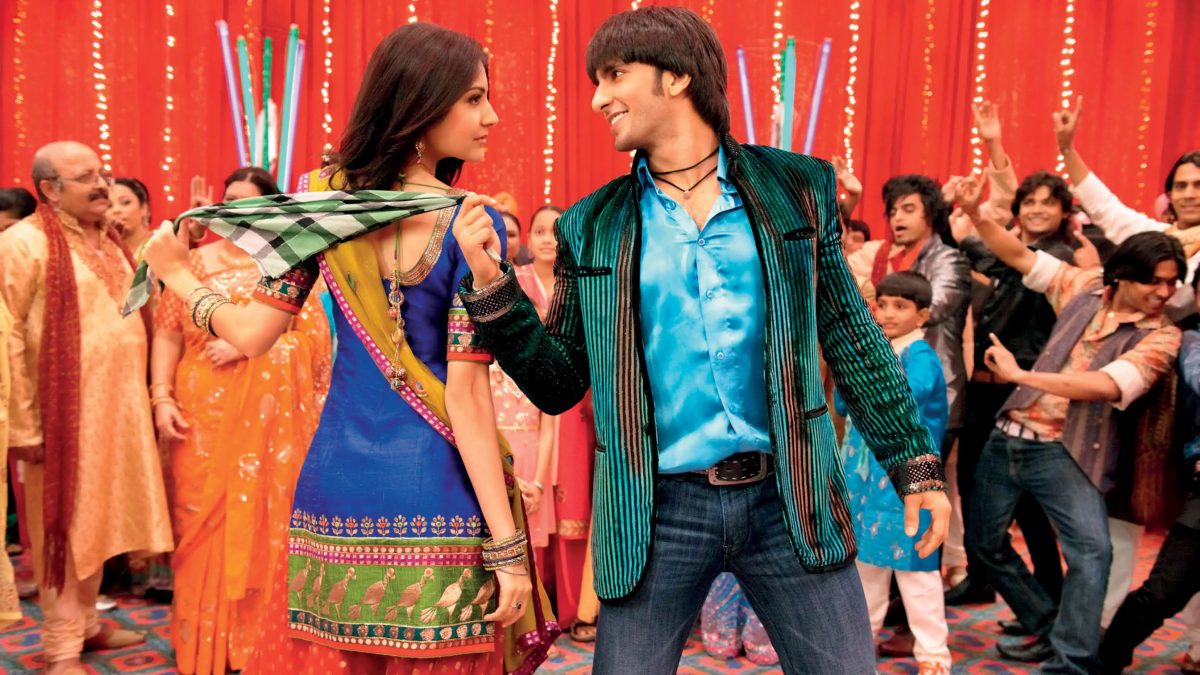
For what it’s worth, one impression that I couldn’t shake during this revisit—and which would kill most romances dead—is how Bittoo and Shruti start borderline sibling-coded. Not that I’m complaining. It does the trick. It’s the quasi-sibling code that understands closeness without sexual tension. Understands teasing without an agenda. Understands banter minus the performance. Whether it’s by design or mere instinct hardly seems to matter. What’s striking is how much time passes before the film asks us to read their proximity as romantic.
The image doesn’t flag them as a couple for a long early stretch, nor is the gaze charged to kick things off. In a genre keen on madcap declarations, “Band Baaja Baaraat” shows what has to be in place before love can make sense. By no means is it in a hurry to put classical romantic embellishments into effect. The first touch—a pat on the shoulder or a playful shove later on—feels habitual. Even the eventual sexual encounter, when it happens, feels like a spillover.
What “Band Baaja Baaraat” keeps returning to is a functional intimacy the rom-coms seldom know how to stage. Even so, the film doesn’t pretend the question is whether they’ll get together. Of course they will. That’s entirely beside the point. What’s really at stake is whether they can do so without the genre flattening them into types. It’s gratifying when a film like this atypically foregrounds equitable partnership. It doesn’t rely on gendered emotional scripts to mine butterflies.
Neither Shruti nor Bittoo in the film is positioned as the center of feeling, while the other orbits. Neither of them tries to impress the other romantically, nor are they being reshaped into the other’s romantic ideal every step of the way. The mere notion of Shruti being softened or made pliable to become desirable, or Bittoo being drafted as a man renewed whose personal growth now allows romance, feels sickening.
They are a long way from being genre avatars, performing for you or each other. They’re not attending to any self-image and move through the image with a decisive ease. Which is not nothing. Such hard-wired lack of pretense is as much an aesthetic cornerstone as it is ideological. Bittoo’s telling all comes through plainly precisely because it’s unvarnished and plain.
It’s a case in point of the only emotional school of thought the film cares for. The film isn’t, as it became clear on the rewatch, one to give in to the romantic exceptionalism that would so often pass for feeling in a romance. Bittoo and Shruti are tethered together. Not because of screenplay obligation, but because the strange logistics of each other’s personal space come naturally to them.

Then there’s Ranveer Singh as Bittoo. As I saw it, if the film finds its pulse anywhere else, it’s in his performance. And while Anushka Sharma as Shruti allows for no proxy either far as I’m concerned, Ranveer’s Bittoo carries a presence so uninhibitedly malleable that I would like nothing more than for the film to hold on to it until it lights up.
His name quietly gives him away. It gives out a nickname that never quite grew up. And Ranveer clads this scaling down by language like a second skin. Imagine him a foot shorter, and the thesis will sharpen. I won’t belabor that. And through all that, Shruti turns essential, giving his unruliness something to push against. You can almost feel the film let up when she’s in the frame with him.
Any deviation, then, feels like a breach. The quiet heat of their relationship comes from a closeness and care that is practically familial, and that being so, so non-negotiable—something more like co-dependency. Chetan, the supposedly “better” romantic move, evokes a category error as the dead air of streamlined. As a disturbance in a private arrangement that predates him, he registers as a hand placed where it doesn’t belong. Sounds dramatic, but feels as if.
Just the name is enough to grate. Fucking Chetan. Being jeopardized, then, is the precious asymmetry that animates Shruti and Bittoo and that makes love possible at all. It’s a hell of a thing. The sensations that move between them—like the way a nudge holds both reprimand and tenderness—are rare. And with each rewind, I’m left jealous in the most ridiculous, unjealous way of the private language that’s totally Shruti and totally Bittoo.