
A short about sexual harassment is a tricky tightrope to walk. In about fifteen to twenty minutes, you must accomplish three tasks: enrage the audience, build empathy for the victim, and make them feel the weight of something deeply uncomfortable. In a longer format, that’s an easier task; you have time to develop characters, create emotional beats, and let the story breathe. But when it comes to short films, there’s no luxury of time. In this media, every second counts, every look carries meaning, and every word has to cut through.
That’s exactly what Marnie Blok achieves in “Beyond Silence.” The film wastes no time in establishing its premise or the emotional states of its characters. It opens in a closed room with three women: Eva (Henrianne Jansen), a deaf abuse victim; Anna (Sigrid ten Napel), her translator; and Sandrine (Tamar van den Dop), the dean who is trying to understand Eva’s allegations. The conversation begins almost immediately, without any cinematic cushioning. There is no comforting introduction and no unnecessary talk to ease the audience in. It’s relentless from the first frame, and that is precisely the point.
Blok’s brilliance lies in the way she uses the “female gaze.” This is not a story about the spectacle of pain or a dramatized retelling of trauma. Instead, she captures the rawness of a woman forced to relive her abuse, surrounded only by other women, yet still trapped by the invisible walls built by a male-dominated system. Just the fact that Eva refuses to speak to a man about her abuse speaks volumes about her psyche. It tells us how deeply her trust has been shattered, how her trauma is rooted not only in the act of assault but in the very structure of power that allows men to get away with it.
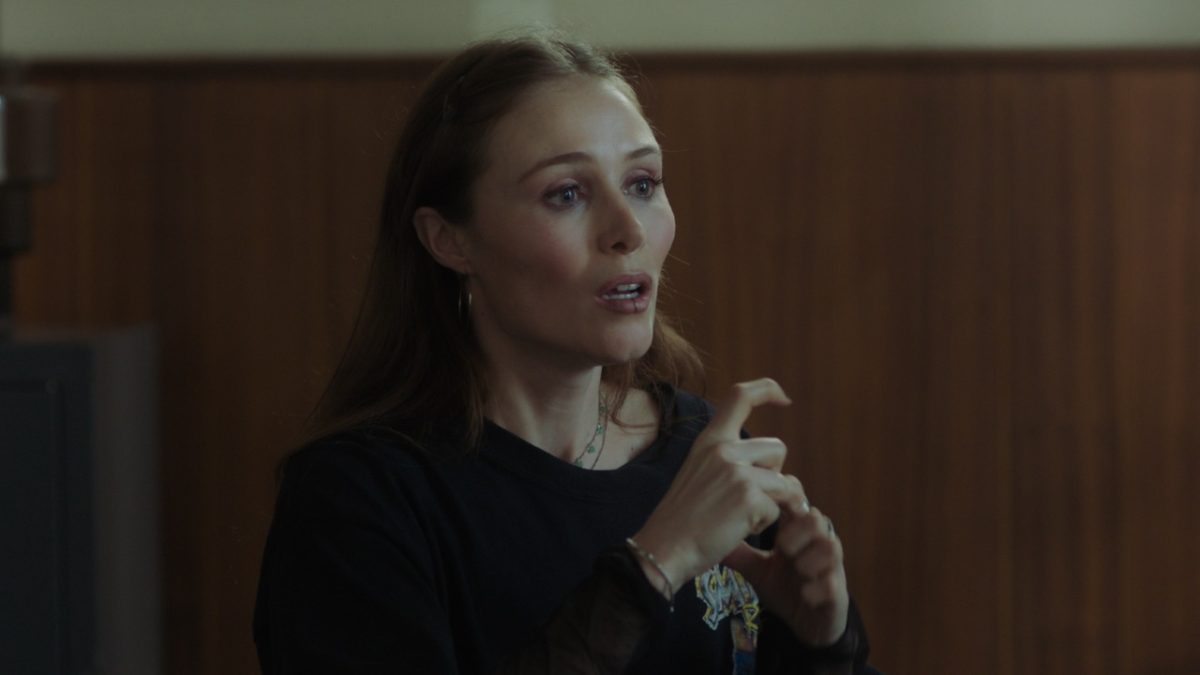
Blok turns this narrative device into an act of rebellion. It acts as a refusal to let the male gaze interfere with how her story is told. The film puts the audience, especially men, in an uncomfortably introspective position. If you are a man watching this, “Beyond Silence” almost feels like it’s holding up a mirror, forcing you to confront the possibility that silence, indifference, or ignorance can make you complicit. The uncomfortable truth that the film asserts, that every man carries within him the potential for harassment or harm, isn’t presented through preachy monologues or shocking imagery. It’s delivered through dialogue, which is restrained, sharp, and disturbingly real.
The most striking thing is that “Beyond Silence” isn’t just angry at the perpetrator. It’s angry at everyone, at the victim for staying quiet, at society for normalizing abuse, and at institutions for covering it up with bureaucratic niceties. It’s an anger that feels earned, not exaggerated. The script doesn’t moralize. Instead, it humanizes and indicts simultaneously. When Eva recounts how her professor harassed her, the details are minimal; we don’t see flashbacks, no explicit imagery, just her words. However, the words alone are enough to break you. She didn’t even have the time to resist, to comprehend, to say “no.” Blok trusts her audience enough to let the horror of that sink in.
Also Read: Objectification or Empowerment: Exploring the Male Gaze in Yorgos Lanthimos’s ‘Poor Things’
Having Eva as a deaf character is an especially powerful narrative choice. On one hand, it symbolizes how women’s voices are often silenced, how they are unheard or dismissed. On the other hand, it creates an intense emotional dynamic between Eva and Anna. The translation process becomes part of the storytelling.
Anna, while voicing Eva’s trauma, begins to absorb it herself. Her tone shifts; her anger surfaces. She is no longer just a translator; she becomes a vessel of pain and fury. In a haunting way, her body language mirrors Eva’s emotions, as if she’s living the trauma through her. It’s through this dynamic that Blok explores empathy as both a burden and a bond.
Then there’s Sandrine, the dean, who represents the system: tired, compliant, and eerily detached. She’s not an antagonist, but she embodies a form of institutional apathy that feels almost more damaging than outright cruelty. We sense she has been through something similar, perhaps decades ago. Her silence when Eva asks, “Has it ever happened to you?” is deafening. It is a silence that echoes through generations of women who have learned to suppress, tolerate, and endure.
Blok uses dialogue like a scalpel. When Sandrine says, “If you want equal rights, learn to take equal risks,” it feels like a punch to the gut. That single line captures an entire societal mentality, as in how women are told to adapt to danger instead of questioning why danger exists in the first place. It’s victim-blaming disguised as empowerment, and Blok exposes it with chilling precision.
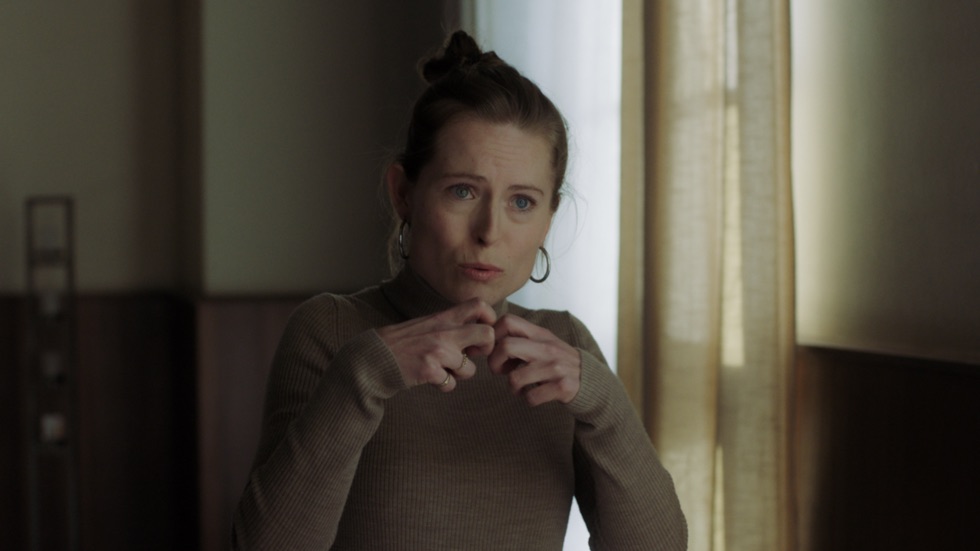
Technically, “Beyond Silence” is competent in restraint. The muted color palette creates a clinical, almost suffocating environment. The entire film unfolds within the confines of one room, yet it never feels static. The camera lingers just enough to capture subtle expressions: a trembling lip, a flicker in the eyes, a tightening grip. The sound design deserves special mention. The faint heartbeat thuds that accompany the opening sequence are psychological cues that put the audience in a state of discomfort even before Eva begins to speak. You feel her anxiety before she expresses it.
There’s an intensity to how the film builds tension without any overt dramatization. At times, it’s so emotionally overwhelming that you feel the urge to pause just to breathe. That’s how effectively Blok manipulates silence and pacing. Every second feels deliberate, every pause a loaded moment of confrontation.
Some may call the film one-sided or accuse it of being “too angry.” But that anger is precisely what makes “Beyond Silence” necessary. The world doesn’t need another “balanced” take on harassment. Instead, it needs raw honesty. And Blok delivers that in spades. For those who have faced abuse, the short film is cathartic in its rage. For those who have inflicted it, knowingly or unknowingly, it’s a challenge to face themselves.
Before the film closes, Blok delivers one final gut-punch: Eva reveals she has been abused again, recently. That revelation shifts the film’s perspective entirely. It’s no longer about one isolated event. Now, it’s about the cycle of silence that allows abuse to persist. “Beyond Silence” ends not with resolution but with a haunting stillness. There’s no closure, no justice, no comforting afterthought. Just silence, which is thick, uncomfortable, and true. Because that’s how reality works.
Most victims don’t get the neat endings that movies often promise. Blok understands that. And that’s why her short film lingers. It doesn’t fade after the credits; it stays with you, gnawing at your conscience, daring you to do better. In fifteen minutes, “Beyond Silence” does what many feature films fail to do in two hours. It’s a near-perfect short that doesn’t turn preachy or exploitative. Instead, it finds its power in empathy, its poetry in anger, and its honesty in silence.


![Android Kunjappan Ver 5.25 [2019] Review: A Sweet and Succulent Surprise](https://www.highonfilms.com/wp-content/uploads/2019/11/Android-Kunjappan-Ver-5.25-content-and-featured-768x576.jpg)

![Old Stone [2016] – A Taut Drama on the Bone-Chilling Bureaucratic Insensitivity](https://www.highonfilms.com/wp-content/uploads/2018/05/cover-768x432.jpeg)
![Dogman [2018]: ‘BFI-LFF’ Review – A Story of Love and Tragedy](https://www.highonfilms.com/wp-content/uploads/2018/10/dogman_02-768x384.jpg)