Every so often, a band doesn’t just break through—they reshape the landscape. Their sound becomes shorthand, a reference point. You hear a new act and instinctively say, “They sound like them.” The Beatles, Led Zeppelin, Linkin Park—they didn’t just succeed, they defined eras.
It’s never easy to predict who will join that tier. Case in point: Bring Me the Horizon. Back in the late 2000s, blasting “Chelsea Smile,” it would’ve been hard to imagine the Sheffield outfit evolving into a band others would one day be compared to. Their early work was heavy, catchy, and built for chaos—music that demanded movement, whether in a packed venue or your own living room. Then came “Sempiternal” in 2013, a turning point that saw them expand their sound and refuse to be boxed in. By the time “That’s the Spirit” arrived, they had crossed into a different space entirely—one where they weren’t following trends, but setting them.
That kind of evolution is always risky. When bands pivot, backlash is almost inevitable—just look at “Minutes to Midnight,” and some of the divided reaction it sparked with old fans, myself included. But BMTH managed to navigate that shift with great success; these new changes feel more like a departure and more like the band maturing. Producer and then Keyboardist Jordan Fish added the extra sauce, becoming a defining ingredient in their sound.
All of that feeds directly into “Bring Me the Horizon: L.I.V.E. in São Paulo (Live Immersive Virtual Experiment)” — a concert film that, much like Bring Me the Horizon themselves, refuses to be easily boxed in. This isn’t just a standard “point cameras at the stage” live recording; it genuinely plays like an experience.
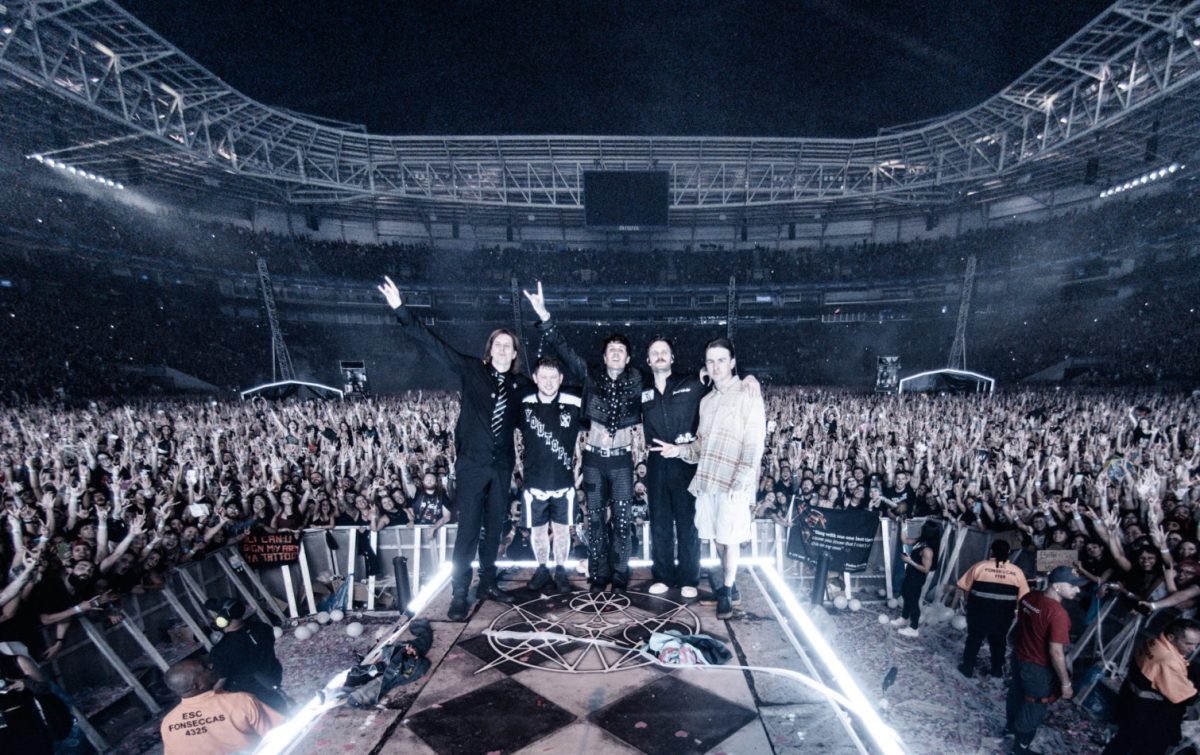
And I’ll admit, I wasn’t expecting to get as pulled in as I did. Watching from home, it’s easy to assume some of that live magic will get lost in translation. But even on a solid home setup —85” TV, Dolby sound, the whole deal — the immersion really comes through. I could practically feel the sweat, the chaos, and the sheer scale of it all, especially when Oli Sykes points out the crowd pushing close to 50,000 people. It’s the kind of presentation that closes the gap between audience and performance — not completely, of course, but enough that you stop thinking about what you’re missing and start getting caught up in what’s right in front of you.
Right from the start, the show frames itself with a kind of apocalyptic narrative—an ominous warning that something is about to go very wrong. If you’ve been following the band since the “Post Human: Survival Horror” era, this all feels like a continuation of that world, almost an “Endgame”-style culmination of ideas they’ve been building toward. It adds a conceptual layer that elevates the whole performance beyond a standard concert.
As the night progresses, things get darker, even veering into satanic imagery, with Oli Sykes leaning into a more demonic persona. I did find myself wishing they pushed that theatricality even further—maybe with full costumes or makeup, because at times the narrative and the performance feel slightly disconnected, like two ideas running parallel instead of fully merging.
Another element that really elevated the experience was the direction and overall visual approach. The band had previously collaborated with CiRCUS HEaD on the live performance video for Kingslayer featuring BABYMETAL, where the editing leaned heavily into a chaotic mix of cellphone footage, social media clips, and fan perspectives — all stitched together into something that felt intentionally frantic and hyperactive.
I’ll admit, while I liked that version of the song, the editing style had me a bit worried going into this. I thought it might overwhelm the performances or make it harder to fully appreciate what was happening on stage. Thankfully, those concerns didn’t pan out. Here, the director takes a similar toolkit — blending crowd-shot footage, dynamic angles, and rapid editing — but refines it into something that feels both exhilarating and purposeful. It still has that high-energy, almost chaotic edge, but it’s more controlled, allowing the performances to breathe while keeping things visually engaging. There are also some really cool stylistic touches, like those drone or HUD overlays that make it feel as if parts of the show are being analyzed through some digital interface.
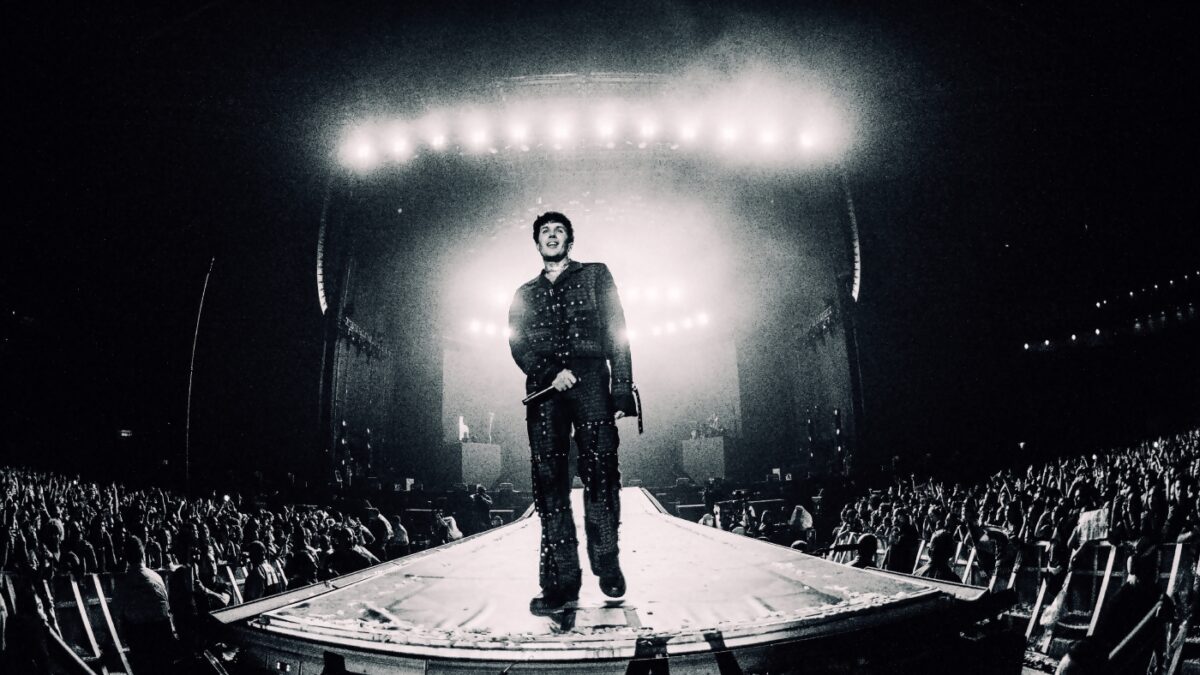
It adds a subtle layer of immersion without becoming distracting. There are even moments where the visuals mimic a kind of digital targeting system, as if the show is being observed—or analyzed—by something else entirely. And then there’s the crowd. Circle pits, tears, people embracing strangers—it’s all there, and it adds so much to the experience. You don’t just watch the concert; you feel like you’re inside it.
The setlist plays out like a greatest-hits sprint through Bring Me the Horizon’s more recent era, so if you’re holding out for older cuts like “Chelsea Smile”, you might leave a little disappointed. That said, what is here feels tightly curated for maximum momentum. From the explosive opener “DArkSide” to the closing knockout of “Throne”, the pacing is relentless in the best way. There’s a clear sense of build and payoff, with each track feeding into the next without losing energy. Even the more pop-leaning songs land with real weight in a live setting. Instead of softening the set, they feel amplified — bigger, louder, and more immediate — proving just how well this era of the band translates on stage.
If I had one minor gripe, it’s the lack of downtime. I grew up on concerts where artists would pause, talk to the crowd, and build that personal connection. Here, it’s mostly back-to-back intensity. That’s clearly by design, but it’s something I did miss in here and so many other shows I’ve seen as of late.
All in all, “Bring Me the Horizon: L.I.V.E. in São Paulo (Live Immersive Virtual Experiment)” works as both a high-octane concert film and a continuation of the band’s evolving artistic identity. It’s immersive, ambitious, and occasionally messy in a way that feels true to who they are. If you get the chance to see it in theaters, that’s absolutely the way to go because, as good as it is at home, something tells me it hits on a completely different level with a crowd.



![Review That Jack Wrote [2018]: ‘MAMI’ Review of The House that Jack Built](https://www.highonfilms.com/wp-content/uploads/2018/11/house_that_jack_built_director_lars_von_trier_header_1050_591_81_s_c1-768x432.jpg)


![Old Stone [2016] – A Taut Drama on the Bone-Chilling Bureaucratic Insensitivity](https://www.highonfilms.com/wp-content/uploads/2018/05/cover-768x432.jpeg)