No figure in the early history of cinema is more contested or more consequential than D.W. Griffith. A man whose moral failures are as monumental as his artistic achievements, Griffith nonetheless stands at the centre of any serious account of cinema’s emergence as a language. He did not simply introduce new devices like closer framing, parallel editing, and expressive lighting, but also understood how those devices could be orchestrated into a system of meaning. To understand Griffith is to understand how films learned to tell stories.
The Problem of Comprehension
In early 1907, American commercial filmmaking became increasingly oriented toward storytelling. With the new emphasis on one-reel films, narratives became longer and necessitated a series of shots. Filmmakers faced the challenge of making story films that would be comprehensible to audiences. Various techniques of editing, camerawork, acting, and lighting had to be combined so as to clarify what was happening in a film to the spectators.
Over the span of several years, these techniques evolved. Sometimes filmmakers influenced each other; at other times, two filmmakers independently arrived at the same solution. Some devices were tried and abandoned. By 1917, filmmakers had worked out a system of formal principles standard across American filmmaking, a system that has come to be called the classical Hollywood cinema. Despite this name, many of its basic principles were developed before filmmaking was centred in Hollywood, and a number were first tried in other countries. In the years before the First World War, film style was still largely international, since films circulated widely beyond their countries of origin.
The basic problem that confronted filmmakers in the nickelodeon era was that audiences could not always follow the causal, spatial, and temporal relations between shots. An abrupt change of locale might leave the spectator disoriented; an actor’s elaborate pantomime might fail to convey the meaning of a crucial gesture.
As one observer of the period noted, many films suffered not from poor photography but from a failure of perspective: the manufacturer, already familiar with the picture and the plot, forgot that the film was not made for him but for the audience. In a few theatres, a lecturer might explain the plot as the film unrolled, but producers could not rely on such aids indefinitely.
Filmmakers came to assume that a film should actively guide the spectator’s attention, rendering every aspect of the story as clear as possible. In particular, films increasingly set up chains of narrative cause and effect: one event would lead plainly to another, which would in turn cause another, and so on.
Character psychology, which had played little role in the brief slapstick chases or simple melodramas of the earliest films, became increasingly central. Those early films depended on physical activity and familiar situations rather than inner life. Increasingly after 1907, however, character psychology motivated action. By following a series of characters’ goals and resulting conflicts, the spectator could comprehend and anticipate what was happening on screen.
Griffith and the Emergence of a Cinematic Language
D.W. Griffith seems to have been the first filmmaker to grasp that film techniques could be combined into something resembling an expressive language, not a collection of tricks, but a grammar. His early shorts demonstrate a consistent attention to camera placement and lighting that heightens mood and tension. The form Griffith evolved owes as much to musical structure as to conventional narrative. It works through rhythm, repetition, contrast, and resolution rather than through simple linear sequencing.
The films Griffith made at the Biograph Company represent his greatest contributions to the art of cinema. They may lack the ambition and renown of his later masterworks, “The Birth of a Nation” and “Intolerance,” but it was in the Biograph shorts that Griffith made the discoveries that would define his legacy and make those later films possible. A remarkable number of them survive, though many exist only in negative or paper print form.
The technical innovations Griffith introduced, such as the expressive use of lighting, cross-cutting, and editing rhythm, were essential to the development of the medium. But the era was such that those innovations were needed and would have been invented sooner or later by someone else if Griffith had not been present. So, Griffith was just at the right place at the right time to bring about these advancements.
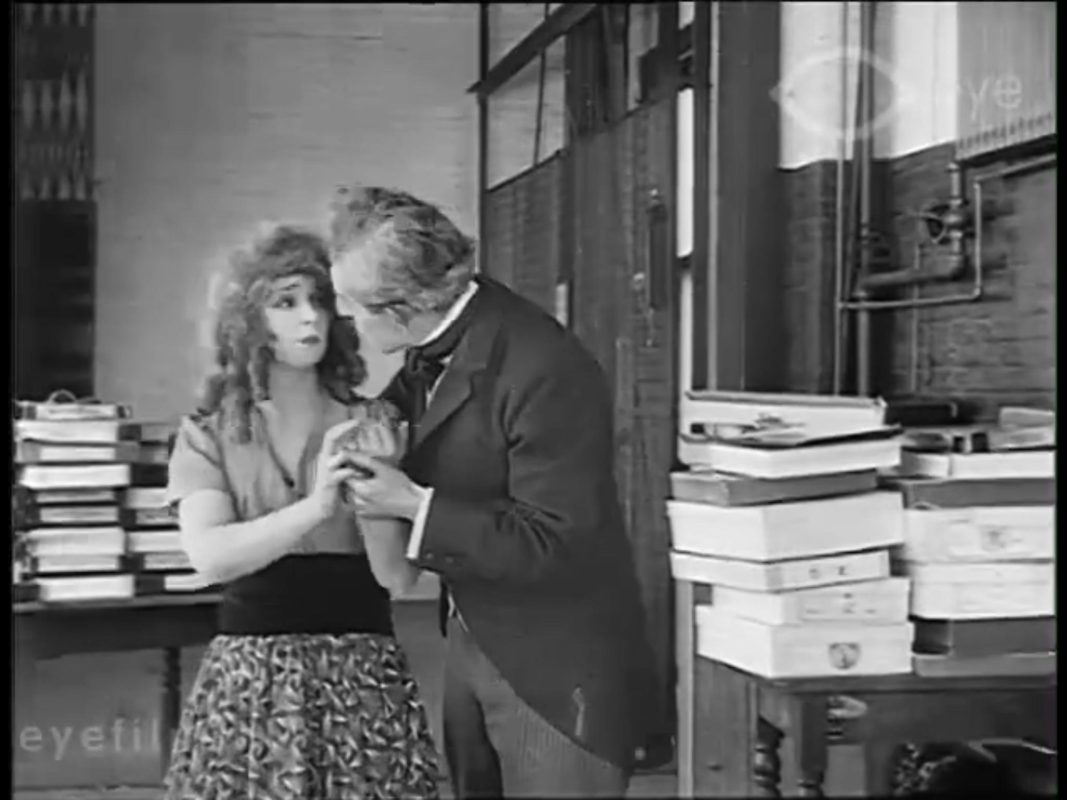
In 1908, Griffith took a minor acting role at the American Mutoscope and Biograph Company, where he met cameraman Billy Bitzer. The collaboration that followed would prove transformative for both men and for the medium itself. In his very early work, Griffith immediately pushed for changes in camera set-up. By June 1909, he was already gaining decisive creative control of his material.
He carried Porter’s initial method of parallel editing to a new stage of development in The Lonely Villa, employing cross-cutting to heighten suspense throughout the parallel scenes in which burglars break in upon a mother and her children while the father races home to the rescue. By March 1911, Griffith had further refined this disjunctive method of narration, achieving a far greater degree of breathless excitement in his chase sequences.
He was simultaneously introducing other innovations. He was bringing the camera closer and closer to the actors in scenes where emotional interplay mattered, or where small gestures and expressions were of special significance. This had two effects: it drew the audience into closer identification with the action, and it demanded of his actors a much quieter, more intimate performance style. The broad pantomime of earlier cinema had no place in a close framing, subtlety became both possible and necessary.
A Case Study in Griffith’s Method
“The Painted Lady” is a 1912 short drama directed by Griffith and starring Blanche Sweet for the Biograph Company. Sweet portrays a young, repressed minister’s daughter who descends into madness after shooting a man she loved to protect her father’s property. The film forgoes extreme close-ups, yet Sweet’s facial expressiveness is such that none are needed, and one senses that tighter framings might, in fact, have diminished rather than amplified her performance. The film is a precise, concentrated demonstration of the techniques Griffith had been developing across his Biograph period.
Griffith establishes the nature of both sisters through camera movement, actor behaviour, and intertitles working in concert. The younger daughter is vivacious and flirtatious. Her elder sister catches her powdering and painting her face and offers a mild reproof, to which the younger retorts: “Well, you have to do it if you want to be attractive.” The contrast is economically and efficiently drawn.
Griffith uses the intertitle to announce a condition, “Unpopular,” and then renders it visually, in a composed shot that isolates Blanche Sweet’s character from the activity surrounding her. The method is characteristic of Griffith at his most controlled: the word names the condition, and the image gives it weight.
Griffith increasingly used edits to transfer the viewer’s point of view across space in line with the psychology and movement of his characters. This method, spatial fragmentation in the service of psychological legibility, would become one of the defining principles of classical Hollywood editing.
Methods of framing changed significantly after 1908. Where the camera had previously been positioned twelve to sixteen feet from the actors, showing them from head to toe, the introduction of the so-called nine-foot line around 1909 brought it to nine feet, cutting the actors off just below the hips. Figures at the centre of the frame became more commanding. Faces became readable. In early 1912, Griffith began training his group of young actresses, including Sweet, to register sustained sequences of emotion through slight gestures and minor facial shifts. “The Painted Lady” was an early result of these experiments.
Throughout much of the film, Griffith frames the heroine from the waist up, so that her slightest expressions register with full force. Conventional pantomime gestures were not yet fully abandoned, but in “The Painted Lady,” they are significantly restrained, deployed alongside rather than instead of facial expression. The film stands as one of the earliest sustained examples of what we might now call screen acting.
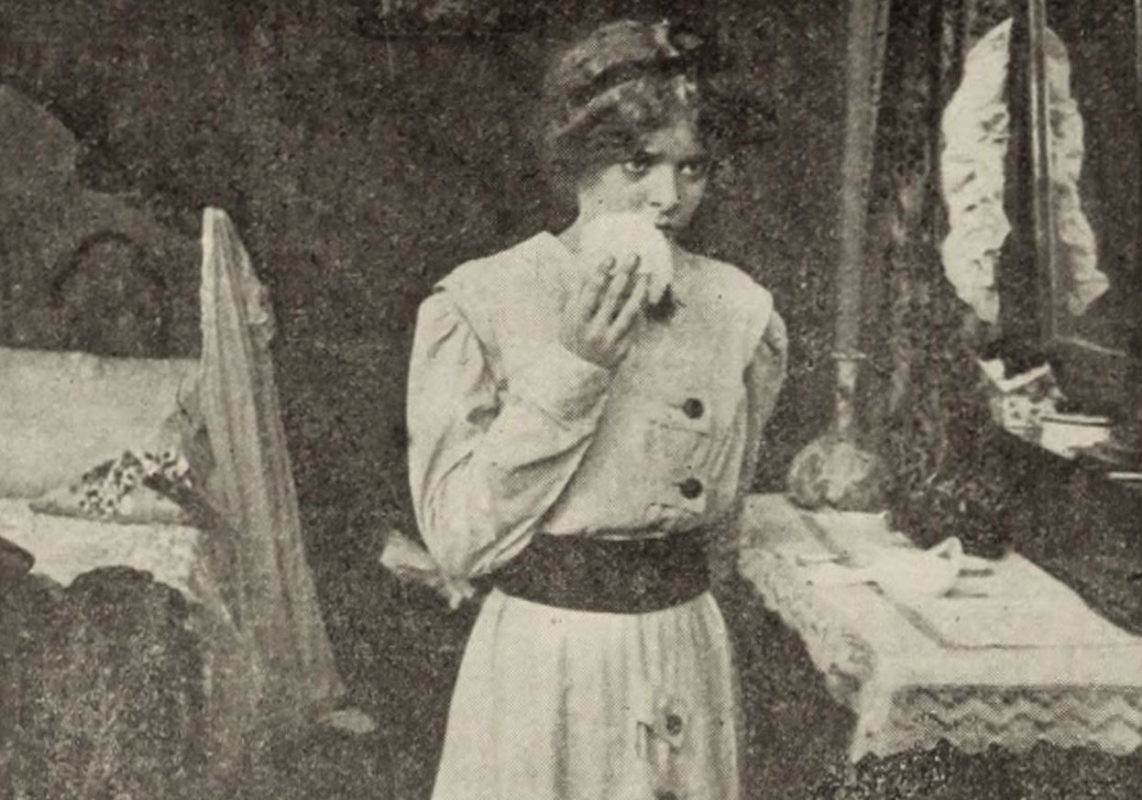
Camera angle also began to shift during this period. In earlier fiction films, the camera typically viewed the action at a level angle, chest or waist height. By around 1911, filmmakers began occasionally to frame from slightly above or below when doing so gave the scene greater force. In “The Painted Lady,” head-to-toe framings are rare; the predominant view is chest or waist height, keeping faces within expressive range at nearly all times.
The introduction of camera tripods with swivelling heads gave filmmakers the ability to pan and tilt to follow action laterally or vertically without cutting. These movements were often used for slight adjustments, or reframings, as figures moved within the scene. In one notable passage of “The Painted Lady,” the camera follows the future love interest of the elder daughter as he plots the crime and enters the party, tracking his movement with an intimacy that aligns the audience’s attention with his trajectory.
Intercutting the alternation between two or more lines of simultaneous action is used to particular effect in “The Painted Lady.” When the elder daughter suspects an intruder in the house, she stands outside the door with her father’s gun. The film intercuts between her tense vigil and the actions of the thief, who is, in fact, her lover. Griffith was undoubtedly influenced by earlier films, including the chase films of the previous decade, but of all directors of the period, he explored the possibilities of intercutting most daringly.
“The Painted Lady” demonstrates Griffith’s ability to render individual psychological drama against the backdrop of crowds and social activity. It is a film about madness, isolation, and heartbreak, and Griffith establishes that isolation not through empty spaces but through crowds. Unlike the cluttered, often confusing crowd scenes of his earliest Biograph work, the compositions here are sharply controlled. The intertitle “Unpopular” prepares the viewer for what follows: Sweet’s plain, solitary figure set against the bustle and excitement of a party, a passive presence in the midst of social activity from which she is wholly excluded.
Later in the film, Griffith returns repeatedly to a bare bridge location, using the emptiness of the setting to concentrate the viewer’s attention entirely on Sweet’s face and body. Although the film contains an action sequence of the kind that typically served as the climax of a Biograph short, Griffith refuses to treat it as such; instead, it functions as a catalyst, propelling the film into its true subject matter: the inner life of a woman. He does not dwell on it, and so it does not overwhelm the second half. The slowness of the final scenes and the sustained close attention to Sweet’s face form a counterweight to the film’s earlier momentum and carry a greater emotional impact as a result.
What is perhaps most remarkable is the quality of Sweet’s performance itself. In earlier Griffith shorts, even as acting styles became more naturalistic, performers still tended to slip into exaggerated pantomime when emotions ran high. In “The Painted Lady,” however, in a scenario with every invitation toward melodrama, Sweet holds her performance to a register of quiet, credible interiority. Griffith encouraged this by shooting her madness scenes in unusually long takes, giving the actress time to inhabit the emotional state rather than demonstrate it.
“The Painted Lady” has aged better than most films of its era, and better than many of Griffith’s own works. Sweet’s portrayal of a woman plagued by isolation, desire, and grief can still captivate a modern viewer. It speaks both about the depth of her performance and the sophistication of Griffith’s formal choices. In this film, we can observe the very moment at which cinema stopped being a record of events and began to be a language capable of portraying an inner life.