The Colorado River is already a landscape of overuse and administrative control: tens of millions depend on it, most of its water is consumed by agriculture, and the basin has been locked in drought for decades. The lower river also loses huge amounts through evaporation, especially around the vast reservoir system tied to Hoover Dam and Lake Mead.
“Desert Passages” opens from that reality: a river shaped by infrastructure and climate stress, in a region where scarcity is distributed unevenly. The documentary works from that urgency. Moving through the Colorado basin and Indigenous lands, especially Hopi and Navajo territory, it contrasts ecological loss with nearby luxury. Water grows scarcer, while hotels keep selling comfort and excess. The imbalance is obvious, and the film is right to center it.
That contrast is already there in the film’s opening movement. Early on, “Desert Passages” gives us a glimpse of urban life, including a woman getting ready indoors, before shifting toward Navajo land, where the film slows into grain, dry planting, open ground, and bodies moving through a harsher, more exposed environment. These later scenes are filmed almost entirely with available light, the sun simply falling across faces, fields, and dust. The beauty is real, and it points to one of the film’s limits.
The repeated landscapes and patient framings seem designed to make visible what the commentary is already telling us: a different relation to land and survival. Too often the images do not deepen that meaning so much as restate it. It is gorgeous, built from recurring visual patterns: wide desert landscapes with carefully composed shots, and interviews or voiceovers layered over the images. At first, that rhythm works. The film finds a mournful beauty in the Southwest, and it understands that environmental damage can register as information and mood.
“Desert Passages” stays with this method longer than it can sustain. Soon enough, the film returns to the same structure: another still image, another measured setup, another stretch of commentary over scenery expected to carry its own meaning. What begins as meditative gradually turns dull. The beauty remains, and the repetition starts to flatten it.
The soundtrack does little to offset that monotony. It is sparse to the point of near-absence, stepping in only occasionally to underline a moment before retreating into long stretches of silence. That restraint may be intended as a sign of seriousness, but it leaves the film sonically thin. A richer sound design might have given the documentary more rhythm, tension, and variation in how time is felt. Instead, the track’s near-emptiness often reinforces the same flatness that already weakens the visual structure.
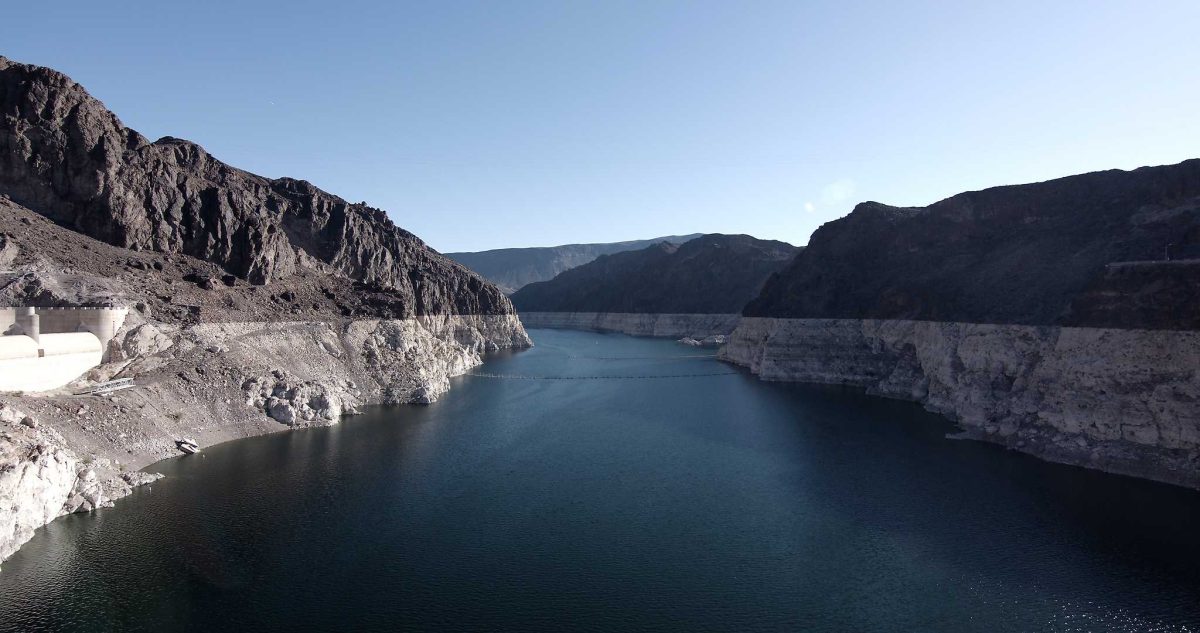
The material is stronger than the film’s form can hold. Hoover Dam did not dry up the river on its own, but it remains part of the larger remaking of the river into a managed resource. The film knows this and makes clear that the burden is not shared equally. Indigenous communities live with the ecological and social damage, while the surrounding tourism economy continues to market spectacle.
This is especially clear when the film turns to Hopi and Navajo lands. The contrast is powerful, but the documentary leans on it so often that it begins to lose force. Colorado’s depletion belongs to a longer history. It recalls other places where water was redirected in the name of growth. Owens Valley is one obvious example: its resources were diverted to sustain Los Angeles, while the environmental costs were pushed outward. The pattern is familiar. Water is moved, landscapes are reorganized, and the damage settles where political power is weakest.
The comparison grows darker when one considers the Aral Sea, where diversion turned an entire ecosystem into ruins. The scale is different, although the logic is similar. In each case, scarcity does not arrive as fate alone. It is produced through planning, extraction, and decisions about whose survival matters most. “Desert Passages” gestures toward that history, even if it never develops it as fully as it could.
One of the film’s more revealing moments comes when an Indigenous interviewee says, in effect, that Native people are not separate from the land in the way modern civilization imagines itself to be: “we are the environment, and the environment is us.” It should land as a devastating line because it cuts through the documentary’s broader argument with far more force than most of its repeated visual patterns do. But “Desert Passages” does not quite know how to build toward that force.
The same problem appears in the film’s geography. For a documentary about the Colorado River as a system of extraction and inequality, it spends most of its runtime in the United States, reducing Mexico to a brief opening gesture. That imbalance creates the uneasy sense of a politics that knows where injustice is, but only fully lingers on the version of it that remains legible to an American frame.
Even so, the film remains attentive to inequality and the way land and water are protected for some while withheld from others. But as a film, it remains too limited to become fully absorbing. What really stays with you is the world it points to: a river system where scarcity is treated as background noise until it reaches the wrong people. “Desert Passages” sees that clearly, but it does not always know how to make that clarity cinematic.


![For Your Consideration: Bone Tomahawk [2015]](https://www.highonfilms.com/wp-content/uploads/2016/12/Bone-Tomahawk-008-768x322.jpg)


![End of Summer [2018]: ‘NYAFF’ Review](https://www.highonfilms.com/wp-content/uploads/2018/06/End_OF_SUMMER_NYAFF_HOF-768x512.jpg)