Fede Álvarez’s Don’t Breathe (2016) is often marketed as a home-invasion thriller about criminals breaking into the wrong house. That description is accurate, but insufficient. The film isn’t merely about thieves facing consequences; it’s about desperation colliding with grief, and about how victimhood, when warped by obsession, can mutate into something far more dangerous. The house at the film’s center is more than a setting. It becomes a sealed moral arena, exposing what each character is willing to do to escape their circumstances. Some choices are shaped by poverty. Others by loss. None is made without blood being drawn.
Spoilers Ahead
Don’t Breathe (2016) Plot Summary & Movie Synopsis:
Why do Rocky, Alex, and Money Break into Houses in the First Place?
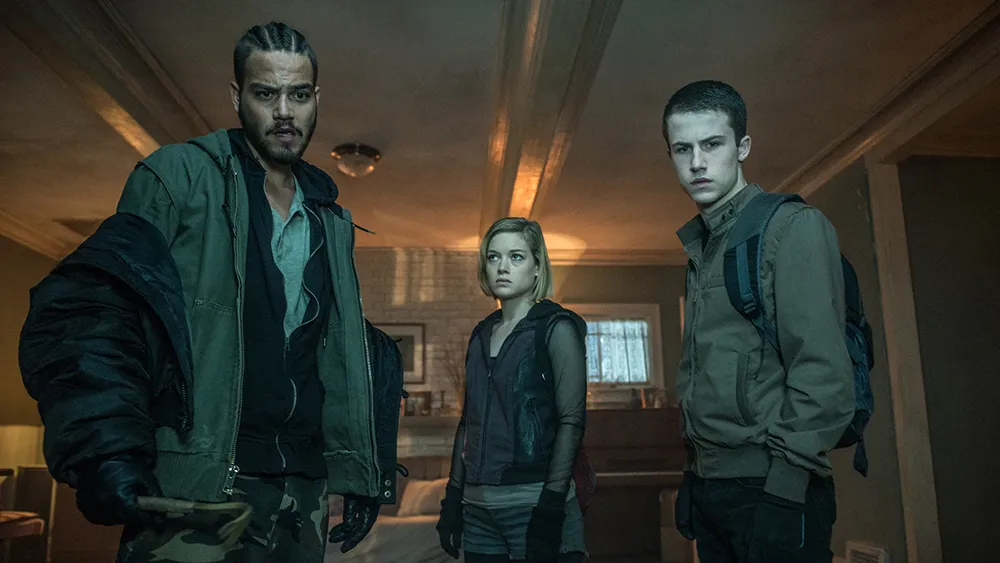
Rocky, Alex, and Money are not portrayed as master criminals. They are kids surviving in a city that has already given up on them. Detroit appears abandoned, hollowed out, full of boarded homes and broken promises. Stealing is not a thrill for them; it is a routine born from stagnation. Rocky’s motivation is the most emotionally defined. She wants out. She wants California. She wants her younger sister Diddy to grow up somewhere safe, far away from their abusive mother and her mother’s violent boyfriend. Every burglary is, in Rocky’s mind, a step closer to escape. She is not stealing for luxury. She is stealing for distance.
Alex is more hesitant, quieter, and morally conflicted. His father works for a home security company, and Alex uses that knowledge to bypass alarms. But unlike Money, Alex does not enjoy the risk. He is motivated by loyalty to Rocky and by fear of being left behind. He wants to help, but he is unsure if this life is really who he is.
Money is the instigator. He treats crime like a game, constantly pushing boundaries and mocking consequences. His confidence borders on recklessness. To him, danger is proof of masculinity. He wants the big score not just for money, but for validation. They are criminals, but the film carefully frames them as products of neglect rather than innate malice.
Why Does the Blind Man’s House Seem Like the Perfect Target?
The tip about Norman Nordstrom’s house comes from their fence, and it sounds almost unreal. A blind Gulf War veteran. A quiet house in an abandoned neighborhood. Three hundred thousand dollars in cash. No alarms. No neighbors. The justification comes easily. Nordstrom received the money as a settlement after a wealthy young woman killed his daughter in a car accident.
In Money’s mind, this makes the theft almost righteous. The woman walked free, and the old man got paid. Taking that money feels like a victimless crime. Learning that Nordstrom is blind seals the decision. They mistake blindness for helplessness and assume the house is defenseless because the man inside cannot see. This is their first fatal error. They confuse physical limitation with weakness, and silence with safety. The house looks dead from the outside, but it is very much awake.
What Goes Wrong the Moment They Break In?
The plan collapses almost immediately, and it does so because of Money. While Rocky and Alex move cautiously, Money pushes forward with arrogance. He gives drugs to the dog, releases sleeping gas into Nordstrom’s bedroom, and heads straight for the locked basement door. The locked door becomes an obsession. To Money, it must hide the money. Instead of waiting, instead of sticking to the plan, he shoots the lock. That gunshot changes the film entirely. Nordstrom wakes up, and the illusion of control evaporates.
The blind man moves with terrifying precision. He disarms Money, overpowers him, and kills him without hesitation. It is not a struggle, but an execution. Rocky watches from hiding, frozen. This is not self-defense in the way she expected it to be. There is no shouting, no warning, no mercy. Money’s death is fast and quiet, and it establishes Nordstrom not as a victim but as a predator who knows his space intimately.
Why Doesn’t Rocky Run After Money Is Killed?

Also Read: 7 Movies To Watch If You Liked ‘Don’t Move’ on Netflix
Rocky’s decision to stay is driven by shock and necessity. Running would mean abandoning Alex. It would also mean leaving empty-handed, trapped in the same life she is trying to escape. When she sees Nordstrom open a hidden safe, the temptation becomes impossible to ignore. The money is real.
The escape is within reach. Taking it feels like honoring Money’s recklessness with purpose, even if it costs her conscience. But the moment she takes the cash, she stops being a burglar and becomes prey. Nordstrom notices the missing shoes. He knows someone else is inside. From this point on, the film shifts from a robbery gone wrong to a hunt.
What Is Really Hidden in the Basement?
The basement is the moral core of Don’t Breathe. It is where the film strips away any lingering ambiguity about Norman Nordstrom. Rocky and Alex discover a restrained, gagged pregnant woman. She is terrified, bruised, and desperate. When she reveals herself as Cindy Roberts, the woman who killed Nordstrom’s daughter, the story takes a horrifying turn.
Nordstrom did not simply receive a settlement and retreat into grief. He kidnapped Cindy. He imprisoned her. He kept her alive not for justice, but for replacement. Cindy is carrying a child that Nordstrom believes will substitute for the daughter he lost. This revelation reframes everything. Nordstrom is not defending his home. He is guarding a secret built on obsession and control. His blindness no longer reads as vulnerability. It becomes symbolic. He cannot see the difference between love and possession.
Why Does Nordstrom Kill Cindy Instead of Saving Her?
When Nordstrom shoots at Rocky and Alex and accidentally kills Cindy, his breakdown feels genuine. He cries. He collapses. He mourns her death not as a person, but as a lost possibility. Cindy’s value to him was never her humanity. It was her womb. Her death destroys the illusion that he can undo his grief. In that moment, Nordstrom is not a righteous father avenging his daughter. He is a man confronting the failure of his fantasy. His grief, however real, does not redeem him. It only explains him.
Why Is the Darkness So Important to the Basement Sequence?
When Nordstrom shuts off the lights, the power dynamic shifts completely. For once, everyone is blind. This is where Álvarez equalizes the field. Rocky and Alex must move without sight, without sound, without certainty. The basement becomes a shared nightmare where panic replaces planning. Alex manages to knock Nordstrom out, but survival feels temporary. Every escape is fragile. Every victory is borrowed time. The darkness does not empower the intruders. It only reminds them how close they are to death.
Why Does Alex’s Fate Feel Inevitable?
Alex survives longer than expected because he adapts. He tricks Nordstrom into stabbing Money’s corpse, buys himself time, and rescues Rocky from one of the film’s most disturbing scenes. But Alex’s hesitation is also his weakness. He wants to believe there is a way out without becoming monstrous. Nordstrom does not share that restraint. When Nordstrom breaks free and shoots Alex, it feels cruel but consistent. Alex represents conscience. He represents the part of the group that still believed there were lines that should not be crossed. In this house, that belief is fatal.
What Does the Turkey Baster Scene Reveal About Nordstrom?
The artificial insemination scene is the film’s point of no return. Any lingering sympathy for Nordstrom is destroyed. He explains his logic calmly. He believes he deserves another child. He believes Rocky can be used, then released. He frames rape as a transaction. His blindness to morality is complete. This moment clarifies that Nordstrom is not driven by justice or grief alone. He is driven by entitlement. Loss has convinced him that the world owes him restoration, regardless of the cost to others.
Don’t Breathe (2016) Movie Ending Explained:
How Does Rocky Finally Take Control?
Rocky survives not by overpowering Nordstrom physically, but by understanding him. She uses noise. She uses disorientation. She turns his strengths against him. Triggering the alarm system floods the house with sound, destroying Nordstrom’s spatial control. The crowbar attack is not elegant. It is desperate, brutal, and necessary. Pushing him into the basement is symbolic. She locks him back inside the space where his secrets lived. When the gun fires and he falls, Rocky does not wait to confirm his death. Survival, not closure, is her goal.
Why Does Nordstrom Let Rocky Escape in the End?
Nordstrom’s silence is not mercy. It is self-preservation. In the hospital, he controls the narrative. Two intruders are dead. Self-defense. A blind veteran protecting his home. The police believe him because the system is designed to. Acknowledging Cindy or Rocky would unravel that story. It would expose the basement. It would expose him. By staying silent, Nordstrom ensures his survival. Justice does not fail because it is blind. It fails because it only sees what it expects to see.
What Does the Ending Say About Escape and Survival?
Rocky boards the train with Diddy, carrying stolen money and invisible scars. She got what she wanted, but not without cost. Alex is dead. Money is dead. Cindy is dead. Nordstrom lives. Don’t Breathe refuses to offer moral comfort. It does not suggest that suffering guarantees virtue, or that escape comes clean. Rocky survives because she adapts, because she becomes ruthless when necessary. The real horror of the film is not the blind man’s violence. It is the realization that systems protect monsters who know how to appear harmless. In the end, the house keeps its secrets. Rocky escapes it.
And the audience is left asking the most uncomfortable question of all. Who was the intruder, and who truly owned the darkness?