It’s tempting to call Ehrland Hollingsworth’s “Dooba Dooba” found-footage horror, but it is a meta-narrative that uses found footage to relay its true intentions. This film within a film is shot by Monroe Jefferson (Betsy Sligh), a 16-year-old who has submitted her work — a curious amalgamation of lo-fi footage and mixed media — as a school project.
Monroe’s suburban home becomes the site of horror here, where every room is fitted with angled cameras, allowing us a disorienting “Paranormal Activity”-esque experience of what’s happening at all times. When babysitter Amna (Amna Vegha) arrives to babysit Monroe, her parents, Taylor (Erin O’Meara) and Wilson (Winston Haynes), immediately make her feel uneasy before she realizes that something is off. And something is extremely off-kilter here from the get-go.
Horror that exclusively relies on analog conventions and mixed media formats can be challenging to execute. But there are always outliers: “Skinamarink” manages to impress due to its startling grasp on childhood anxieties, simulating the visceral fear felt within one’s own home. Online analog horror like “Petscop” or “The Mandala Catalogue” effectively uses dated media aesthetics to heighten suspense, incorporating glitchy, distorted footage to explore unsettling narratives.
Even when subgenre aesthetics remain unstated, a gripping narrative reinvents expectations, as with “Lake Mungo” or “Creep.” From a technical perspective, “Dooba Dooba” excels in a bit of everything, be it the use of spliced-in footage or sudden distortions to underline a tonal shift.
There’s a genuine knack for rule-breaking here, as Hollingsworth isn’t afraid to use wacky text overlays and camera angles to flag the presence of something sinister lurking beneath a veneer of normalcy. But such stylistic brilliance can only do so much heavy-lifting in service of a trite, predictable story, one which squanders its potential halfway through and lets go of its taut control over tension when one least expects it.
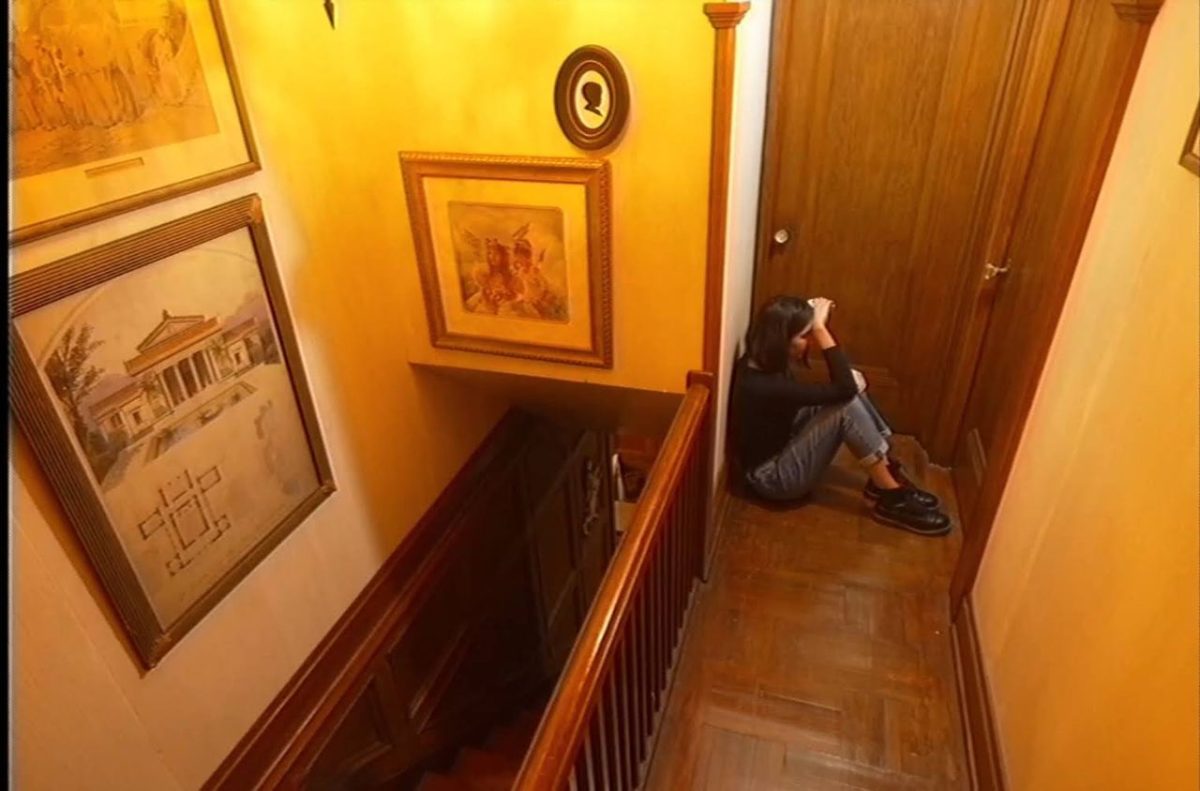
On paper, “Dooba Dooba” has some worthwhile ideas going for it. The film is an on-your-nose dissection of racism in America and how deeply entrenched such institutional bigotry is. Such all-consuming evil manifests itself in Monroe’s unhinged film presentation, where a clueless Amna is gradually cornered into a situation that proves itself horrific beyond imagination.
Monroe’s parents initially frame their daughter’s behavior as one rooted in trauma, stating that she witnessed the murder of her brother years ago, which has made her anxious and overly suspicious ever since. The eerie, singsong mantra of “Dooba Dooba” is essential to make Monroe feel safe, but Amna’s escalating discomfort directly counters this as the film begins.
“Dooba Dooba” is meant to be uncomfortable, especially when it subjects us to the cruel Monroe deliberately weaponizing Amna’s polite compassion against her as the night progresses. While Amna’s behavior might be understandable from the perspective of a young woman simply trying to get through the night, the way her empathy is divorced from self-preservation feels like an egregious way to frame her character. It really gets to a point: watching Monroe verbally berating a person of color and shirking accountability by throwing a tantrum is bad enough, but Amna’s impractical need to people-please at the cost of her safety or dignity reads as a cheap cop-out.
Given the half-baked nature of the narrative, the film’s stylistic flourishes start to feel tacked-on after a while, and even encroach on try-hard territory. The magic lies in the camerawork, where choice POV-shots, eerie close-ups, and off-center sequences contribute to the atmosphere of dread that “Dooba Dooba” consistently embraces.
The mixed-media splices start to feel a little too insistent towards the end, especially if you’ve been exposed to the subgenre and its telltale tricks to weave a bizarre spell. Sure, one can infer an iota of unease when archival footage of inhumane experimentation is juxtaposed against a shot of Monroe’s unhinged unraveling, but it doesn’t really convey much beyond a superficial connective tissue.
“Dooba Dooba” works well as a decent foray into experimental horror with analog tendencies, but it severely lacks depth when it comes to its characters, who often come off as strange for the sake of it. There’s nothing inherently wrong with that, of course, but a strange world with strange rules needs to be fleshed out in ways that are convincing or utterly unforgettable. “Dooba Dooba” is neither, even though it emerges as a stylistic stand-out with some deliriously delightful camerawork.



![Diane [2019] Review: A carefully observed character drama of a woman who understands need](https://www.highonfilms.com/wp-content/uploads/2019/04/Diane_HOF2-768x433.jpeg)