Jim Jarmusch’s “Father Mother Sister Brother” (2025) unfolds with a kind of patience, drawing attention through a gradual, immersive presence, as though the film invites one to sit within this stillness. That emerges as a deeply textured exploration of what it means to exist in relation to others across time, where intimacy is neither fully present nor absent. The sense of intimacy is suspended in a delicate in-between, shaped by memory, distance, and the subtle transformations of lived experiences.
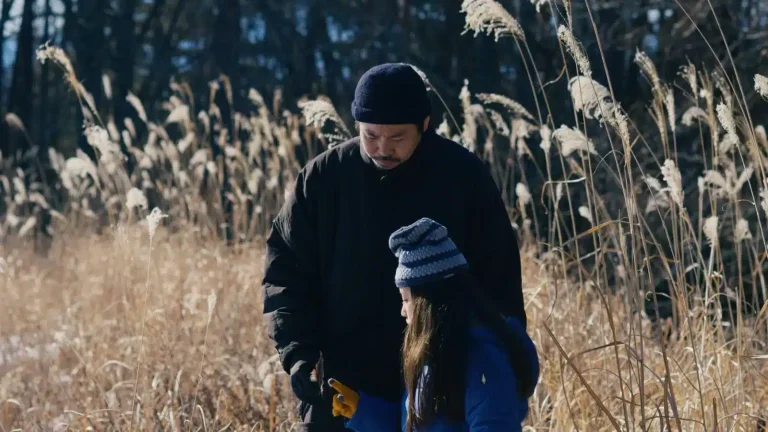
The recurring image of the frozen lake, when Adam Driver’s character and his sister sit in their father’s space, facing that wide, unmoving expanse, feels less an extension of the father’s own interior rhythm and more a visual articulation of a life that has settled into a kind of deliberate stillness. There, nothing insists on urgency, and everything seems to exist in a quiet, self-contained equilibrium. The ice here carries a sense of completion rather than tension, a calm that does not demand resolution but simply holds. And the father’s presence is felt grounded, despite his own mischiefs, almost undisturbed by the emotional hesitations the siblings bring with them.
The familial structure implied in the title, father, mother, sister, brother, feels more like a set of coordinates that the characters can no longer fully occupy. These roles, once definitive, have become estranged from the very people who once inhabited them. The film seems to approach this estrangement with a kind of quiet acknowledgment, allowing moments to unfold with an almost hesitant stillness, where conversations trail off.
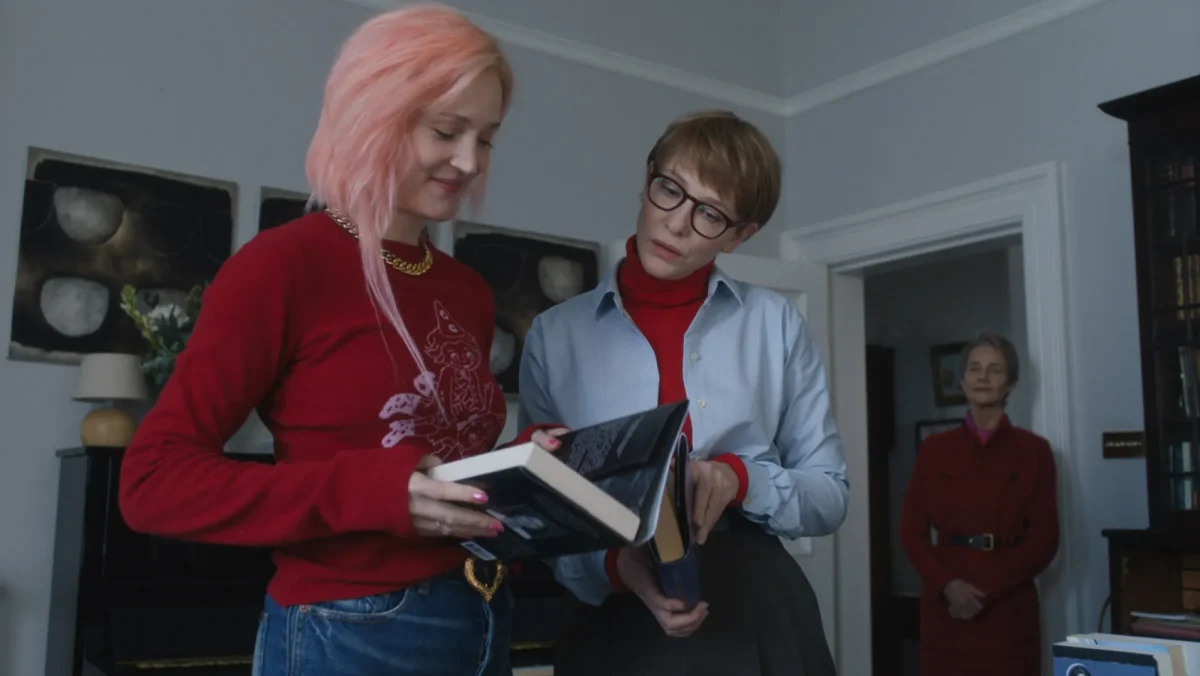
The glances of Timothea and Lilith carry more weight than declarations. Furthermore, the past of Skye and Billy refuses to return as memory in any linear or reassuring form. It flickers, repeats, and destabilises itself through that subtle oscillatory movement between childhood images and adult presence. This happens to create an effect where time continues to reverberate unevenly, never quite settling into coherence.
It is here that the film’s engagement with temporality becomes particularly striking, because it treats time as a series of overlapping states, so that the child and the adult seem to coexist in a kind of uneasy simultaneity. This is perhaps why those recurring images like photographs, gestures, fragments of remembered spaces, do not function as nostalgic anchors but as interruptions and reminders that what has been lived cannot simply be revisited without distortion. This creates a peculiar tension where the past feels both intensely present and irrevocably inaccessible, a tension that the film sustains, paving the way for it to permeate even the most mundane interactions.
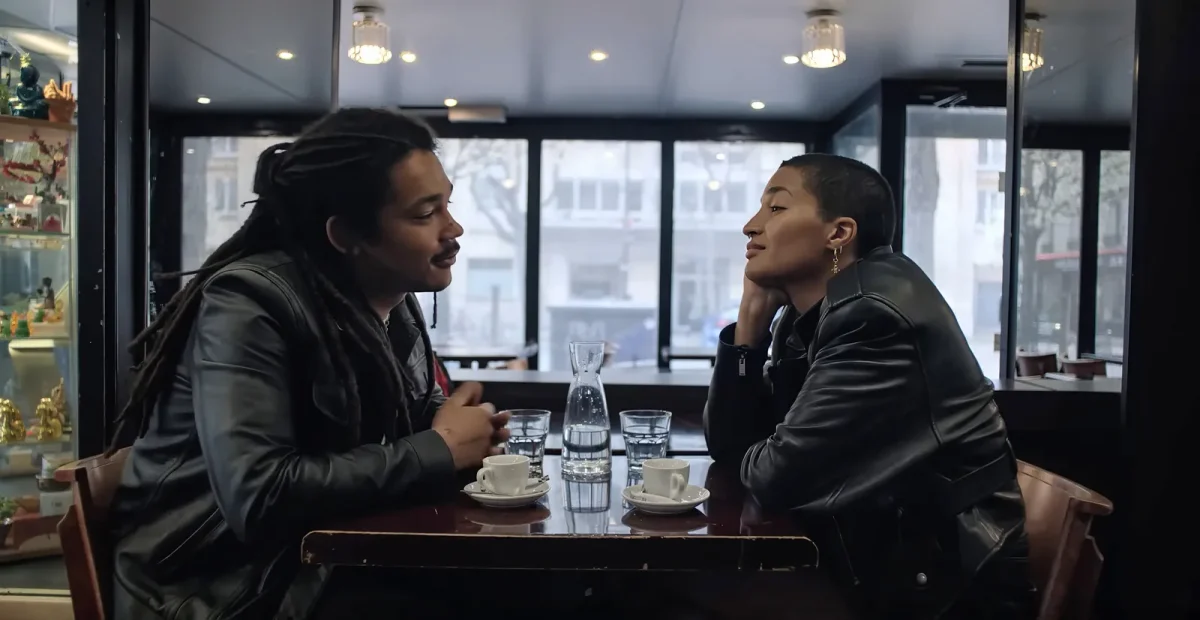
The recurrence of skating begins to gather a quiet precision, appearing across different narrative strands with a consistency that allows it to carry a shared emotional memory between characters who otherwise remain separated by space, time, and circumstance. In this repetition, skating seems to hold within it a particular quality of movement that belongs distinctly to childhood as a lived rhythm of being.
The act itself carries a sense of ease that is both physical and relational, suggesting a time when balance did not require conscious effort and when connection existed as a given rather than something to be negotiated. As the film returns to this image through the siblings visiting their father and through Skye and Billy meeting in the apartment shaped by the absence of their parents, skating begins to function as a shared gesture that allows each of these encounters to briefly access that earlier continuity. It shows that the body remembers a way of being that the present can only partially accommodate.
The frozen surface beneath this movement becomes integral here, offering a ground that supports without resistance. It mirrors a past that once held these relationships in a similar quiet cohesion. Yet, within the present, this same movement carries a heightened awareness and a sensitivity to the fact that what once existed as ease now unfolds with a certain attentiveness. Each glide traces the subtle distance that has emerged over time. And in this interplay, skating comes to embody a form of return that is neither fixed nor complete, but gently sustained across moments, allowing different lives and different losses to resonate within a shared, almost tactile memory of connection.
Also Read: All Jim Jarmusch Movies Ranked
This sense of negotiated distance is further reinforced by the spatial quality that might be described, perhaps somewhat loosely, as “nowheresville”, a setting that resists specificity. In doing so, it creates an atmosphere of dislocation, where the characters are neither fully anchored in a recognizable environment nor entirely detached from it. This ambiguity of place seems to echo the ambiguity of their connections, suggesting that belonging is something that is continually deferred, existing somewhere between memory and present experience, between what is remembered and what is lived.
It is within this indeterminate space that the film’s emotional register finds its most compelling expression, through the accumulation of small, almost imperceptible details. The way a conversation falters, the way a gaze lingers just a moment too long, the way a shared silence carries within it both comfort and unease – these details create a texture of experience that feels at once restrained and deeply resonant. They invite a form of attention about attunement, and recognition of the subtle shifts that occur when people who share a past attempt to occupy the same present.
What gradually settles into clarity in “Father Mother Sister Brother” is a way of understanding relationships that does not move toward a singular point of arrival. They gather meaning through its careful arrangement of moments, where each event feels complete in itself while quietly passing by others, conceiving an emotional continuity to form without ever being insisted upon.
This becomes especially palpable in the sequence where Adam Driver’s character and his sister sit in their father’s room, framed against the still, frozen lake outside, a composition that carries a sense of composure and internal quiet. The father’s life appears aligned with that unmoving surface, settled into a rhythm that does not seek to alter itself. While the siblings, positioned within the same frame, bring with them a different temporal energy, their pauses and glances suggest lives shaped by movement and return. Within this meeting, there is a gentle acceptance of distance as something that can coexist with intimacy.
This sensibility extends with equal delicacy into the thread involving Skye and Billy, where the apartment, marked by the absence of parents lost to a plane crash, becomes a space that holds memory through presence rather than declaration. The familiarity of objects and the cadence of their interaction seem to carry forward a shared past. It is within these spaces that the recurrence of skating begins to gather its full resonance. It appears as a shared bodily memory that links these lives together, letting movement become a form through which this connection is quietly re-experienced.
This continuity finds a different yet equally compelling articulation in the moments shared between Timothea and Lilith, where their interaction carries a distinct intimacy shaped by an attuned awareness of each other’s presence. Their gestures and stillness seem to echo that same underlying rhythm, where connection unfolds through small, attentive actions, allowing their relationship to feel both immediate and gently suspended within the film’s larger temporal flow.
What ultimately comes into view in “Father Mother Sister Brother” is a cinema that seems to trust duration, texture, and presence as primary carriers of meaning. It shapes a viewing space where attention becomes attuned to the smallest shifts, so that the film’s structure begins to feel like a field of sensations that accumulate and refract. This approach gives rise to a form that feels porous and open-ended, where transitions mark continuation, and where images seem to extend beyond their immediate frame. The lives exist without needing to be fully articulated.
Within this openness, the film cultivates a quiet precision, where each visual choice contributes to a larger rhythm that resists emphasis and sustains attention, allowing meaning to emerge through a kind of patient recognition. There is also a distinct sense in which the film engages with absence as something that actively shapes presence, giving contour to what remains visible.
What is unseen continues to resonate within what is seen, creating a layered experience where perception is guided as much by what lingers outside the frame as by what is contained within it. This interplay fosters a mode of engagement that feels contemplative without becoming distant, maintaining a balance that allows the film to remain accessible while still retaining a certain depth of inquiry.