Eight years of distance from Paweł Pawlikowski’s last feature film “Cold War”—with nothing but a four-minute short for Mubi and an embarrassing co-writing credit on one of Kirill Serebrennikov’s many recent duds to add to his portfolio in the meantime—virtually guarantees that any proper return to the unforgettable and instantly recognizable style that made him famous would, theoretically, be a sight as welcome as liberating forces come to signal the end of a long, debilitating war on aesthetic and thematic mediocrity. “Fatherland,” then, is precisely the sort of film to steamroll its way through the town square, just as suddenly as the film was announced and completed, to herald the return of a balancing force in Europe’s arthouse sphere.
And announce change, Pawlikowski certainly does, precisely by sticking to the very same field of postwar transitional adjustment that made him such a force to remember and miss in the first place. Returning to the spaciously magnified monochrome palette that had proven to be such a stark representation of a region in a state of prolonged petrification, “Fatherland” sees Pawlikowski shifting his sights across the border of his native Poland to a place and time where borders themselves never felt more reliant on the power of their verbal enforcement.
This time is, of course, the Cold War, and while one might be wont to get excited for more Cold War material from a filmmaker whose last film was titled “Cold War,” “Fatherland” sets its focus on one of the major artistic voices in the nation most obviously torn apart by the decades-long chest-puffing contest between the Western and Eastern Blocs.
That voice is Nobel Prize-winning German novelist Thomas Mann (Hanns Zischler), who, in 1949, leaves the refuge of California to embark on a trip from Frankfurt in West Germany to the Weimar region of the East, accepting an award centred on one of his literary inspirations, one Johann Wolfgang von Goethe.
It’s mostly for symbolic purposes that Mann is making this trip, as an early-film press conference featuring probing questions from voices emanating on all sides of the Berlin Wall shows just how trepidatious the author’s position is as a figure who’d long exiled himself to the farthest corners of the West, and now seeks to find some sense of home in the ruins of a land only recently (and superficially) purged of a multi-generationally scarring force of evil. If Thomas’s stoicism allows him to shield his own trepidations, then it might not be enough for his assistant and travel companion Erika (Sandra Hüller), the author’s daughter and a prominent figure of this torn German identity in her own right.
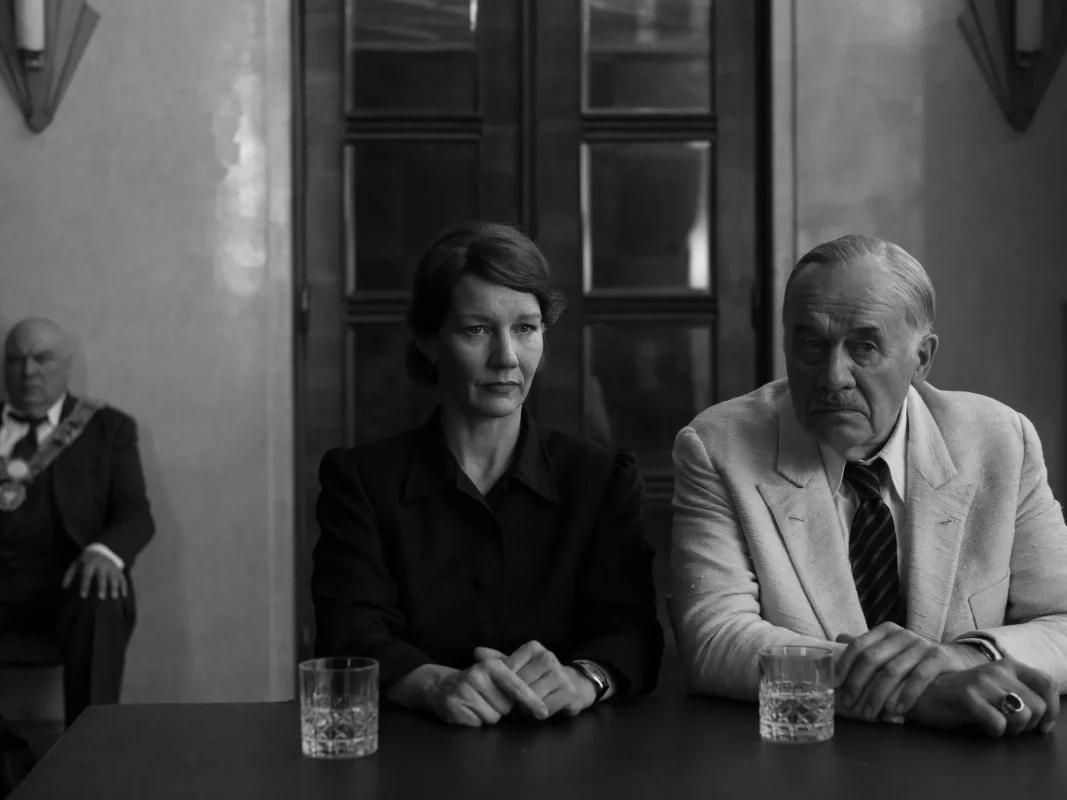
Pawlikowski’s concerns typically lie with the lives on the fringes of the Second World War’s fallout, and while the Manns were undeniably prominent figures at this time—you don’t even really need to be privy to much of the historical context to gather as much from the filmmaker’s depiction—it’s precisely their chosen, privileged status lying on the edges of the war (as far away from it as possible, really) that positions “Fatherland” as a compelling study of sought nationalist closure in one of the most volatile places and times for such a proposition to even be considered.
In a compact 82-minute runtime (some things never change), Pawlikowski packs in so much deliberately ruminative imagery of this inner (and outer) conflict in full, meditative force: a choir of West German children serenading Mann on one side of the border and proud Soviet soldiers doing so on the other; a series of Weimar-era statues buried in overgrowth; a flashbulb from a camera as Mann’s trip to Goethe’s deathbed is played up for publicity.
Still, “Fatherland” may just be Pawlikowski’s most talkative exploration of this period and time to date, yet the stark refusal to connect the dots on the missing context for Mann’s own history allows the audience to buy into the heft of this journey based only on the surface-level symbolic reasoning fed to the press and the quiet anguish that comes when Erika is forced to translate poison letters sent to her father to the CIA operative tasked with his protection.
Or when she hears the sound of jovial German soldiers drunkenly singing in the rain-drenched streets, or when she sees her close but reclusive brother Klaus’s (August Diehl) face in a crowd of her father’s dejected speech audience. Hüller, it goes without saying, is exceptional in carrying this constant burden, as her increasingly familiar poise and nonchalance is pushed at every slight juncture to give way to an outburst that she can’t afford—or rather, doesn’t know how—to unload.
While “Fatherland” embodies Paweł Pawlikowski’s now-signature visual panache to an extent that it feels like he’d never even left, there is, curiously, one small but fundamental change made to his vision: the prominent negative space that would always hang over his Polish subjects has now been relinquished, his German faces now fully centred on the screen. This time, it would seem, the crushing weight from above has fully collapsed, and those resigned faces are left to confront the ripples of their cultural abandonment, front and centre.