On the surface, the reasoning for Asghar Farhadi’s sudden move to making cinema in France is quite obvious: an Iranian filmmaker who has recently—some critics might say, too late—run afoul with the spearheading religious entity that governs his home nation, it only makes sense for him to take artistic and personal refuge in a European venue that has always been welcome to dissidents and outcasts of the artistic realm. By the time Farhadi’s “Parallel Tales” comes to an end, though, the reasoning for his new choice of national inspiration becomes quite clear.
The direct source of Farhadi’s inspiration is a defining chapter in Krzysztof Kieślowski’s “Dekalog” series (VI, or the later-extended “A Short Film About Love”), focused on the sixth imperative of the Ten Commandments: “Thou shalt not commit adultery.” But while Kieślowski’s production interprets “adultery” rather loosely (I suppose perverted peeping can count if you squint at it sideways?), Farhadi takes the term in its most modern sense, so where better to set his loose remake than the proud country where infidelity is, in every sense but the official one, something of a national pastime?
This trepidatious status of adultery in the French public consciousness—less “outright endorsement” than “general neutrality”—doesn’t mean, however, that questions of fidelity won’t sting the wronged party, which proves to be a compelling point of entry for sheltered and terminally bored author Sylvie (Isabelle Huppert). Either stumped for inspiration or absolutely captivated by the goings-on across her Parisian street (or, more likely, both), Sylvie’s latest novel draws inspiration from her peeping across the street at the daily antics of a trio of foley recordists.
Anna (Virginie Efira), in Sylvie’s mind, is in a relationship with Pierre (Pierre Niney) and is secretly having an affair with their colleague Christophe (Vincent Cassel). The actual truth of the matter doesn’t matter as much as the captivation this written version has in the eyes of Adam (Adam Bessa), a homeless man who comes into Sylvie’s employ as a cleaner/assistant, who finds in his employer’s discarded manuscript the means to ingratiate himself into Anna’s (actually Nita) life.
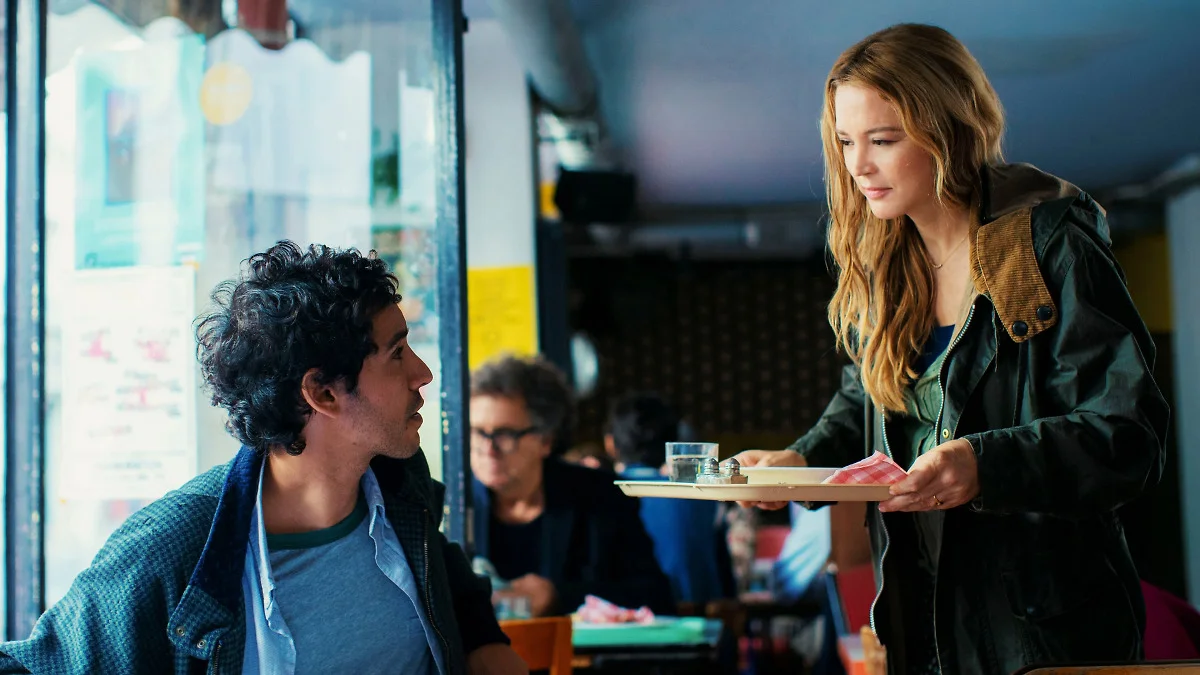
Interspersed within this main narrative is the written exaggeration conjured up in the author’s mind, which is given a distinctive atmospheric camouflage to separate it from the mainline story. From a sullen blue colour palette to non-diegetic music (a usual Farhadi no-no), the inner narrative of “Parallel Tales” is given enough of a stylistic distinction from its framing device—shot with the director’s typically naturalistic and frenetic hand—that one can at least credit Farhadi for his somewhat organic storytelling interspersion.
Sadly, this is more or less where the compliments have to stop, as “Parallel Tales” otherwise proves to be a dismal and aimless proposition from everyone involved. Farhadi, co-writing with his brother Saeed—his first credited co-writer since the pre-“A Separation” days, and the first since Farhadi faced those plagiarism accusations over “A Hero”—takes the intensified proximity of Kieślowski’s partial opus and expands it to a point of unwieldy exhaustion. (There is, for keen-eyed viewers, a prominent nod to the fifth “Dekalog” entry, later “A Short Film About Killing.”)
The strength of Farhadi’s greatest efforts is his concentrated perspective on tension within volatile familial and social structures, but the film’s refusal to stay locked onto any one perspective or issue for too long leaves this never-ending experience lost in its own stunted sense of lust. With a sprawling French ensemble struggling to do anything besides look slightly perturbed or slightly horny—Catherine Deneuve really gets mileage out of the “Special Appearance by” credit when appearing onscreen for all of 40 seconds—“Parallel Tales” rarely affords these headlining names the space to do more than sink into shallow melodrama and stand around vacantly staring out a window for their next emotional cue.
Where such tonal ineptitude would normally lead to discomforting bouts of unintentional humour, Farhadi, for what it’s worth, does manage to throw in some (assumably) intended comedy, mostly by way of the cutesy foley recording techniques for what seems to be an endless series of nature documentary clips. That said, when you’re making one of many French films centred at least partially on Virginie Efira’s sex appeal, and the most compelling image in your film is of her caressing parsley leaves with chopsticks to mimic a butterfly’s wingbeat, you might have to ask yourself if these parallel tales could have been shaved down to just one.



![Tristana [1970]: Shifting Power Dynamics in Human Relationship](https://www.highonfilms.com/wp-content/uploads/2018/08/tristana-and-don-lope-outside-church_630x330_4cda94b9-984d-e311-bba7-d4ae527c3b65_lg.jpg)
![Buoyancy [2019] ‘IFFI’ Review – A heart-pounding drama](https://www.highonfilms.com/wp-content/uploads/2019/11/buoyancy-2019-review-768x315.jpg)