Lucía Aleñar Iglesias’s feature film debut, “Forastera” (2025), is a ghost story tucked into the structure of a coming-of-age drama. It follows the usual genre arc through a string of realizations in the character’s life that lead her to a transformative moment of growth and emotional maturity. The genre framework allows it to invite us into its mystical undertones, thanks to a character we can resonate with, without much effort. Cata (Zoe Stein), the protagonist of Iglesias’s film, represents a period of life that we’ve all gone through with variations in our socio-cultural backgrounds.
We all know what it’s like to be a child growing up, realizing the burgeoning expectations of adulthood. We understand the awkwardness that comes from knowing we’re neither a child nor an adult, but are inching closer and closer to the inevitable burdens of life. On one hand, there’s desperation to be seen or perceived as an adult, while on the other, there’s a creeping dread about everything the experience would entail. We see it all happen in the film through Cata’s eyes, who offers us a window into her world.
The script follows her, a teenager on the cusp of adulthood, spending some leisure time at her grandparents’ idyllic seaside house in Mallorca. It doesn’t reveal any details about her past before arriving at this cozy, sun-drenched location, which makes her appear as a clean slate, opening up to the new stage of her life, while captivated by its undeniable beauty and charm. Agnès Piqué Corbera’s cinematography conveys it through everyday moments in her life that capture a distinct mood while moving the story forward. Iglesias presents similar shots throughout the duration that feel quite similar to the pillow shots from Ozu’s films.
Eventually, a transition occurs in Cata’s life after her grandmother’s unfortunate death, which shifts the narrative in a gloomier direction. Before that, discontent in her life seems limited to her grandmother’s expectations of her, but it becomes far more layered with grief overshadowing every other emotion on their canvas.

Iglesias’s script explores different ways we process those difficult emotions, but she conveys it with a billowy touch, never resorting to theatricality while conveying their overwhelming nature. Over time, the film starts feeling like a magic realist tale, even if her narration sticks with its breathy naturalism.
There’s a fleeting mention of a potential ghost in their lives, but it never burdens the narration through its insistent presence. Instead, it shows up in rather unexpected ways. You notice it through a ray of light gently touching a wall, crawling through that space. You also notice it through tangible remnants of the past. Even a flickering bulb can haunt it, or a piece of garment can retain memories, the latter of which Iglesias employs to a visceral effect. We notice it as Cata tries on her grandmother’s clothes, which becomes her pathway to connect with her, while getting a tactile sense of living as her.
Find Out: How To Get Started With Ingmar Bergman
The effect is akin to something that we witness in Ingmar Bergman’s “Persona,” of two personalities seemingly fusing into one. That is also noticeable in Katie Kitamura’s “Audition,” which I happened to finish around the time of rewatching Iglesias’s film. The novel follows four adults realizing the joys and limits of mutability as they find traces of themselves in each other. It analyzes this strain of transformation through creative professionals, following actors, writers, and artists, knowingly or unknowingly, fusing into one another. That takes a different meaning in Cata’s context, as she is processing her grief while stepping closer to adulthood.
As an adult, you realize how people don’t always know what they’re doing but are simply better at pretending that they do. That’s the sense you get from Cata’s metamorphic experiment as she begins acting as her grandmother. Through her, the film begs us to ask ourselves: when does it stop being playacting and become the truth? It becomes a slippery slope with her grandfather, Tomeu (Lluís Homar), grieving alongside her. The script walks on a tightrope while showing Cata and Tomeu’s transformed relationship, while underlining his co-dependency on his late spouse.
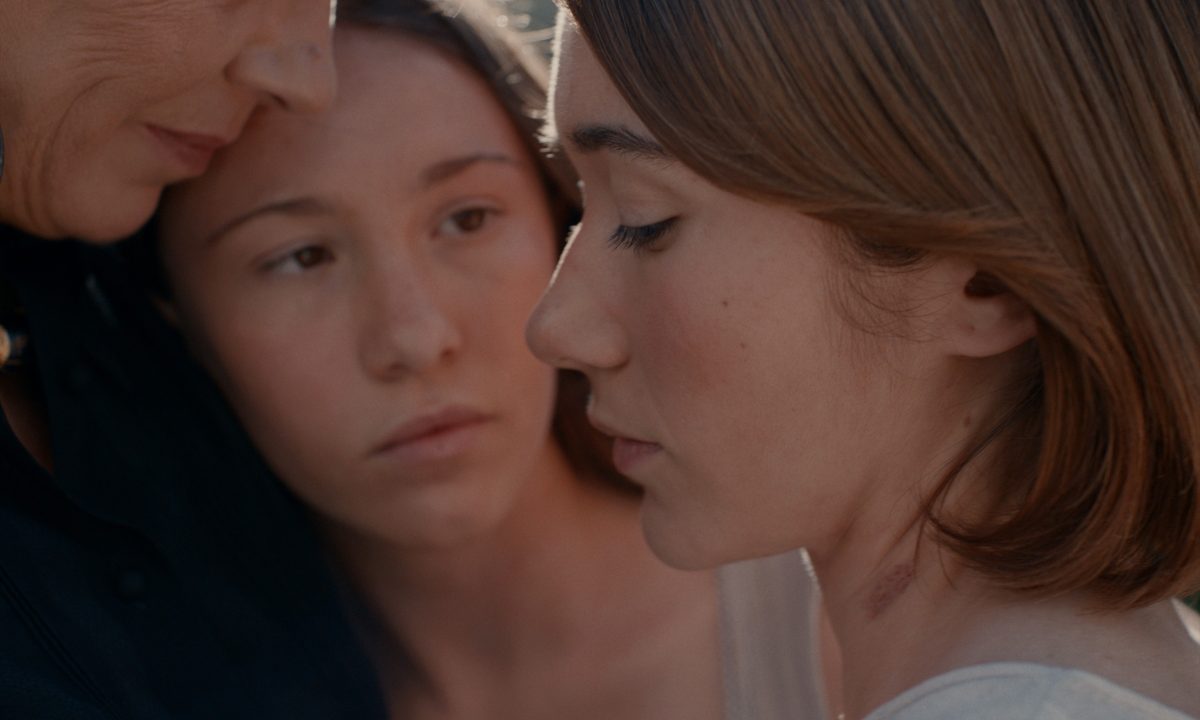
Although focused on Cata’s interiority, the film also explores the nature of grief through Tomeu and her mother, Pepa’s (Núria Prims) points of view. It effectively captures the intricacies of this process through different angles, whether it’s someone trying to alleviate their overbearing guilt regarding the deceased, seeking a distraction to ease their pain, or not realizing the extent or depth of their own emotions.
Iglesias presents it with a deliberate pace, maintained by Paola Freddi’s editing, while spending time on the in-between moments in Cata’s life instead of rushing through her realizations. It leads Cata’s story through the classic genre arc, which makes the final moments barely unpredictable. You realize that this phase she and Tomeu are going through will run its course as they transition from their emotional mess to enter reality instead of finding ways to avoid facing it.
The script could have avoided that predictability by leading the arc on an unconventional note or extending it further, showing more of Cata’s life beyond the moment of emotional growth. Yet, not doing so doesn’t make the film any less impressive.
The most impressive aspect of ‘Forastera’ is how it builds this film as a sensory experience, focusing on the textural details of light and fabric to offer a tangible understanding of their reality, while pairing it with an immersive, quietly haunting soundscape. Stein’s performance is another strong element of this film. She bears the weight of its thematic exploration while portraying Cata through her awkward paradoxical inclinations.
One moment, you sense her wish to step outside of her own skin, and the very next, you notice her self-assuredness with hints of teenage angst. You sense the constant push-and-pull in her mind between her contrasting desires, which makes her seem like a living manifestation of her own grief. Stein’s mature performance becomes a clear highlight in Iglesias’s film that weaves Cata’s coming-of-age journey with a mesmerising ghost tale.





![Boys State [2020] Review – A Pertinent & Microcosmic Look into the American Political Theatre](https://www.highonfilms.com/wp-content/uploads/2021/02/Boys-State-2020-768x512.jpg)