
Ric Roman Waugh’s “Greenland” didn’t make much of a splash when it debuted in the winter of 2020, as there couldn’t have been a worse time to release an apocalyptic disaster thriller about humanity turning in on itself. Gerard Butler’s involvement may have suggested that it would be another entertaining B-movie in the vein of his past efforts with Waugh, such as “Angel Has Fallen.”
But “Greenland” was a surprisingly sober genre film that authentically depicted the plight of one family’s survival amidst a mass-scale disaster. If the first “Greenland” had the benefit of presenting a plausible scenario and exploring realistic consequences, its sequel is unfortunately ridden with cliches. Rather than feeling like a naturalistic continuation, “Greenland 2: Migration” (2026) moves in conventional directions that are far less compelling.
Ten years have passed since the end of the first film, in which former structural engineer John Garrity (Butler) and his wife Allison (Morena Baccarin) were able to find shelter within an underground facility after a devastating interstellar comet wiped out a significant portion of the global population.
Their son Nathan is now a bright teenager who has taken up his father’s independent streak. The character was portrayed by child actor Roger Dale Floyd in the previous film, but is replaced in the sequel by “Jojo Rabbit” star Roman Griffin Davis. Although John never expected that the bunker containing the remnants of humanity would be a long-term solution, dramatic circumstances force his family to once again search for a new place to find safety.
The best disaster films tend to be those that at least emulate some sort of relatable scenario, even if the science fiction elements are exaggerated. What the first “Greenland” did excellently was explore how completely unequipped the world’s infrastructures were for an event that caused people to lose sight of reason or selflessness. The film was a mad dash of survival in which the Clarkes were forced to question if their survival may have inadvertently harmed another family.
That moral ambiguity is briefly hinted at during the beginning of “Greenland 2: Migration,” but it drops any interest in supporting characters as the Clarkes are jostled in between setpieces. Despite the addition of talented new cast members like Amber Rose Revah, who was excellent in Marvel’s “The Punisher,” none of the additional characters do much beyond delivering exposition and navigating John amidst his journey.
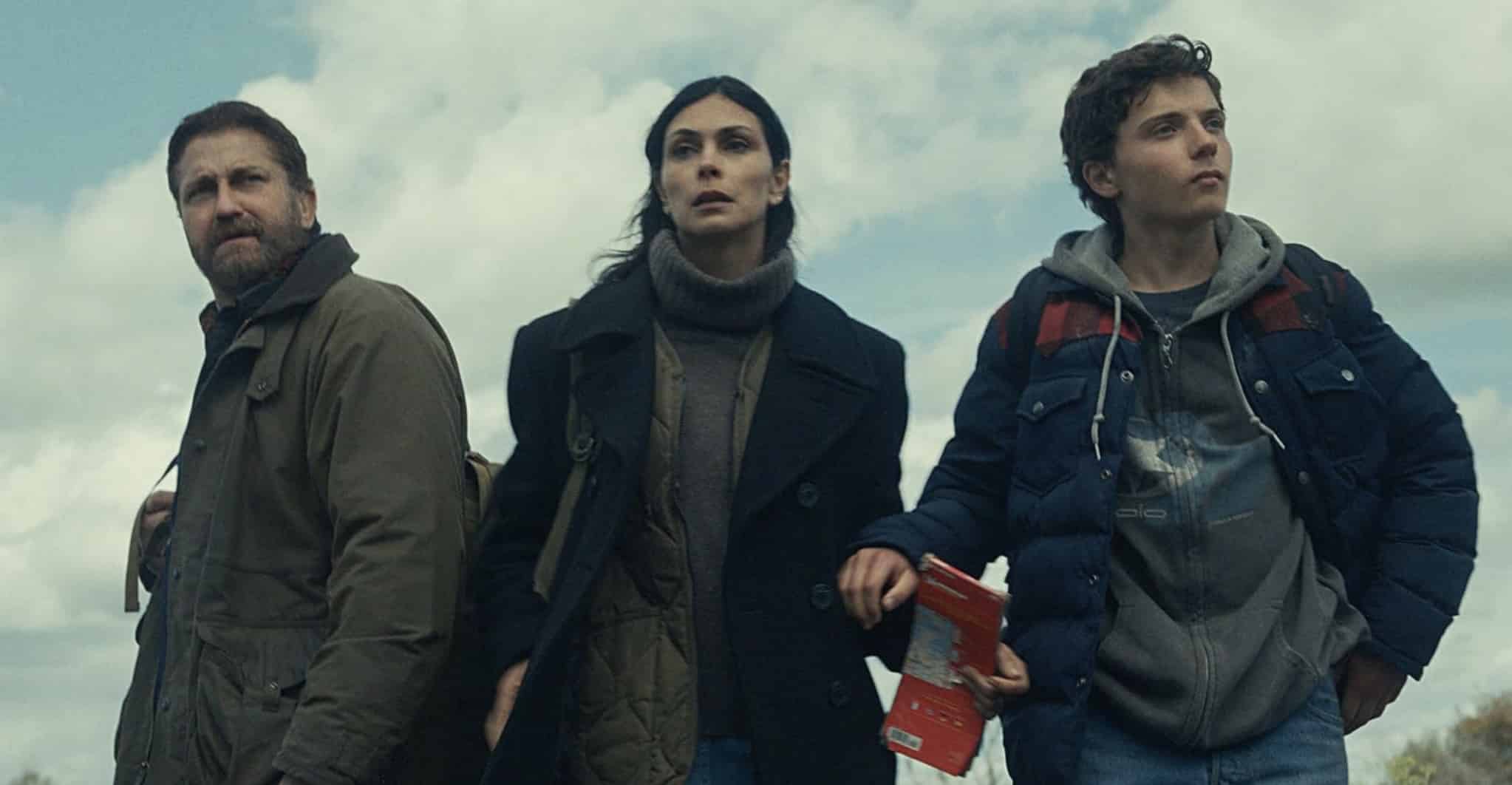
What’s disappointing is how quickly “Greenland 2: Migration” seems to fold its own concept. The title does suggest that it would relate to timely issues regarding the acceptance of displaced people, but this is a theme that is only briefly mentioned as a means of setting up another road trip adventure. The most terrifying scenes in the first film were those when John and his family saw their fellow civilians willing to trample and harm others out of fear. Not only does the lack of these substantial moments make “Greenland 2: Migration” feel more conventional, but it malso akes it feel more like a typical sci-fi disaster flick.
Despite the fact that it takes place on a scarred Earth, the action is significantly less involving the second time around. Action scenes may contain more special effects (including more than a few moments of dubious CGI), but they’re so frequent, yet unmemorable, that there’s no sense or urgency. There’s also the challenge regarding the Clarkes’ destination, which isn’t well-defined and makes the more drastic weather events feel less dangerous.
After a few times in which pivotal conversations or emotional breakthroughs are disrupted by a cataclysmic event, it becomes clear that the script has not taken the time to map out what the new reality on Earth looks like. Even if the first “Greenland” would never be cited for its scientific accuracy, the way it positioned its escalation conformed to a plausible strain of logic.
The frequency of danger also robs the film of human moments, which becomes particularly glaring when the reason for John’s desperation is revealed in an unusual manner that grinds the pacing to a halt. There are ideas regarding mental health and the maintenance of a somewhat functional underground society that are abandoned early on, leaving the characters less time to adjust to their new circumstances.
Even if the true intention of any disaster or survival film is to deliver spectacle, the first “Greenland” built suspense as the situation grew gradually worse. By putting the Clarkes in a seemingly unwinnable situation from the beginning, “Greenland 2: Migration” struggles to find any way to differentiate its severity. The scenes could nearly be assembled in any order, especially when they only barely feature any compelling interactions between the leads.
Although he’s dealing with significantly weaker material, Butler still delivers a strong performance that serves as another reminder of why he is such an underrated actor. Butler has a sense of gravitas that makes him perfect for chewing the scenery when given truly ridiculous material, but “Greenland” offers him the chance to play a regular, mortal character in a way that most contemporary action stars could never be believable as.
Clarke’s ability to find purpose in chaos, which also distracts him from having to cope with his innermost fears, is well-handled by Butler, who is able to ground even the most absurd moments in recognizable emotions. Although there is a physical component to the role, Butler shows vulnerability during the action scenes, which show that he’s more than an elevated stuntman. Even if this doesn’t end up being a recurring franchise for Butler in the way that “Den of Thieves” and “Olympus Has Fallen” were, it’s one of his better performances.
There are some stirring moments of familial reckoning in “Greenland 2: Migration” that are effective, even if the route to reach them feels absurd. Many of the more grandiose survival scenarios are almost laughably staged, but situations of chaos and confusion ring true, and mirror current events in the same way that the first film seemingly anticipated the fallout of COVID-19.
Perhaps “Greenland 2: Migration” is the type of disposable, forgettable, but ultimately harmless post-apocalyptic adventure that the first film was expected to be. It’s only disappointing because it’s clear that Waugh can do better.




![Shubh Mangal Saavdhan [2017]: An Elegant and Plausible treatment to accomplish Love](https://www.highonfilms.com/wp-content/uploads/2017/09/shubha_1501590643_725x725.jpg)


![For a Few Dollars More [1965] Review : A Sequel worthy of its recognition](https://www.highonfilms.com/wp-content/uploads/2020/07/vlcsnap-2020-07-30-15h44m52s329-768x330.png)