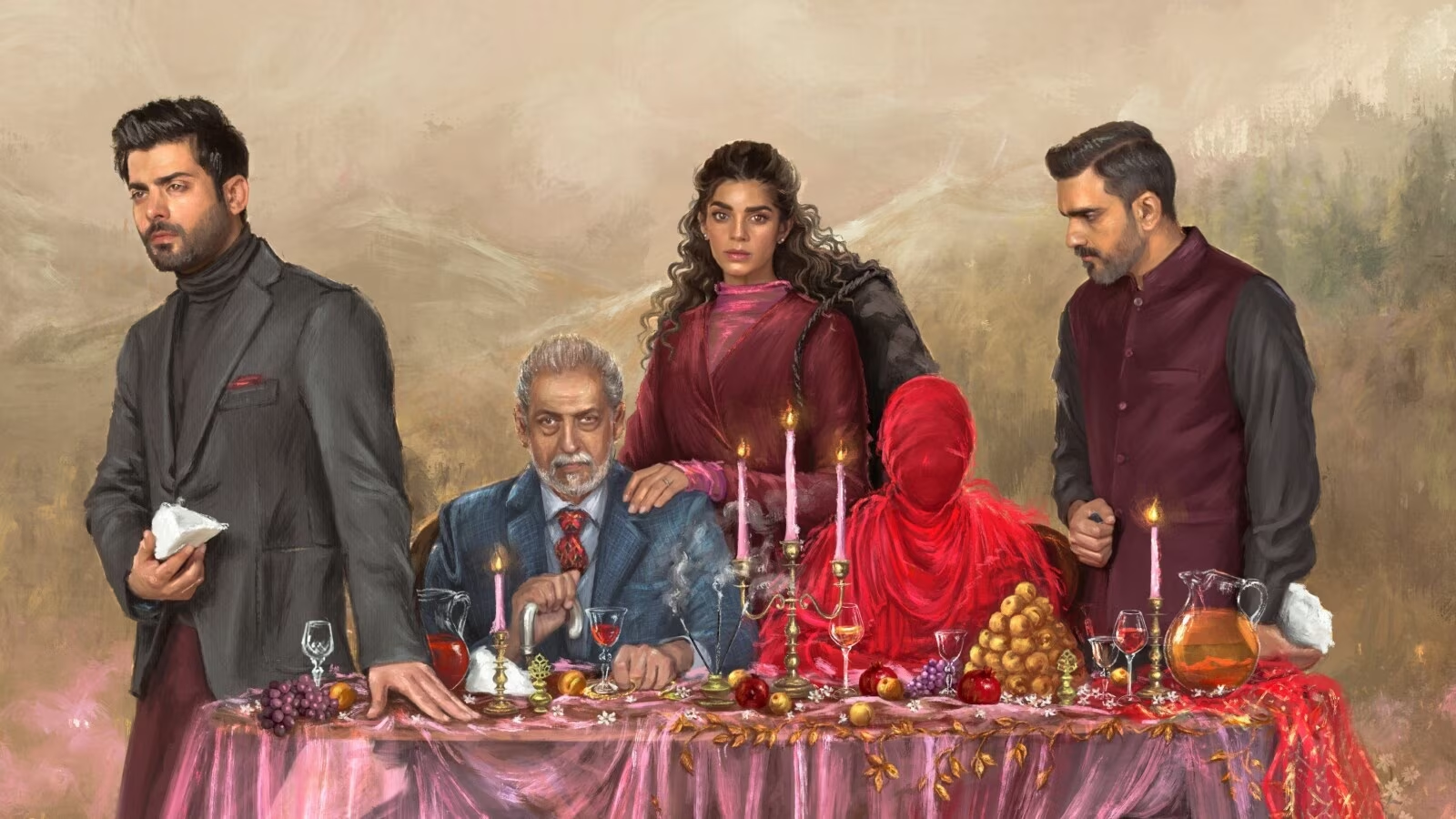
“Flying Tigers,” Madhusree Dutta’s return to the Berlinale after sixteen years, is many things at once: a personal documentary, a historiographical excavation, and what Dutta herself calls an argument. The film traces a forgotten Second World War American military operation, the Flying Tigers air unit that flew supplies between Assam in northeastern India and Kunming in China, through the intersecting family histories of three collaborators: Dutta herself, Chinese-German media scholar You Mi, and Assamese writer Purav Goswami. At its emotional core is a simpler, more intimate thread: Dutta’s memory of her older mother, born in Assam, who, in the grip of Alzheimer’s, would cry out, “Tiger is coming! Close the windows!”, words Dutta initially dismissed, and only years later understood as something much larger.
The film premiered in the Forum section of the 2026 Berlinale. Shubham Sharma spoke with Dutta shortly after the premiere.
Shubham: In the film, your mother’s Alzheimer’s becomes almost like a topography you’re exploring. I wanted to understand how you think about neurological memory in relation to the historical memory that’s embedded in landscape and infrastructure. How do you hold these two things together?
Madhusree Dutta: I should clarify something in the beginning: I’m not a neuroscientist, and I’m certainly not a military historian. I don’t know how to read the radar records, and I’ve never entered a military museum. I spoke to a few neurologists, but only in the way a caregiver speaks to a doctor, trying to understand what was happening to my mother.
I’m a storyteller, a filmmaker, an artist. And like anyone of my generation, I was surrounded by the experience of age-related memory loss. It’s become the tragedy of our time. People are frightened of it, frightened that they themselves are headed that way. But here’s what I actually felt when I was spending time with my mother as her sole caregiver: I thought it was great fun.
It was like being with a child who is learning to talk, except this one is learning to forget. The vocabulary is similarly limited. She might say something like “A tiger has entered the drawing room.” That isn’t what she means, but she doesn’t have more than those three words available to her. So you have to read it, the way you read a child. I didn’t have the peace of mind to reflect on this at the time, but after she died, it stayed with me.
Then I spoke to a few medical practitioners, and one thing they told me struck me deeply: Alzheimer’s, and people use it as a generic term, which isn’t even accurate. It’s a specific condition related to blood circulation in the brain; not all dementia is Alzheimer’s, but true Alzheimer’s patients don’t hallucinate. What they have instead is a kind of liberty. There is no anger. A person can be placed in any space, at any time. It’s a kind of liberation. The irony wasn’t lost on me. When we started this interview, I asked where you were. I needed to place you. That impulse, to locate someone in a geography, is something she had completely lost. And as an artist, that fascinated me.
But I didn’t sit down one day and decide: this is the film I’ll make. What actually happened is in the film itself. I was with a Chinese friend, and I told her the story of the Flying Tigers, and she said, “This is my family’s story.” That’s the moment it became something wider. Otherwise, it would have been a very focused, very private story about my mother. And I wasn’t particularly drawn to making that kind of film.
Shubham: You mentioned not wanting to go too technical. And watching the film, it really does feel like an artist speaking rather than someone trying to impose knowledge. But there’s still so much research that went into it, so much information coming your way. As a filmmaker, there’s a translation happening from knowledge into feeling. So I wanted to ask: how did learning more change your relationship to the places, the landscapes, and the people? And how were you navigating those choices while making the film, what to include, where to go next?
Madhusree Dutta: I think one way to answer this is something others have also asked me: “You did so much research, did you already know all of this?” And the honest answer is no. I’m not interested in borders as a subject. I’m not interested in military history. Left to my own devices, I would never have learned any of this.
I started learning because of the story. And throughout, I was very self-conscious about one thing: I did not want to make another military film. There are many of them. There are very good personal war films. I have nothing against them. But that is not what I was making. The war is the background, not the subject itself.
If you look at how I use archival material in the film, it’s sparse. Deliberately. My research was actually quite simple. I’m not a researcher by training or by methodology. I had some research assistance, but the questions were things like: How much of the border between India and China was there in 1947? What was its length in 1962? How many aircraft crashed in the Himalayas during the Second World War? These are facts you can find in half a minute.
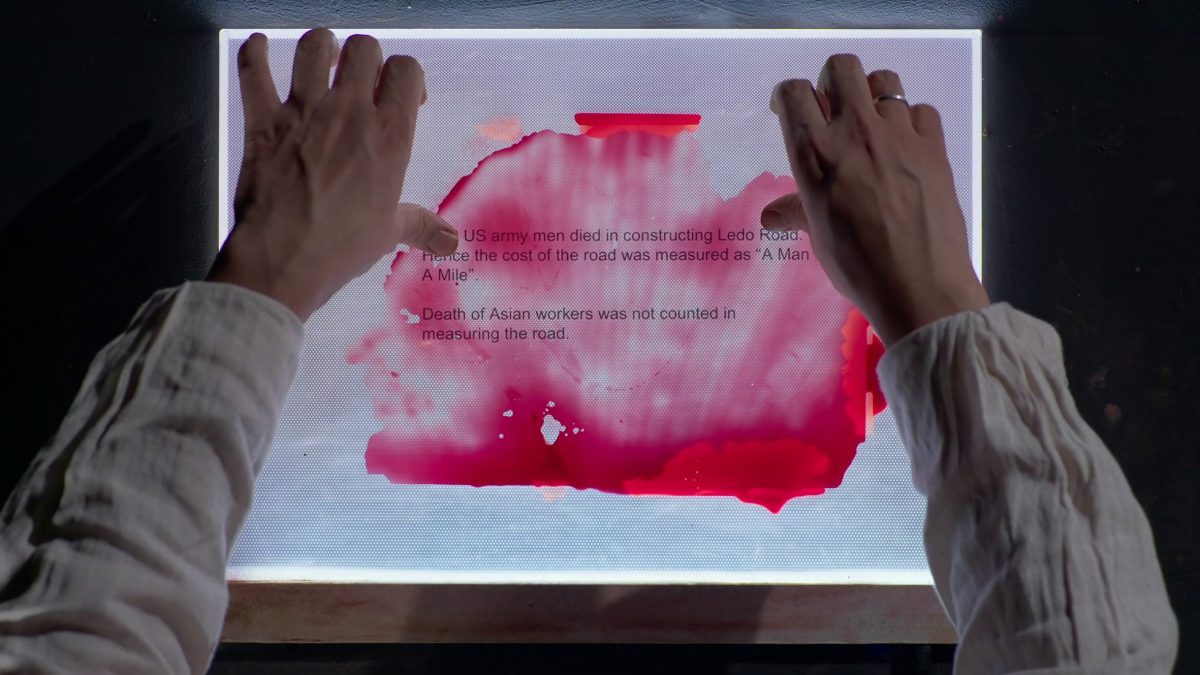
The harder question is always: how do you connect them? That’s where my work is. And the connection told me what to look for next. My narrative prompted my research; my research did not make my narrative. I want to be very clear about that distinction. The research was precise because the story already knew what it needed. So in the film, when I say I’m not interested in war memory, I mean it. I’m not interested in military history as such. The story just happens to move through that terrain.
Shubham: I did feel, while watching, that the landscape itself was telling its own story, as a co-author. There were so many different co-authors, if I can call them that. So the question is: how was it decided who gets to speak? Who tells this story? And even when it comes to the landscape, how does it get represented, as an image, as sound, as music? Who was making these decisions?
Madhusree Dutta: Ultimately, the final choices are mine. Filmmaking is not fully democratic — it can’t be, or you never finish. But it is democratic in the way you see it in the film: the three of us are traveling, and we are sending each other stories as we go. I found this, she found that — and then suddenly someone says, no, this one is mine. That’s how it worked in practice.
But the deeper reason for the three-narrator structure is something else entirely. I’m from Mumbai. I sometimes live in Germany. So Assam is as foreign to me as China. I don’t need a visa, but that’s about it. I don’t speak Assamese, I don’t speak Chinese. When I go to Assam, people look at me with suspicion. When I go to China, I need someone to be with me.
And this is important: it cannot be only my point of view. That is exactly what colonizers do, especially a Mumbai filmmaker going to Assam and telling their story. It’s vulgar. So the film had to have someone who is from that land, someone who can also challenge my assumptions and blind spots. That’s where the structure came from. The narrative demanded it.
Take the old man, the one who came to Assam as a student trainee, stayed in Dhinjam, and whom people called “Chinese Babu.” Who is going to talk to him? He will not talk to me. So it had to be someone else. And the Miya poets, I found it, yes, but it was Pulakesh Goswami’s research that I was drawing on, not my own. And again, that has nothing to do with me personally, but it opened a door. Every land has multiple stories, and they often contradict one another. I was deeply interested in that.
What I want is for the audience to become what I call public historians. This is almost a campaign for me, for connected history, and for collected history. You don’t need to understand every local nuance. You just need to recognise that parallel things were happening in different parts of the world at the same moment, in India, in China, in Assam, and that these things are linked.
As for the artistic choices, the visual abstractions, the installations, those are entirely mine, and I take full responsibility. There were places where I could not show people’s faces, or where showing them could have put them in danger. Even if they agreed to be filmed, the risk was too real. So abstraction became necessary. The artworks themselves were made by others, the installations were designed by the very well-known Indian artist Suresh, but the directorial decisions around how and where to use them was me.
Shubham: I was curious, have you been able to screen the film in India yet, or in China?
Madhusree Dutta: I have no idea when that will happen. I’m keeping my fingers crossed. This is the premiere, so definitely not before that. And definitely not before the Assam elections. That much I know.
The Miya poet section is a tricky area. I thought many times during editing that I would just drop it, because for audiences outside India, it might not make sense. It’s not directly related to the Second World War. It’s related to borders and citizenship, but not to that particular time period, not to the era the rest of the film concentrates on. So there was a real question: Does this section belong?
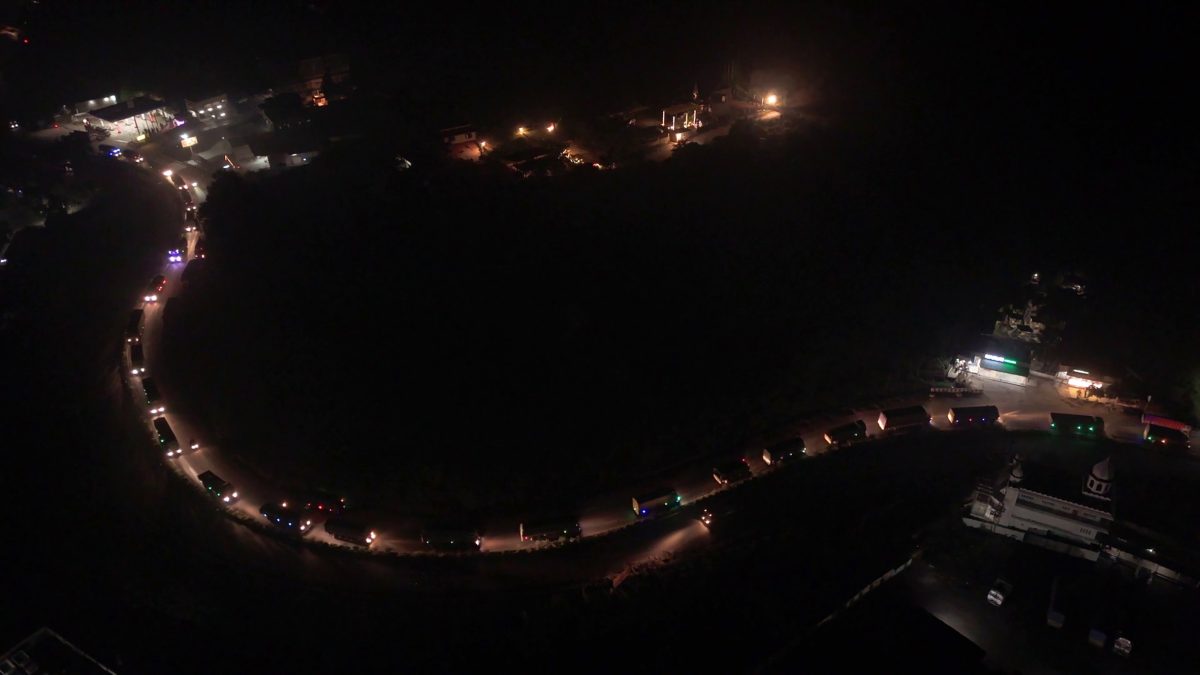
And then, to my complete surprise, the film has only just started its life, but so far, not a single person in Europe has said, “I didn’t understand that section” or “Why is this here?” I was talking to a journalist recently, and I suddenly realised why. Living at a border, being a fluid community caught between two languages, two cultures, two citizenships, with the constant danger of falling through the cracks of a system that doesn’t quite claim you, that is so common in Europe. People understand it immediately. They don’t need the specific Indian political context to feel it. That was a real discovery for me. Berlinale is the ideal place to premiere a film like this, precisely because the audience here is so argumentative, so willing to engage. It’s a dream premiere for this kind of work.
Shubham: And about protecting the Miya poets, you used their work but didn’t show their names or faces. How did you navigate that?
Madhusree Dutta: It’s a balance that made me uncomfortable, honestly. I am using their work, but I am erasing their faces, erasing their names. And I felt troubled by that. But they said to me, “Show our work. That is what matters to us.” So I had to trust that.
There are other tricky areas too, in Germany, in China. I expect controversy when this film reaches China. It is a political film. That is its nature, and I have to face what comes with that. But I want to be clear: there is nothing in this film that is not already known. I am not revealing secrets. I am not doing something hidden. It is all connected from the facts that exist. It’s just that nobody has put them together this way before. That, I think, is where the discomfort will come from.
Shubham: When you were making this film, were you thinking about the audience? Who do you think this film is for, and what would you want them to take from it?
Madhusree Dutta: I don’t make many films. And I haven’t used so much public money that I owe anyone a particular kind of return. So I don’t make films for an abstract audience. I don’t believe in that concept. Someone gets it, someone doesn’t. That’s fine.
What I will say is that this film is a hybrid in everything, and it is not really a film. It is an argument. An argument made through music, poetry, people, water, drawings — many things. But it is an argument I am having. It is a riddle. It is genuinely interactive, in the sense that I am asking the audience: what does this say to you? And if you connect this to that, then what? I invite people in. I don’t deliver conclusions.
The practical consequence of that is: anyone who is uncomfortable with subtitled films is already out. That’s a large section of potential viewers, and I don’t regret it. There are many kinds of films. And anyone who doesn’t want to argue, think, or disagree, this film is not for them either. But the themes are bigger than I expected. What I thought might be too specifically Indian, the Miya poets, the citizenship question, turns out to be immediately legible in Europe. So I am also waiting for the surprises. That is part of the life of a film like this.
Shubham: And just personally, why did you want to make this film? Your mother is clearly the emotional starting point, but I imagine there was something larger pulling at you as a filmmaker, too.
Madhusree Dutta: If you know film history, you’ll know that women filmmakers all over the world, from the 1980s through the 90s, in the era of 16mm and then VHS, began making films about their mothers and grandmothers. It was the rebellious gesture of that generation. To preserve, to accumulate, to protect, and to retrieve those sepia photographs from the grandmother’s trunk and hold them up to the light. That was the right thing to do at that time.
But fifty years have passed. And I think now the task is different. Now the time has come to take it out. Not to preserve but to release.
What does that mean? I took my mother’s story to the wall. To the world. She may not even have known she was part of a Second World War story. It was not her story in any conscious sense; it was mine. Because in the twenty-five years between her generation and mine, I have learned things she was never party to. The world changed around her without her knowing, but it enters the film through me.
And yet, she lived as a neighbor to the Chinese. That is the thread. Interestingly, my mother was on this side of the Himalayas, and the family of my Chinese co-narrator was on the other side. Before the Second World War, there was a flight between those two points that took one hour. After the war, it was stopped. And all that distance, all that estrangement, came from that silence.