
Josh O’Connor insists he’ll never replace Andrew Scott as the internet’s favorite Hot Priest. “I will never be able to top the billing of Andrew Scott, as far as Hot Priest is concerned,” he jokes.
But Wake Up Dead Man: A Knives Out Mystery may give O’Connor something far more interesting than a thirst crown: the most politically relevant character the franchise has produced so far.
His Rev. Jud Duplenticy isn’t just a tattooed, swearing ex-boxer turned priest. He’s a challenge to fear-based leadership — religious, political, and cultural — at a moment when those forces feel increasingly intertwined.
A Priest Who Refuses Moral Certainty
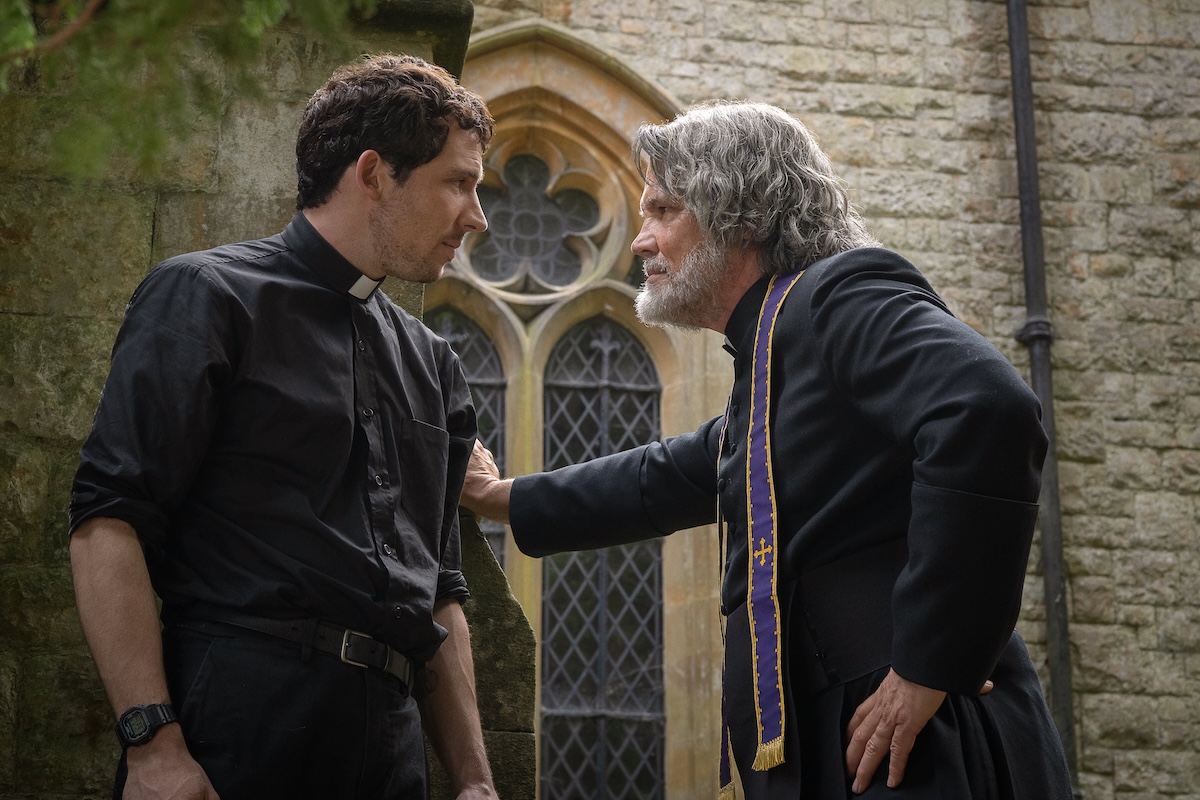
Josh O’Connor’s fascination with the role came from Johnson’s script, which directly challenged the common perception of religious leaders as infallible, untouchable figures.
“We often hold priests, or in any sort of faith or religion… there’s this subconscious notion of them being otherworldly or not human,” O’Connor observes. “When the reality is they are human.”
Jud is young, idealistic, and deeply flawed. “He swears. He’s a young priest trying his best to fit in,” O’Connor says. “He’s come straight out of priest school and is ready to take on the world.”
That optimism puts him on a collision course with Msgr. Wicks (Josh Brolin), whose authority is rooted in tradition, hierarchy, and fear. Jud’s power comes from the opposite place: openness.
Jud’s humanity is not a weakness. It’s a threat.
Also, Read – Josh O’Connor: 5 Important Movie Performances
Forgiveness as a Radical Idea
One line defines Jud — and quietly reframes the entire mystery.
“It’s a line that Jud says, which is that ‘God loves me when I’m guilty,’” O’Connor explains.
In a culture that often treats mistakes as permanent, that belief lands like a provocation.
“We live in a time where mistakes are damning,” he says. “And he was a character who was saying, ‘I made this grave error and yet I believe in change, I believe in reform, and I believe in forgiveness.’”
Jud doesn’t deny guilt. He refuses to let it become a life sentence.
Faith Without Fear
What drew O’Connor to the role wasn’t sex appeal or mystery mechanics. It was the chance to explore religion without cynicism.
The actor says Rian Johnson’s script focused on faith leaders as “real people who make mistakes and seek forgiveness and redemption.”
Those themes were central to their earliest conversations. “We had calls where he explained, not about the mystery necessarily, but more to do with the themes of forgiveness,” O’Connor says. “We clicked immediately.”
Both men share complicated religious backgrounds, but also, O’Connor says, “a lot of hope about faith, and acknowledge the beauty behind it.”
That hope shapes Jud’s approach to his congregation — welcoming, loving, and accessible.
A Character Built for This Moment
O’Connor sees Jud as especially relevant now.
“We’re living in this extremely polarized time – of course in the U.S. but in the U.K. too,” he says. “Very often, the political and the religious line can be really sort of hazy.”
Jud exists squarely in that haze. He doesn’t wield faith as a weapon or a badge of moral superiority. Instead, he rejects authority rooted in fear and certainty, choosing connection over control. In a world where power is often maintained by drawing lines: who belongs, who is forgiven, who is beyond redemption; Jud quietly refuses to draw them.
That refusal is what makes him dangerous.
His worldview doesn’t rely on punishment or shame to enforce order. It invites participation rather than obedience, empathy rather than submission. O’Connor says Jud’s compassion “makes him so approachable to the community and his parishioners,” a quality that destabilizes traditional hierarchies. When people feel seen instead of judged, fear loses its grip.
That approachability is quietly political. Jud represents a model of leadership that undermines authoritarian impulses not through confrontation, but through openness. He exposes how fragile power becomes when it can no longer rely on moral absolutism or manufactured outrage. In Wake Up Dead Man, the threat Jud poses isn’t that he challenges doctrine — it’s that he proves belief doesn’t have to come with domination.
In that sense, Rev. Jud isn’t just a priest navigating a crisis of faith. He’s a mirror held up to a polarized culture, asking whether authority should be enforced through fear — or earned through compassion.
Grounded in Reality
To shape the role, O’Connor spoke with a real priest, Father Scott.
“Father Scott and I had a few calls that were really brilliant and gripping, philosophically challenging,” he says. “That really formed Jud — I really leaned into Father Scott’s example.”
He also trained in boxing, reflecting Jud’s violent past and the guilt that led him toward faith. Jud’s belief isn’t theoretical — it’s earned.
The Most Subversive Knives Out Character Yet
Knives Out has always skewered power. With Rev. Jud, it questions something more elusive: moral certainty.
Jud isn’t compelling because he’s righteous. He’s compelling because he’s guilty — and still believes in redemption.
In a franchise built on exposing lies, Jud stands out by insisting that forgiveness is not weakness. As O’Connor puts it, he believes in “change, reform, and forgiveness.”
In today’s climate, that belief may be the boldest political statement Knives Out has ever made.
This article is based on the John O’Connor’s Interview with Entertainment Weekly




![[Watch] Video Essay Exploring Why Costa-Gavras'”Z” is an Enduringly Relevant Political Thriller](https://www.highonfilms.com/wp-content/uploads/2022/08/Z-1969-768x433.jpg)